In the land where somebody else doxing the president’s daughter can cost you 14 years of freedom, the use of your fingers and your sanity, a mother reports that her son no longer recognizes her after mistreatment in prison disfigured his mind.
The case relates to a web administrator, Niu Tengyu (牛騰宇), who provided technical support to a website known as Vulgar Wiki (惡俗維基) that was tenuously linked to a breakaway site, zhina.wiki (支纳维基), where identity details about China President Xi Jinping’s only child, Xi Mingze (習明澤), then in her mid-twenties, were posted in May 2019, having reportedly already appeared on Twitter and at least one other website.
Administrated from abroad and doxing figures that include Chinese Communist Party royalty, such as Mingze, the anarchic and anti-establishment zhina.wiki prove to be beyond the reach of China’s embarrassed state security apparatus, which seems therefore to have vented its wrath on the easier target, Vulgar Wiki, as the fall guys instead. Twenty-four of its young associates were rounded up in the summer and autumn of 2019, and the related allegations of torture and humiliation are ghastly even in the context of Chinese Communist Party rule.
Niu, for one, has apparently suffered multiple beatings, the burning of his genitals and long-term nerve damage and, now, according to an update from his mother reported by Voice of America, is exhibiting sudden and shocking signs of incoherence and mental derangement. He still has approximately one decade of his sentence to complete, and, although the site for which he worked may not have been the prettiest corner of the internet, the punishment hardly fits the crime, if, indeed, there was any.
The latest news of Niu’s condition broke on November 26, nine days after the suspicious death of dissident and journalist Sun Lin (孫林) in Nanjing. Released from prison in 2022 having served the second of two four-year sentences for reporting on topics like state corruption and forced evictions as well as expressing well-founded opinions like “Down with the Communist Party,” Sun was visited by police at home on November 17, 2023, and reported dead several hours later on the same day. Neighbors have apparently described sounds of a struggle after the police entry. Sun’s family was not permitted to see his body, according to Radio Free Asia.
Such tragedy elevates the sense of urgency for others such as Kwon Pyong, a.k.a. Quan Ping (權平), a democracy activist, who fled to South Korea from China’s Shandong Province on a jet ski back in August 2023. Detained and charged for entering the country illegally despite holding a tourist visa, Kwon was handed a one-year suspended prison sentence and freed in Korea on November 23 in a court ruling that seems intended to balance pressure from Beijing against international concern at his treatment in a democratic country. He has not, however, been granted asylum yet so is still at risk of refoulement to a similar fate as that of Niu and Sun.
Kwon is an ethnic Korean, one of the many minorities facing differing levels of state interference and persecution in China, a reality that was underlined again this month by proposed fines in Yi-dominated areas for people who do not make their beds properly and a Human Rights Watch report into mosque closures and sinicizations in Ningxia and Gansu provinces, both of which have large Hui Muslim populations. The report claims that about half of all mosques in these areas have been destroyed in the past six years under a Chinese Communist Party policy of “consolidation,” which, if it follows the East Turkestan (Xinjiang) model, works by shuttering the majority of religious establishments and then funneling the followers of Islam who still persist into the remainder, where the religious message can be pared down to Xi Jinping thought and the congregation conveniently surveilled.
According to a U.S.-based member of the Hui community named Ma Ju (馬聚), who is quoted in the report, Muslims are also often forced to choose between their faith and their studies or employment. Soon, however, the Chinese government may have another way to twist their arms: exclusion from the monetary system. Currently, as per China Law Translate, authorities are looking to aggravate the lack of safeguards in the country’s legal system by introducing a new Law on Telecommunication Fraud that will permit the police, without trial, to “designate someone as a discipline target, largely blocking them from modern payment systems,” which are, of course, predominantly smartphone-based in China. Appeals go through the police themselves, too.
Under these grim autumn to winter circumstances, to which should be added also the hunting down and detainment of last month’s satirical Halloween cosplayers and the unverified claims of tear gas fired at Myanmar nationals fleeing a warzone, one of the worst scenarios would be if China succeeded in pushing its repressive methods out beyond its borders. Yet this is exactly what Madrid-based human rights NGO Safeguard Defenders warns against as Beijing formalizes, through an official State Council Decree, its long-held policy of enlisting “consular volunteers” to extend its reach into overseas Chinese communities.
While these volunteers nominally provide administrative duties, such processes have traditionally acted as a veil for Chinese Communist Party intrusion into citizens’ lives in the motherland, and their now-authorized role in other countries is believed to be executed through the notorious United Front organization. In the words of Safeguard Defenders, this gives United Front goons “potential broad access to individuals’ private data, home addresses, and contact information but may also dangerously enhance their function of control over overseas communities and dissenters.”
The kind of remote puppeteering that this approach enables was perhaps the motivating force for the flag-waving zealots who appeared on the streets of San Francisco to swarm and sometimes attack protesters at Xi Jinping’s mid-November visit to the city. Many are certainly genuine adulators of the dictator, but there is every reason to believe that tentacles emanating from China’s consulates and the United Front is stinging others to perform adoration for the great leader, so that his triumphant visit to the U.S. can be broadcast with the appropriate propaganda pomp back at home.
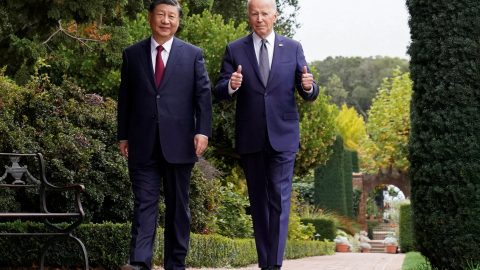
Depending on exactly how harshly Beijing is pushing individuals’ buttons, some complicity in the Chinese diaspora is forgivable, but the same cannot be said for the San Francisco police, if it is true that they turned a blind eye to assaults and intimidation of anti-Chinese Communist Party activists in their city, and the likes of the corporate leaders of Apple (Tim Cook), Black Rock (Larry Fink) and Blackstone (Steve Schwarzman), among others (Boeing, Qualcomm, etc.), who made up the crowd that gave Xi two standing ovations at a corporate dinner on November 15.
Meanwhile, with the sound of that applause still reverberating, in mid- to late November alone, U.S. President Joe Biden was transitionally rolling back sanctions on China’s Institute of Forensic Science, a Ministry of Public Security entity that purchases genetic sequencing machines in East Turkestan (Xinjiang), where the Uyghur minority is being systematically targeted and persecuted. The European Union was failing to pass any kind of sanctions whatsoever on Chinese companies suspected of supporting Russia’s brutalization of Ukraine. A U.S. airport was revealed by surveillance industry specialists IPVM to be flagrantly disregarding a U.S. National Defense Authorization Act that bans Huawei-enabled cameras. The U.K.’s University of Nottingham was alleged to have censored staff and closed an institute at the behest of Beijing. And the authorities of East Turkestan (Xinjiang) were able to boast record overseas trade, despite suspicions that the products manufactured under their rule are tainted by forced labor.
Such a world can often leave one speechless, so it is perhaps fitting that blank paper held aloft remains one of the most elegant responses. Marking one year since such protest techniques ended China’s “Zero COVID” tyranny, protests and vigils were held in cities like London, Los Angeles and Istanbul to promote a call for liberation from state-party rule. The strongest voices, it seems, are those that are not supposed to be heard at all.





Leave a Reply