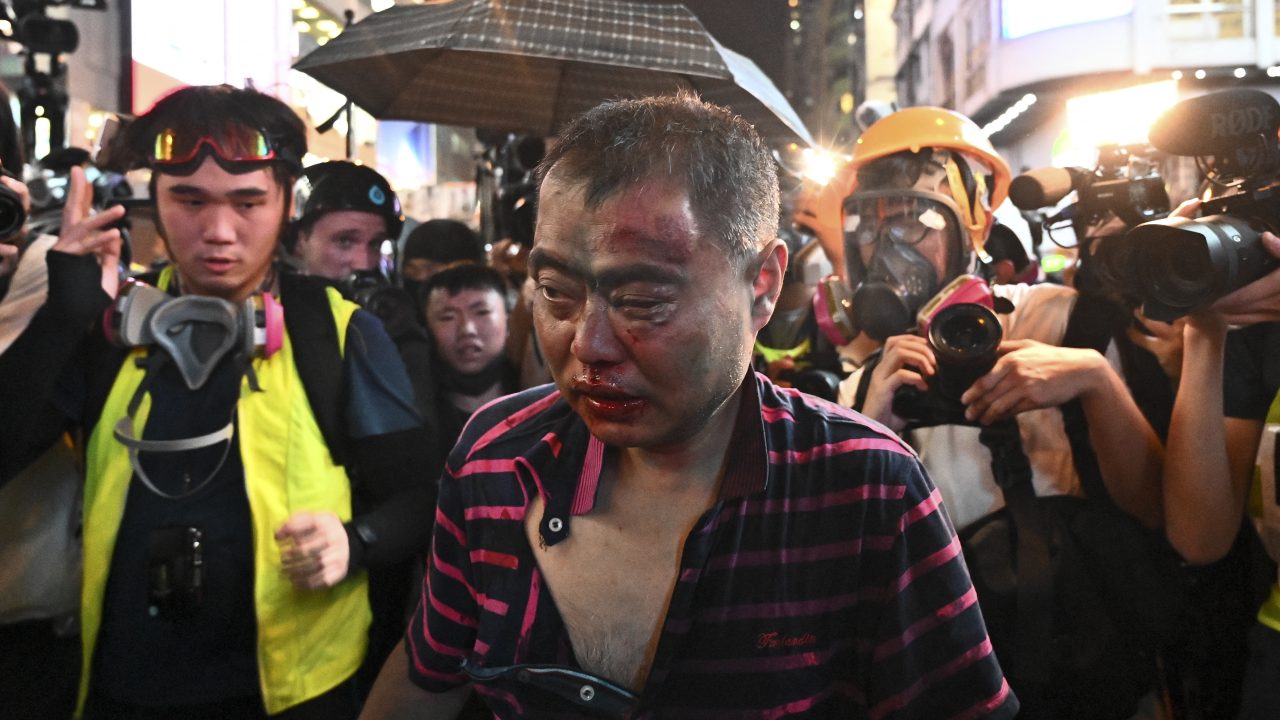
“If you see the police on the bus, absolutely do not think it is weird,” insisted the Mong Kok District police division in a Facebook post on November 9, neglecting, again, the dual facts that party-state forces of control slithering into every crack of civilian life is innately creepy and Hong Kong Police is perpetrating crime, not fighting it.
Sandwiched between photos of the force indoctrinating children, the post arrived three days after publication of a new book “Among the Braves,” which provides a revelatory timeline of the lead-up to the infamous July 21 incident of 2019, when supporters of democracy, journalists and members of the public alike were attacked by rod-wielding gangs in Hong Kong’s Yuen Long metro station.
Written by Shibani Mahtani and Timothy McLaughlin, the book provides evidence of the gangs’ political ties and suggests that police had insider knowledge of what would happen with plenty of time to take aversive action had they been minded to do so. Rumors were apparently swirling in the Yuen Long neighborhood for days in advance, and the police had infiltrated a triad WhatsApp group where the assault was planned.
Instead of protecting people, officers were busying themselves elsewhere by feeding Hong Kong’s pro-democracy youth into the penal system, often on poorly substantiated charges of rioting, via a judiciary that has “departed in many ways with past precedents and norms, straining the system of rights, due process, and fairness previously (if always imperfectly) guaranteed to defendants,” according to a new data analysis of arrests and court decisions from Georgetown University’s Center for Asian Law.
Combined with custodial sentences for convictions at over double the rate of those that were handed down in the wake of Hong Kong’s 2014 Umbrella Movement, sometimes for simply wearing black in the vicinity of alleged rioting, the judiciary’s role in subjugating Hong Kongers has led, on November 2, 2023, to the introduction of the Hong Kong Sanctions Act, which has been tabled by three U.S. representatives to their president, Joe Biden.
As a result, Biden must now ascertain, within six months, whether 49 figures, including judges and prosecutors, should be sanctioned in line with legislation like the 2019 Hong Kong Human Rights and Democracy Act that has already been passed in Washington. The move provoked howling responses from the Hong Kong government, the Chinese General Chamber of Commerce and the Real Estate Developers Association of Hong Kong, while the city’s commissioner of police Raymond Siu Chak-yee (蕭澤頤) wailed that “certain US politicians have been wantonly smearing officials of the HKSAR [Hong Kong Special Administrative Region].”
A half-hearted protest by one of the few political parties still allowed to stand for election in Hong Kong then hit the streets to signal piety to Beijing, chanting, “Oppose U.S. interference in Hong Kong affairs,” from next to the U.S. consulate, as Chinese Communist Party flunkies took to the airwaves to threaten that political prisoners could be transferred to mainland China if Biden does indeed sanction the 49, a point that, if anything, served to exemplify judicial arbitrariness and the use of Chinese courts as instruments of terror, not justice.
While these individuals were debasing themselves for favor with China President Xi Jinping, other injustices were piling up, as a young woman, Mika Yuen Ching-ting (袁靜婷), was jailed for supporting an independent Hong Kong in social media posts made in Japan; an unnamed 26-year-old man was arrested under national security auspices at Hong Kong airport for possessing a seditious T-shirt; prominent pro-democracy figures, including former lawmakers, entered final submissions in their show trial for “conspiracy to subvert state power”; and the activist Owen Chow Ka-shing (鄒家成) was arrested, along with his lawyers, for smuggling “an unauthorized article” from prison that turned out to be a complaint form to a government watchdog.
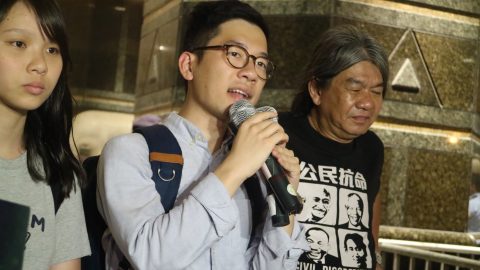
The fatwa issued by Hong Kong authorities towards eight influential pro-democracy leaders overseas, whereby HK$1,000,000 ($128,000) rewards were offered in July of this year for information leading to their arrests, has been progressing along both official and less official lines in November, too: The Hong Kong Department of Justice filed a bankruptcy petition against Ted Hui Chi-fung (許智峯), perhaps related to the legal costs it has imposed on him in absentia. A suspicious post purporting to be from Nathan Law Kwun-chung’s (羅冠聰) brother, Law Kwun-peng (羅冠鵬), appeared from a long-dormant social media account and fizzed through Hong Kong’s pro-Beijing media to denounce the former lawmaker and challenge him to return to the city. And Anna Kwok Fung-yee (郭鳳儀) was made the target of vigilantism and bounty hunters during Xi Jinping’s mid-month visit to San Francisco, as internet trolls fantasized about “[dropping] her unconscious body at the Chinese consulate/embassy.”
Aside from herding hate towards its perceived enemies, Hong Kong has been moving to eliminate any hold that its people have over those in power by further turning the screws on the last remnants of organized democratic entities in the city. After being denied the right last month to field any candidates in forthcoming district council elections, the Democratic Party this month had a successful bid for a stall at the large Lunar New Year fair rescinded without explanation, denying it yet another way of interacting with the public, while, two weeks later, ten members of the League of Social Democrats were hit with 26 charges of raising funds and displaying posters without a permit, rules that are very unlikely to be similarly applied to pro-Beijing political outfits, who will certainly encounter fewer problems with permissions.
Yet those who rule Hong Kong realize that choking off elections alone will not be enough to insulate them from popular views — like support for LGBT+ rights — that differ from their own. So, they are constricting any space where contrary opinions may be formed, developed and shared. Consequently, during November 2023 alone, they have squeezed the academic world on all sides by compelling the final implosion of the city’s largest teaching union, announcing the introduction from 2025 of a new 93-hour elementary school curriculum composed of insular Chinese Communist Party narratives and passing a bill to restructure the governing council of the Chinese University of Hong Kong that will dissolve the decision-making power of its staff into desuetude.
It is therefore little surprise to see that Hong Kong has plunged into the bottom 20 percent of all countries and territories globally in the most recent Academic Freedom Index. Nor is it any wonder to learn that the city’s government has chopped the chapter on history from its annual yearbook just released for 2022. Not only is there no room for discussion of Hong Kong’s story, but also no way to beautify what it has now been forced to become.



Leave a Reply