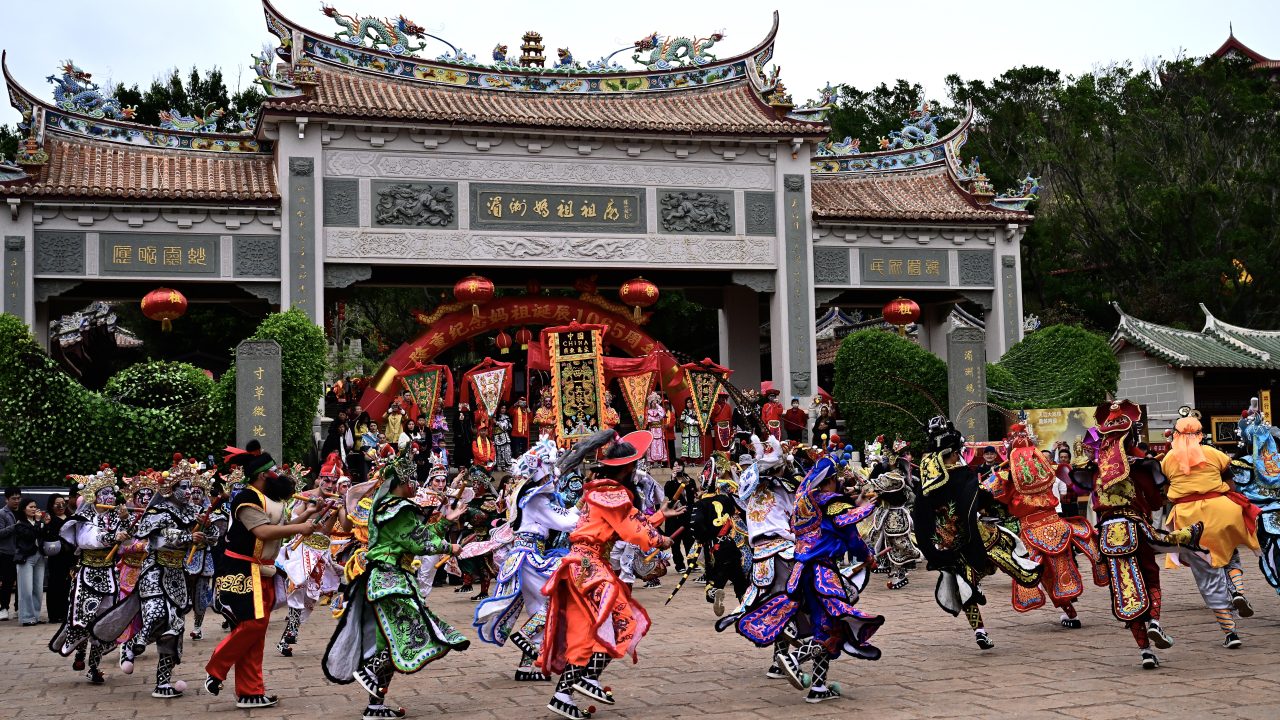
In March, two statues of the sea goddess Mazu boarded Xiamen Airlines Flight 881 for a six-day trip to Taiwan. The statues were given boarding passes with the name “Lin Mo” (林默娘), Mazu’s human name before deification, and strapped into their seats. Chinese state media reported that “The statues were fitted with custom extended seat belts and secured with red cords, ensuring their safety and symbolizing cross-Straits unity.”
Mazu is a preeminent figure in folk religion on both sides of the Taiwan Strait. In Taiwan, Mazu worship is often associated with grassroots spirituality and local Taiwanese identity. But the goddess originated in China, specifically on Meizhou Island in Fujian province, where Lin Mo was born during the Song Dynasty. Chinese who crossed over to Taiwan during the Qing Dynasty brought Mazu worship with them. Today, around 1,000 or so registered temples in Taiwan feature Mazu.
While there is certainly shared history and culture here, the Chinese government has leveraged Mazu worship to promote unification. Fostering these cultural ties around Mazu “illuminat[es] the path to peaceful reunification,” the Global Times wrote last year.
As China plans its policy roadmap for the next five years, enhancing cultural ties between Taiwan and China will certainly be a component. A communique outlining the broad direction of the 15th five-year plan, published yesterday, urged the advancement of “the peaceful development of cross-strait relations” and “the great cause of national reunification.” When the plan is published in the spring, it will likely echo its predecessor, which called for increased cultural exchanges between Taiwan and China to “promote the peaceful development of cross-strait relations, and strive for the great rejuvenation of the Chinese nation.”
China has made good on this mission so far. The Taiwan Information Environment Research Center said in a report published on Wednesday that approximately 16,000 Taiwanese attended more than 110 religious trips to China in 2024. Most of these trips involved pilgrimages to Fujian for Mazu worship, the largest of which happened in October to celebrate Mazu’s ascension into heaven.
State agencies regularly collaborate with the local government to plan cultural events in Meizhou, including the Global Mazu Culture Forum, which will take place at the end of this month. People’s Daily, the Chinese Communist Party’s official mouthpiece, reported that “this year’s event will debut a cross-Strait integration community to create a better environment for Taiwan compatriots in Putian, further promoting integrated development across the Strait.”
State involvement has influenced the symbolic framework of these events. “In line with the mainland state agencies, the Meizhou ancestral temple and other original temples of popular deities have reshaped themselves as symbols of cultural exchange and common community,” Yanchao Zhang, a philosophy professor from Xiamen University in China, wrote in a journal article published in 2021.
Zhang’s observation is increasingly apparent. During festivities in Meizhou to celebrate Mazu’s 1,063rd birthday in 2023, the state-run China Daily reported that the event convened devotees from both sides of the Taiwan strait, featuring 25-meter silk banners to “symbolize a common bond.” Le Monde reported that when Taiwanese arrived to mainland China for a pilgrimage to Meizhou in October 2024, they were greeted with banners that said, “Let peace spread to every shore of the strait.”
Multiple reports indicate that seemingly innocuous connections made during these trips lead to overtly political messages via Line that contrast the merits of the Chinese Nationalist Party (KMT) with the divisiveness of the Democratic Progressive Party (DPP). The KMT is generally more sympathetic to China; the party’s recently elected chairperson, Cheng Li-wun (鄭麗文), said in a debate last month that “Taiwan and the mainland should join forces to reach new heights in human civilization.”
Chinese state media has framed the DPP’s reluctance to promote these exchanges as political manipulation. In 2023, a Chinese spokesperson criticized the DPP for obstructing the journey of a Mazu statue from Fujian to Taiwan by subjecting the process to unnecessary bureaucratic hurdles.
When China professes a commitment to “peaceful” reunification, it can be easy to dismiss that as perfunctory. But Beijing clearly seeks to foster a sense of inevitability around unification that could bring it closer to realization, whether that be through convincing Taiwanese to vote for a sympathetic KMT government or by planting the seeds for a less-unruly province in the event of annexation.
That spirit was on display two years ago, when Buddhist and Mazu leaders gathered for a religious ceremony in central Taiwan. Together, they chanted: “We wish for Taiwan to be a blessed island but not an island with military arsenals … not to become an island of battlefields.”






Leave a Reply