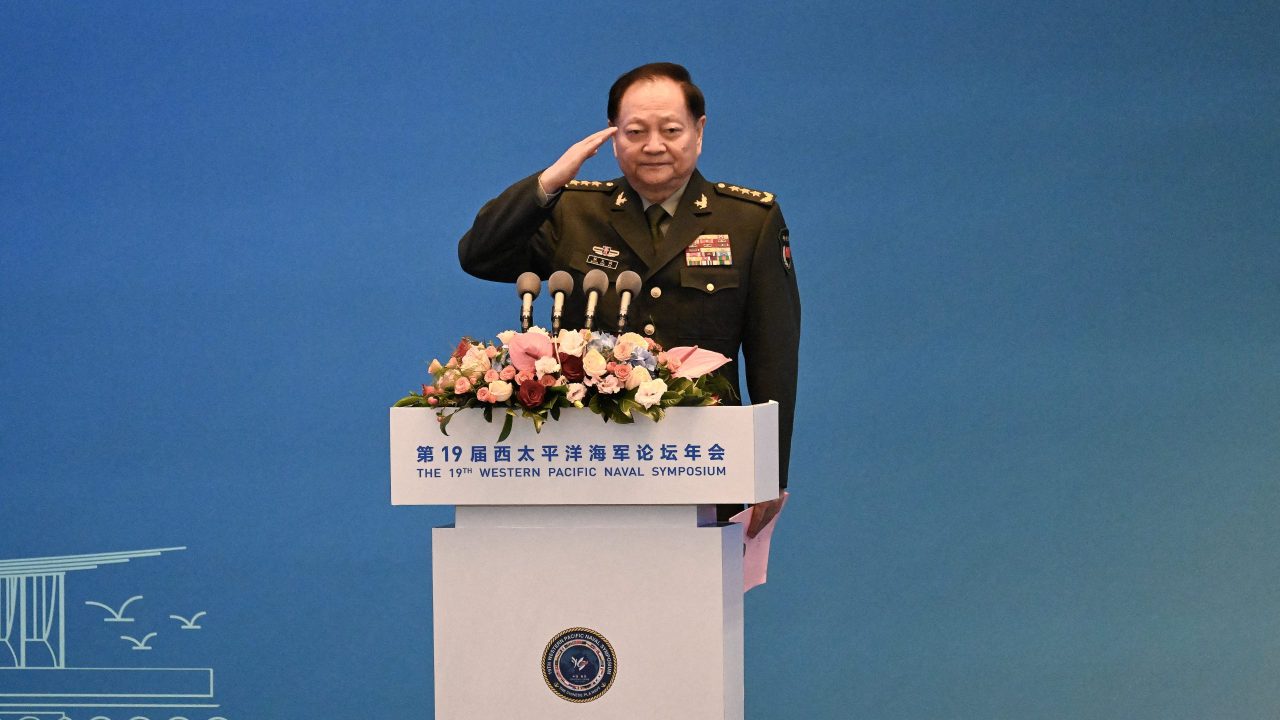
Two of China’s top generals, Zhang Youxia (張又俠) and Liu Zhenli (劉振立), were seen missing from a public event on January 20. Domino Theory was one of the first outlets to cover their absence, speculating that they could have been purged.
The confirmation that they were in serious trouble came far sooner than anyone expected, with Chinese state media announcing the two were under investigation the following weekend. And the tenor of those articles didn’t exactly leave much room for “innocent until proven guilty.” Their culpability is clearly pre-established.
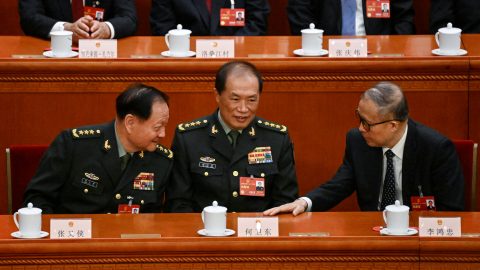
Their fall follows the purges of three other senior military officials: He Weidong (何衛東), Miao Hua (苗華) and Li Shangfu (李尚福). All five were members of China’s most senior military decision-making body, the Central Military Commission. Headed up by Xi Jinping (習近平) in his capacity as chairman, a title of at least equal importance to president, the Central Military Commission is responsible for formulating and implementing military policy, and is the mechanism by which the Chinese Communist Party exerts power over the Chinese military, which is ultimately loyal to the party and not the state.
Since he came to power in 2012, Xi has instituted wide-ranging reforms to the military, including forming and reforming entire branches, and changing from a system of seven military regions to the five theater commands that exist today. These reforms were accompanied by a reduction in the size of the Central Military Commission. In 2012 it had 11 members. That shrank to seven at the start of Xi’s current term in 2022, and as of today, if Zhang and Liu are excluded, the Central Military Commission has only two members, Xi and Zhang Shengmin (張升民), a man who we can only assume is sitting far from comfortably.
Much ink has been spilled on why Zhang, Liu and the rest were purged, and what it means for the countries that are threatened by China militarily, like Taiwan. But there’s another question: What will happen to the Central Military Commission? Clearly it is not a functional body as of right now, with only one general and Xi. It’s also been often pointed out that Zhang Youxia and Liu both saw combat fighting against Vietnam, whereas Zhang Shengmin rose up through the ranks in roles focused on party discipline.
There are basically two schools of thought on what will come next: Either Xi will add more people to the Central Military Commission in the near future, or he won’t. And while it’s impossible to say with confidence which is correct now, we will probably know sooner rather than later.
Those who think that Xi won’t add new generals argue that the Central Military Commission is already redundant. Xi’s goal is more centralization of power, according to Matthew Johnson, a historian and senior fellow at Jamestown Foundation. He said that Xi has an “alternate design for what military command should look like,” including the chairman responsibility system. But Johnson allows that the Central Military Commission could still persist as a shadow of its former self.
While analysis of the chairman responsibility system indeed suggests the current emphasis on it is related to Xi’s attempts to entrench his control of the military, Henry Gao (高樹超), a professor of law with a focus on China, pointed out on X that an editorial in the People’s Liberation Army Daily, the official newspaper of the Chinese military, said the chairman responsibility system meant “to resolutely follow Xi’s commands, be responsible to Xi, and reassure Xi.”
Somehow the idea that one of the main functions of this control mechanism is to reassure the controller is not very reassuring. Reassurance is not always strongly correlated with truth-telling.
The demise of the Central Military Commission is also the view taken by Julian Ku (古舉倫), another legal scholar but with more of a Taiwan focus. He said that the Central Military Commission could become a “defunct institution.” But he warned that this would be bad for China’s military, including its capabilities, especially if it ends up being run by Xi’s closest aides.
Xi has already shown that he doesn’t really trust Zhang Shengmin. Wang Shengyu, a research assistant at the Asia Society Policy Institute’s Center, pointed out that when Zhang was promoted to take He Weidong’s vice chair spot on the Central Military Commission, he didn’t get He’s position in the politburo. Wang also doesn’t think that the empty seats will be filled anytime soon.
Anushka Saxena, a research analyst at the Takshashila Institution in Bengaluru who focuses on the Chinese military and Chinese internal politics, has a track record of correctly predicting who will be purged and who will replace them. After Miao’s fall, she wrote that He could be next. And after He’s fall, she told Domino Theory that Zhang Shengmin might be the one to move up and replace him.
Saxena expects that Xi will assign new replacements to the Central Military Commission at the National People’s Congress, China’s legislature, in March. She pointed out that this would give Xi over a year to get them ready for the autumn of 2027, with the People’s Liberation Army’s centenary and the Chinese Communist Party congress. New members to the Central Military Commission would typically be chosen at a plenary session of the party’s Central Committee. But Saxena thinks under the extraordinary circumstances Xi finds himself in an exception could be made.
If March is the time, it would provide a fixed point for observers that is sooner rather than later. If no-one is added, it is suggestive that Xi intends to sideline the Central Military Commission. If he fills it up, the converse is obviously true.
One obvious problem is who to fill it with? Recent analysis from The New York Times of Chinese state media and official reports shows that the purges have also eviscerated the level below the Central Military Commission, including theater commanders. Rapid rises might be necessary. Writing before Zhang and Liu’s fall, Mark Parker Young, a former nonresident senior fellow at the Atlantic Council’s Global China Hub, suggested the Joint Staff Department may gain importance relative to the Central Military Commission. That could well have been the intention. But the idea presupposes a functional joint staff that has not itself been crippled by purges.
As for who might be next? Saxena had two names. “If I was the Northern Theater Commander Huang Ming (黃銘), I might be worried,” she said, citing his links to Zhang when both were serving in the Shenyang military region. Wu Yanan (吳亞男), too, is a name to watch. Currently the Southern Theater commander, he has ties to Zhang and Huang through working in Jilin in the Northern Theater Command.





Leave a Reply