920,000 Reports to National Security Hotline
More than 920,000 reports have been made to Hong Kong’s national security hotline over past four years, according to Hong Kong’s Secretary for Security Chris Tang (鄧炳強). The hotline was established in 2020, four months after Beijing imposed national security legislation in Hong Kong. Speaking at a ceremony marking the 2020 national security law’s introduction, Tang said it “filled a gap in Hong Kong’s legal system to safeguard national security,” but “hostile forces continue to seek opportunities to harm our country and the [Special Administrative Region of Hong Kong].”
Trial of Anna Kwok’s Father Adjourned
The trial of high-profile activist Anna Kwok’s (郭鳳儀) father — charged with a national security crime — has been adjourned until August.
Kwok’s father has been charged with “attempting to deal with, directly or indirectly, any funds or other financial assets or economic resources belonging to, or owned or controlled by, a relevant absconder.” The prosecution was granted an adjournment last Friday on the grounds that an insurance company involved in the case needed more time to prepare documents for the police.
Human Rights Watch has said the campaign of harassment against Hong Kong activists has “intensified.”
“The Chinese government has increased its appalling use of collective punishment against family members of peaceful activists from Hong Kong,” said Yalkun Uluyol, China researcher at Human Rights Watch. “The Hong Kong authorities should immediately and unconditionally release Anna Kwok’s father and cease harassing families of Hong Kong activists.”
A new report by rights group ARTICLE 19 said “China is now waging a global campaign of transnational repression against protesters critical of the Chinese Communist Party.”
U.S. Official Warns U.K. Government Over Chinese Embassy Decision
After the Bank of England recently warned the U.K. government against allowing the proposed new Chinese embassy to open near sensitive financial institutions in London, in recent days a senior U.S. official told the Sunday Times the U.S. is “deeply concerned” about allowing China access to communications cables near the site that link up to the U.K.’s financial-services industry. Some have warned that if that is the position of the Trump administration, allowing the embassy to be developed may hurt the U.K. in ongoing trade talks with the U.S.
The proposed embassy is already controversial because protesters believe it could be used as a base for increased surveillance of Hong Kongers and dissidents in the U.K. A decision over its future is expected from the U.K. government in the near future.
The fourth protest this year against the embassy took place this weekend.
In an additional development last week, the U.K.’s shadow housing secretary Kevin Hollinrake accused the government of giving the go-ahead for the embassy before the official process began. “There is a clear case that the Government codes and guidance have been breached, and Government Ministers have acted unlawfully,” he wrote in a letter that called for the process to be restarted.
Four More of Hong Kong 47 Released
Four additional members of the “Hong Kong 47,” a group accused of conspiracy to commit subversion, were released last Friday after spending more than four years in prison. The release of Jimmy Sham (岑子杰), Kinda Li (李嘉達), Roy Tam (譚凱邦) and Henry Wong (王百羽) comes in the wake of four prisoners being released last month.
On his release, Sham told the media: “I don’t know how to plan ahead because, to me, it feels like today is my first day of understanding the world again. So, as for what I can do or should do in the future, or where is the red line, I feel like I need to explore and figure it out all over again.”
In November last year, 45 of 47 Hong Kong pro-democracy figures were sentenced to serve prison time for their parts in organizing unofficial pre-election primaries to choose the best candidates in 2020 local elections.
June 4 Tiananmen Square Anniversary
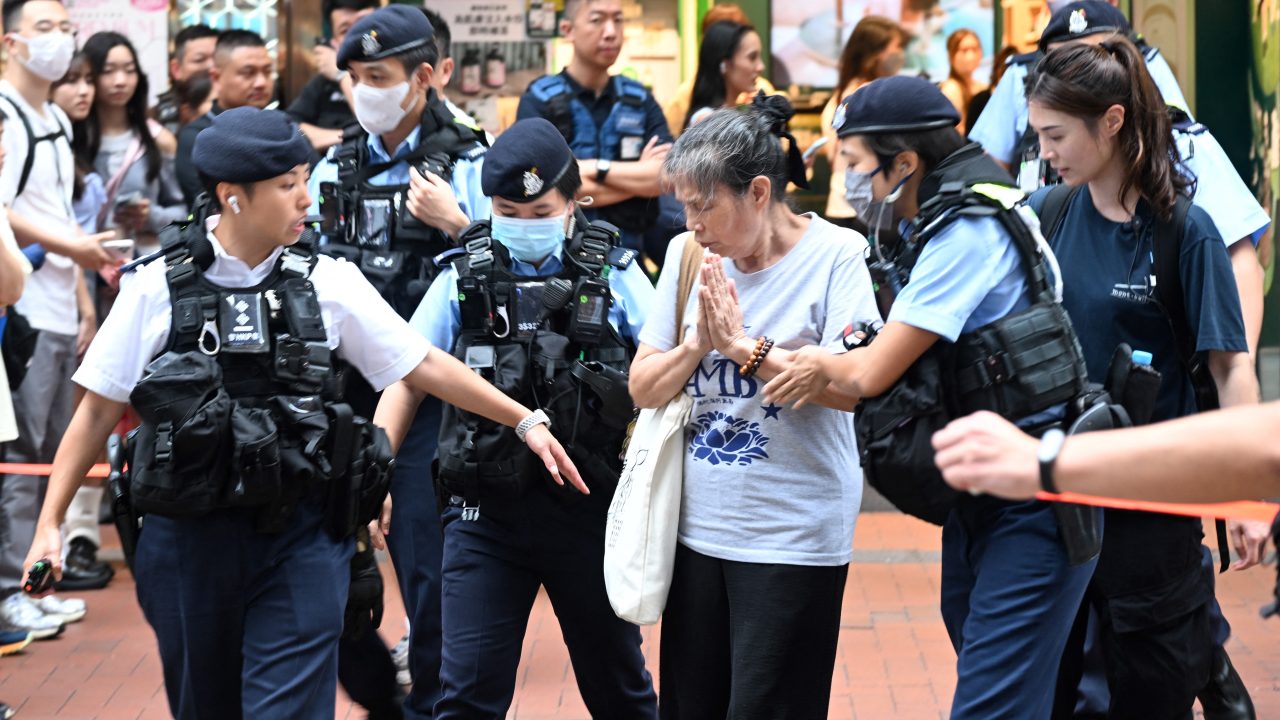
On the 36th anniversary of the Tiananmen Square crackdown, hundreds of police officers patrolled Victoria Park in Hong Kong, where mass candlelight vigils were held prior to 2020’s national security crackdown. Passers-by were searched and activists were called by national security police, followed in public and had premises searched.
Chow Hang-tung (鄒幸彤), who used to help organize the annual vigil at Victoria Park, mounted a 36-hour hunger strike in prison to mark the anniversary.
Puppet Organizations
An investigation by the International Consortium of Investigative Journalists has accused the Chinese government of using puppet organizations to intimidate activists and organizations critical of the Chinese government. The consortium said it and its partners had spoken to 15 activists and lawyers focused on human rights in China who “described being surveilled or harassed by people suspected to be proxies for the Chinese government,” particularly around the U.N.’s Palais des Nations in Geneva.
The International Consortium of Investigative Journalists analysis looked at 106 NGOs from mainland China, Hong Kong, Macau and Taiwan with consultative status at the U.N. It found 59 were closely connected to the Chinese government or the Chinese Communist Party. “Forty-six are led by people with roles in the government or the party. Ten accept more than 50% of their funding from the Chinese state,” it detailed.
English Lessons Have Added Patriotic Messages
Hong Kong’s government revised primary school curriculums so that English lessons are required to come with sections that emphasize patriotic and national security education.
Taiwanese Game Could Be Considered Inciting Secession
Hong Kong’s National Security Department has said people who downloaded “Reversed Front: Bonfire,” a game by Taiwanese developers ESC Taiwan, should “uninstall it immediately” as it promotes “armed revolution” and the overthrow of the Chinese government.
The game is about “overthrowing a communist regime,” according to its profile on gaming platform Steam. Players can play the role of “Hong Kong, Tibet, Uyghurs (East Turkestan), Kazakhs, Mongolia, Manchuria, Taiwan or Cathaysian Rebel factions.”
Hong Kong national security police have said anyone who publishes related content could stand accused of inciting secession and subversion, offences under the 2020 national security law. They may also be considered to have violated the Safeguarding National Security Ordinance (known as Article 23), which criminalizes “offences in connection with seditious intention.”



Leave a Reply