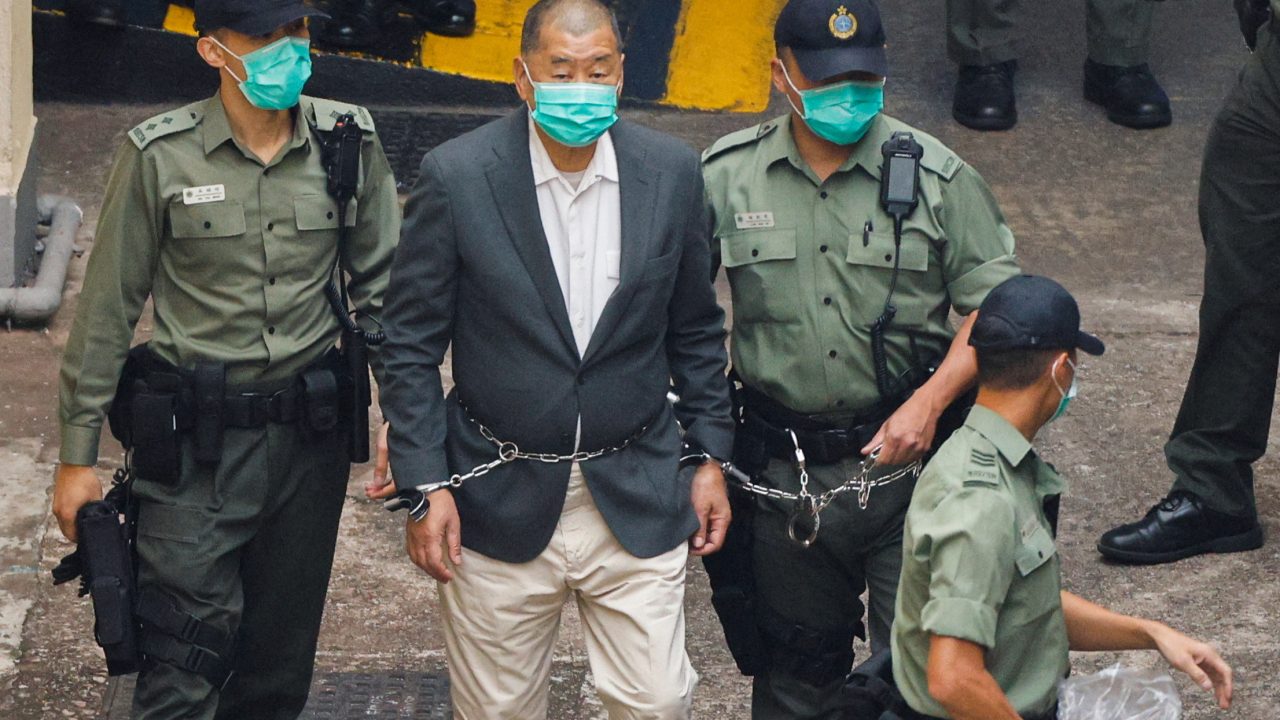
Jimmy Lai Alleged Mistreatment
On September 12, the legal team of Jimmy Lai (黎智英) submitted an urgent appeal to the United Nations Special Rapporteur on torture, Alice Edwards, alleging torture and mistreatment. It said Lai, founder of pro-democracy newspaper Apple Daily, had been denied specialized medical care for diabetes while in prison and that his solitary confinement was a threat to his health.
In a statement, the Hong Kong government denied wrongdoing. “Any accusation concerning Lai Chee-ying not receiving appropriate treatment in prisons, including not having access to optimal medical services, cannot be further from the truth and is only spreading rumours to create trouble,” it said.
Sedition Sentences
At the end of August, Stand News journalists Chung Pui-kuen (鍾沛權) and Patrick Lam (林紹桐) were found guilty of conspiracy to publish seditious materials, the first conviction of that kind since Hong Kong returned to Chinese rule in 1997. Last week, Chung was sentenced to 21 months in prison and is set to stay in prison for a further ten months owing to time previously served. Lam was sentenced to 11 months in prison but was allowed to go free because of a medical condition.
The materials that formed the basis of the conviction consisted of articles from 2020 and 2021 covering the pro-democracy movement.
British Judge Steps Down
This week, British judge Nicholas Phillips, 86, became the fifth foreign judge to leave Hong Kong’s judiciary this year after stepping down from its court of final appeal for “personal reasons.” He chose not to return after his fourth term ended. Another British judge, Jonathan Sumption, said Hong Kong “is slowly becoming a totalitarian state” when he resigned earlier in the year.
Seditious T-Shirt Conviction
Hong Konger Chu Kai-pong (諸啟邦) became the first person to be sentenced to jail under the new the Safeguarding National Security Ordinance this month. Chu wore a t-shirt which read “Liberate Hong Kong, revolution of our times” on June 12, the anniversary of clashes between protesters and police in 2019.
Chu pled guilty to “doing with a seditious intention an act or acts that had a seditious intention,” which is an offense under the Safeguarding National Security Ordinance, known as Article 23. He was sentenced to 14 months in prison.
U.N. Report on Intimidation
In a new report from U.N. Secretary-General Antonio Guterres, China was listed as one of seven states where news acts of intimidation and reprisal were committed against individuals cooperating with the United Nations in the field of human rights.
One of the examples listed was the case of Hang Tuan Chow (鄒幸彤), who was convicted of “inciting others to take part in an unauthorized assembly” during Hong Kong’s 2021 Tiananmen Square vigil. According to the report, the U.N. Working Group on Arbitrary Detention was told by the government of Hong Kong that statements or acts intended to interfere with the administration of justice may constitute “criminal contempt of court.”
Harassment of Journalists
The Hong Kong Journalists Association has said it has tracked a “systematic and organised attack against journalists in the city.” In a statement released September 13, it said journalists and their family members were harassed both online and offline from June to August by anonymous senders identifying as “patriots.” Emails, letters and Facebook posts with similar formats were sent “portraying legitimate reporting as problematic or illegal, and baselessly accusing articles of being inflammatory.” In addition, at least four cases were found in which “trolls” used Facebook and Wikipedia to make violent threats.
German Tibet Activist Entry Blocked
The deputy chairman and spokesman of the Tibet Initiative Deutschland group, David Missal, was refused entry to Hong Kong early in September after being questioned for several hours. Missal had traveled to Hong Kong from China. In 2020 he had petitioned for Germany to sanction China in response to its introduction of the National Security Law.
Academic Freedom Declines
Hong Kong’s academic freedom has “severely declined” since the introduction of the National Security Law in 2020, according to a new report from Human Rights Watch. The report said students and academics believe “any misstep … can potentially land them or those they associate with in serious trouble, resulting in a ripple of repercussions that could even land them in prison for years.” It detailed how student unions have been forced off campus by university administrations and peaceful demonstrations have been punished. Students and faculty interviewed reported the need to self-censor.
Objection to John Lee Participation
Nine U.K. Members of Parliament signed a letter objecting to Hong Kong Chief Executive John Lee (李家超) and China’s top diplomat in Hong Kong Cui Jianchun (崔建春) appearing at the British Chamber of Commerce in Hong Kong.
“We do not consider it wise for the British Chamber of Commerce in Hong Kong to provide a platform for Mr Lee and Mr Cui to extol the virtues of a national security regime which the [U.K.’s Foreign, Commonwealth and Development Office] officially considers to have violated the [People’s Republic of China] international treaty commitments signed with the British government,” the letter said.
Lee, however, did ultimately speak at the event.



Leave a Reply