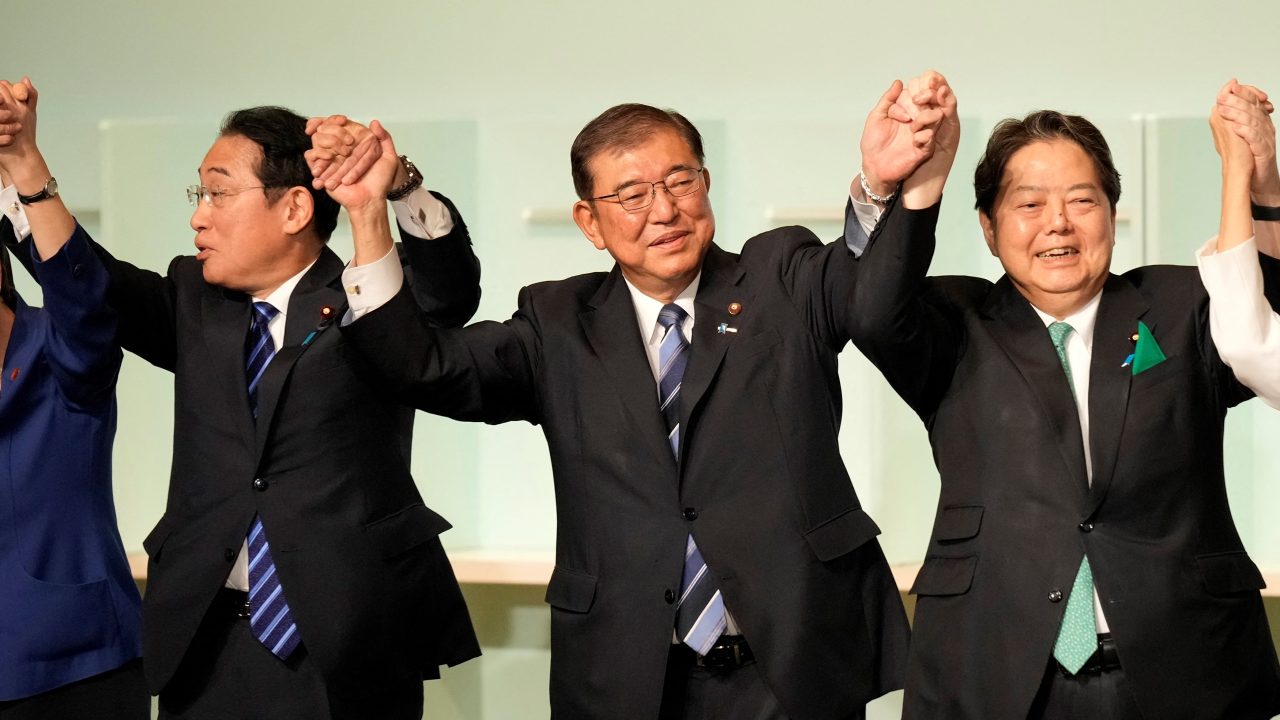
On Friday afternoon, the Liberal Democratic Party (LDP) of Japan elected Ishiba Shigeru as its new leader, virtually guaranteeing that he will become the next prime minister of Japan when Kishida Fumio steps down at the end of this month.
Ishiba is a veteran politician who has failed to win the leadership contest four times in the past. He is also a former defense minister, having served in the role twice, who has maintained a keen interest in defense issues as a politician.
Importantly for Taiwan, he has visited twice in recent years, including in August of this year when he met Taiwanese President Lai Ching-te (賴清德) in Taipei. What happened at that meeting and what else does his election mean for Taiwan?
Although Ishiba’s visit to Taiwan took place right after the leadership race had been triggered by Kisihda announcing he would step down, it had clearly been planned beforehand. Nonetheless, Ishiba took the opportunity to announce while he was in Taipei that he was open to running for leader if he could get enough support.
When meeting with Lai, Ishiba said: “There is a debate in Japan that what is happening in Ukraine today might be a problem that northeast Asia faces tomorrow,” Kyodo News reported at the time. He continued: “We have to rack our brains” to prevent that scenario from happening.
What exactly Ishiba expects to find after racking his brains is not a secret. In an interview with The Diplomat at the end of 2023, he said: “Some say that NATO countries spend 2 percent of GDP on defense, so Japan must follow suit. But Japan’s security environment is worse than NATO countries’, so 2 percent of GDP may not be enough.”
He also called for Japan to abandon the second part of the “controversial” Article Nine of the Japanese Constitution, which states that:
“Aspiring sincerely to an international peace based on justice and order, the Japanese people forever renounce war as a sovereign right of the nation and the threat or use of force as means of settling international disputes.
In order to accomplish the aim of the preceding paragraph, land, sea, and air forces, as well as other war potential, will never be maintained. The right of belligerency of the state will not be recognized.”
In the interview, Ishiba said it is “unfathomable” that Japan does not recognize the rules of warfare laid out in the Geneva Convention. Clearly, he thinks Japan should be able to fight wars in accordance with international law as any other country can. (In case it isn’t obvious, the point of Article Nine is for Japan to deny itself that right. Needless to say, changing it would be controversial both in and outside of Japan.)
In 2022, Ishiba also visited Taiwan with other lawmakers, meeting then-President Tsai Ing-wen (蔡英文). At that time, the Associated Press reported that he said Japan and Taiwan “need to work together,” saying his delegation aimed to engage with Taiwan on defense and prepare for potential conflicts in East Asia.
During the campaign, in response to the so-called “Taiwan contingency is a Japan contingency” situation, Ishiba, along with eight other candidates, gave their arguments as to how Japan should coordinate with Taiwan to rescue Japanese expatriates living in Taiwan in the event of an invasion from China.
Ishiba shared his opinions on the matter, saying “Since civilian aircraft won’t be able to operate, we’d have to deploy Self-Defense Force planes and ships. We need to decide in advance which bases, planes and ships to use. If we’re scrambling after the crisis begins, it’s too late. We must establish a clear legal basis for action.”
However, speaking at the Asia-Pacific Forward Forum in Taipei, former defense minister Yanagisawa Kyoji said the “Taiwan contingency” concept is not a mainstream consensus in Japanese society, and Taiwan should not hold the expectation that Japan will provide help as Japan might face heavy retaliation from China. But if Japan does not provide help, it could also be seen as a violation of the U.S.-Japan Alliance.
While Ishiba’s remarks and visits were not made as leader of Japan, Domino Theory still views them as significant in determining the direction of travel of an Ishiba government. Additionally, while the personal relationship between the two men is not known, it is rare for world leaders to have had recent face-to-face contact with Taiwan’s president. It can be hoped that the August meeting between Ishiba and Lai has laid a solid foundation for the Taipei-Tokyo relationship in the coming years.
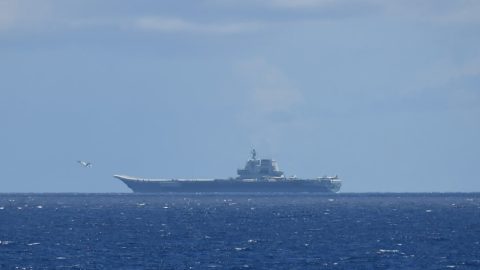
The Japanese Self-Defense Forces have been undergoing significant reorganization and investment. Last week, Domino Theory reported on the new (sort-of) Japanese aircraft carriers. The Japanese military is also acquiring and developing new long-range strike capabilities.
Two weeks ago, in an interview with Japanese Tabloid Shukan Shunbun, Ishida said that the Japanese military needs to build bases in the U.S. to receive more training, he pointed out that Japan does not have enough bases for either its army or navy.
In response to last week’s PLA incursion into Japan’s airspace, Ishiba said Japan should explore the possibility of amending new laws to allow the Japanese military to conduct “hazardous firing” to deter the PLA aircraft from entering Japanese airspace.
Ishiba arrives into office in a tense period for Japan and China. A Japanese navy ship sailed through the Taiwan Strait on Wednesday for the first time in decades, apparently in response to the Chinese incursions into Japanese airspace. Meanwhile, earlier this week a Japanese navy captain was removed from his position after his ship entered Chinese territorial waters in July (this incident did not take place near the Taiwan Strait).
More troublingly, in 2024 there have been two separate incidents of Japanese children being attacked with knives in China. In June a Chinese woman, Hu Youping (胡友平), died defending a Japanese family that was attacked in Suzhou. A ten-year-old Japanese student was fatally stabbed in Shenzhen last week. In neither case has the motivation for the attack been revealed.
In response to last week’s stabbing incident, Ishiba said the Japanese government should not only raise concerns with China, but should strongly request that China explain what measures it has taken and what it will do to prevent a similar incident from happening again.
In two separate incidents this year, pillars at the controversial Yasukuni Shrine in Tokyo were vandalized. In the first case a Chinese national was arrested, in the second Chinese characters were used to deface the pillar. The Yasukuni Shrine is controversial because it honors all of Japan’s war dead, including convicted war criminals.
Like every Japanese prime minister, Ishiba will have to decide whether to visit the shrine or not. Doing so will anger Beijing and Seoul (Ishiba values the relationship with South Korea), not doing so will anger Japanese conservatives. Ishiba has not said whether he plans to visit.
During the first weeks of his prime ministership, Ishiba will have to try to set the tone for many different relationships. Not only within East Asia, but also with allies such as the U.S., other Quad partners and new, stronger European relationships as well. It wouldn’t be surprising if Taiwan doesn’t get a lot of attention during this period of signal and noise, but there is no reason to think that Ishiba will divert from the trend of closer partnership between Tokyo and Taipei.
Taiwan’s foreign ministry has published a statement to congratulate Ishiba’s achievement, pointing out that it appreciates the trips LDP members and lawmakers make to Taiwan to deepen Japan-Taiwan relations. The ministry said the Japanese government under LDP leadership has consistently emphasized the importance of peace in the Taiwan Strait and supported Taiwan’s participation in international organizations. The ministry expressed hope that under Ishiba’s leadership, the LDP will continue to strengthen Japan’s relationship with Taiwan, fostering substantive relations and jointly safeguarding peace and prosperity in the Indo-Pacific region.
Taiwan’s ruling party Democratic Progressive Party (DPP) and opposition party Chinese Nationalist Party (KMT) both also published a congratulatory statement for Ishiba’s victory. The Taiwan People’s Party (TPP) has yet to publish one.



Leave a Reply