
Last week, a Malaysian official announced the first ever deployment of DeepSeek and Huawei Ascend-powered AI servers at a national scale outside of China. Deputy Minister of Communications Teo Nie Ching said the initiative was a testament to Malaysia-China cooperation on AI. “What we launch today is more than a platform. It is a national declaration.”
The next day, the Malaysian government rescinded these comments. The Ministry of Investment, Trade and Industry said the initiative is private sector driven and not officially endorsed by the government. Malaysia’s prime minister, Anwar Ibrahim, even stepped in to clarify that Malaysia remains “fiercely independent” amid the U.S.-China tech rivalry.
What happened?
In her speech, Teo said this deployment of Chinese AI technology by Skyvast, Huawei and Leadyo would form the foundation for Malaysia’s sovereign AI infrastructure. By Teo’s definition, AI sovereignty ensures “that our data flows through trusted, sovereign networks — governed and protected under Malaysian law.” In truth, sovereign AI has become somewhat of a buzzword used to market national interest-driven and locally compliant AI initiatives.
As a long-time advocate of national sovereignty and non-interference, China is well-positioned to market its home-grown technology by leveraging the sovereign AI narrative. In fact, some claim that the contemporary idea of sovereign AI has roots in an argument China has been making since the 1990s that it has the right to deal with digital information within its borders the way it sees fit.
Yet, for the past few years, the most outspoken advocate of sovereign AI has been an American. Specifically, Nvidia’s chief executive Jensen Huang. Huang has embarked on a global campaign for sovereign AI in an effort to compete with hyperscalers, which are companies like Microsoft, Amazon and Google that can provide end-to-end, scalable AI services built on their centralized AI infrastructure. In other words, customers of hyperscalers can access AI capabilities without needing to invest a bunch of money in the physical infrastructure. Nvidia’s alternative pitch is that it can supply the chips and other AI infrastructure to build national AI systems that are locally owned. In Malaysia, Nvidia is investing $4.3 billion into local supercomputing infrastructure through a partnership with Malaysian infrastructure conglomerate YTL. The plan includes building a national Malay AI model based on local data.
Nvidia is not the only American AI company investing major sums in Malaysia, nor the only one framing its project — implicitly or explicitly — as sovereign AI. Hyperscalers tend to define sovereign AI in terms of compliance with local policies and regulatory requirements, as opposed to locally owned infrastructure investments. In May 2024, Google and Microsoft announced their respective plans to build $2 billion data centers in the country. Google called this a “sovereign cloud” solution. Microsoft is also working with the Malaysian government to establish a national AI Centre of Excellence. In August 2024, Amazon announced its plan to invest $6.2 billion to build out Amazon Web Services cloud computing infrastructure in Malaysia. Last October, Oracle announced one of the largest tech investments in Malaysia at $6.5 billion. This “sovereign AI” project will include an OCI Supercluster that can host up to 131,000 Nvidia GPUs.
Despite this willingness to align with Malaysian policy and national objectives, in her speech at the Skyvast-Huawei launch event, Teo seemed to denounce these initiatives. Or at least imply that partnering with Huawei and Deepseek was a welcome alternative to collaborating with American tech giants. “[W]e have been constrained by foreign infrastructures, cloud dependencies, and barriers to high-performance computing … If we do not act decisively, we risk becoming perpetual consumers of technologies defined by others, running on infrastructure governed by others, under laws written by others,” Teo said.
How the Skyvast-Huawei project would be more empowering of Malaysia’s “sovereign AI” than other AI infrastructure investments, particularly the Nvidia-YTL partnership, is unclear. Both deploy foreign hardware via local implementing partners. Ibrahim once said of the Nvidia investment that it will “spearhead the development of Sovereign Cloud.” Perhaps the framing of Teo’s speech was motivated by geopolitics — specifically, the U.S.’s tightening grip on the export of American AI technology.
As Teo implied, allowing American companies to build infrastructure and provide AI solutions in Malaysia doesn’t come without risks of foreign intervention. Plenty of bipartisan U.S. tech policy in recent years has sought to control the flow of American technology around the world. The most notable example is the Biden administration’s AI Diffusion Rule, which was announced in the twilight of his presidency.
If it had gone in effect on May 15 as scheduled, this rule would have significantly altered the U.S.’s treatment of countries like Malaysia when it comes to the trade in chip technology. The rule differentiated countries into tiers, in large part based on the risk that chips sold there would be diverted to China. Most countries in the global south, like Malaysia, were classified as Tier 2. Unlike the 18 close American allies who would face no restrictions on their access to American AI, Malaysia and other Tier 2 countries would only have been allowed to receive 49,901 H100-equivalent GPUs each through 2027, with some flexibility for low-volume imports. These caps would have become more restrictive as increasingly powerful chips proliferated.
The AI Diffusion Rule caused a lot of backlash. Not only because it restricted the ability of American companies to compete in critical new markets for AI, like Malaysia, but also because it could easily be spun as insulting to the countries deemed second class. Chinese state media the Global Times characterized the rule as the U.S.’s attempt to generate another development divide, the real purpose of which was “to deprive developing countries, including China, of the right to make their own progress in science and development.”
In some ways, U.S. President Donald Trump’s approach to technology leadership has made it increasingly difficult for American AI companies to do business abroad because he has projected onto them a sense of chaos and unilateralism. In Europe, American hyperscalers are struggling to assure leaders that they can be trusted to protect European data. Europeans are also worried that the hyperscalers might cut off cloud services if Trump decides to sign an executive order to that effect.
However, making Europe feel insecure about its access to American technology probably doesn’t matter as much to American tech supremacy as competing in Malaysia and other emerging markets for AI that are open to Chinese tech alternatives. Europe’s technological ecosystem is heavily dependent on American technology, and this is unlikely to change in the near future. The key battleground for U.S.-China AI competition lies in countries like Malaysia that have a lot of potential for growth in this sector and are more willing to balance between the U.S. and China. By 2027, AI buildout is expected to contribute $120 billion to regional GDP in Southeast Asia, according to Boston Consulting Group. In other emerging AI hubs like the Gulf Cooperation Council countries, generative AI could produce $35 billion on top of other AI technologies annually.
With this in mind, the Trump administration’s decision to rescind the AI diffusion rule was smart. And the Malaysian government’s prompt retraction of their comments regarding the Skyvast-Huawei deal is indicative of this. Analysts suggest that Malaysia distanced itself from AI cooperation with China because the Skyvast-Huawei project caught the attention of the White House. David Sacks, a Silicon Valley heavyweight and Trump’s AI czar, posted on X shortly after the announcement: “As I’ve been warning, the full Chinese stack is here. We rescinded the Biden Diffusion Rule just in time. The American AI stack needs to be unleashed to compete.”
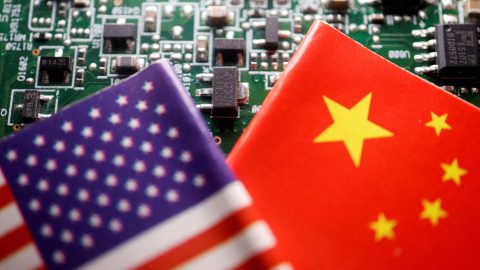
Since Trump rescinded the diffusion rule, he has entered into negotiations to craft tailored export control rules bilaterally. Negotiations between Malaysia and the U.S. regarding reciprocal tariffs and chip export controls officially began on May 6. A Malaysian delegation is in Washington for the next couple of days to continue the discussions. Despite Malaysia’s openness to Chinese technology, it has much to lose if the U.S. restricts its chip exports. While cloaked in CCP-esque anti-hegemonic language, the AI plan Teo announced would deploy only 3,000 Huawei chips — a modest number compared to American investments in the region.
China is innovating rapidly but it clearly can’t yet compete in chip technology at the scale that the U.S. can. Before China catches up, the U.S. needs to secure its foothold in countries like Malaysia. The competition will be fierce in regions that are willing to keep their options open when a cheaper and more reliable AI stack from China becomes available.




Leave a Reply