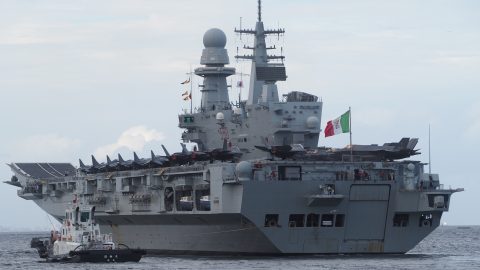
Earlier this month, Domino Theory reported on the visit of the Italian aircraft carrier Cavour to Japan. The visit coincided with other news reports that, unusually, there were no U.S. aircraft carriers in the Western Pacific. In part this wasn’t a surprise because the Cavour was moored at the berth usually reserved for whichever U.S. carrier is forward deployed at the time.
However, despite the fact that the Cavour was the only aircraft carrier in Japanese waters, it wasn’t the only aircraft carrier in Japanese waters. Confused? Well, read on.
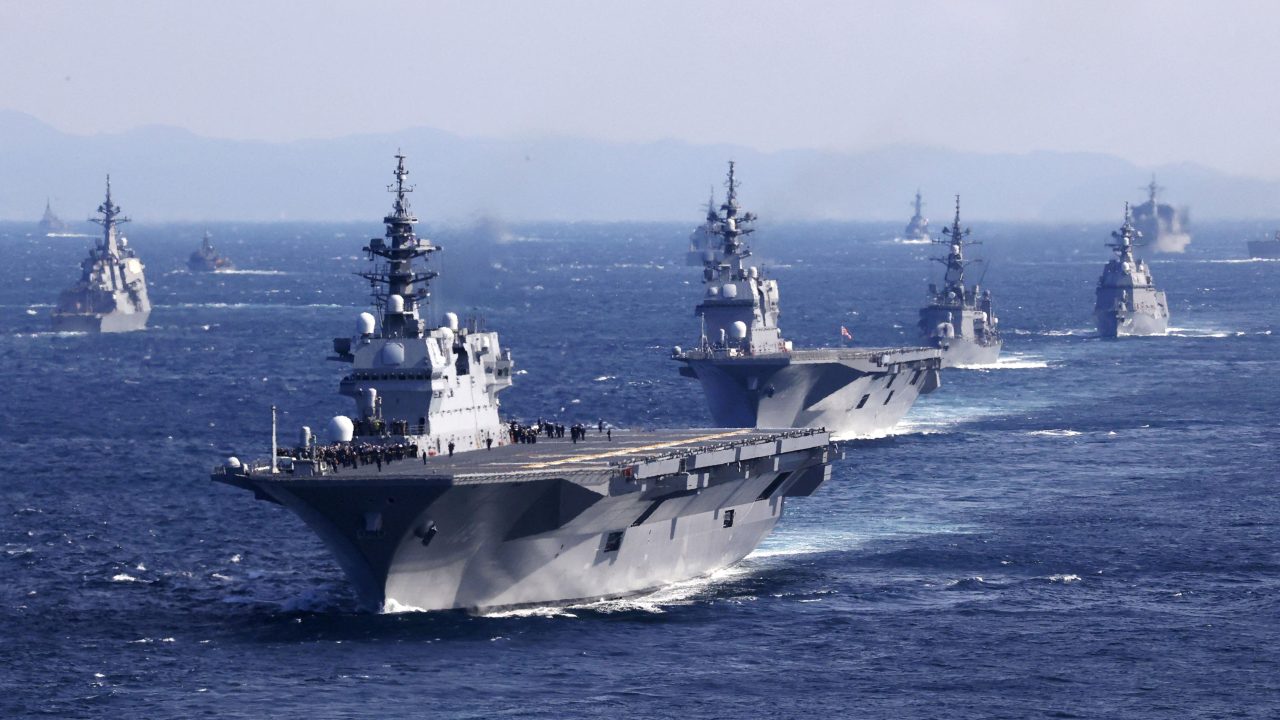
The Izumo class of ships in the Japanese Maritime Self-Defense Force (JMSDF) was ordered in 2009, and the Izumo, the first in class, was commissioned in 2015. The Kaga, the second and final ship of the class, was commissioned in 2017. When they were ordered, they were described as “helicopter destroyers” (they are still currently classed as DDH).
That name was and is a polite fiction. Like the preceding Hyuga class, the Izuomos were in reality helicopter carriers, with a large through-deck to allow flight operations, and having hangers below the flight deck and elevators to transfer aircraft between them.
However, the Izumo class is substantially larger than the Hyuga class, at 19,000 to 14,000 tonnes. This immediately aroused people’s attention, because the Izumo is of comparable size to some of the smaller aircraft carriers operated by European navies like the Spanish Juan Carlos I, and indeed the Italian Cavour.
Furthermore, it was immediately noticed that although the Izumo and Kaga were clearly well-suited for operating helicopters, in the dimensions of their hangers, elevators and flight deck they were also perfectly capable of operating fixed wing aircraft, or the F-35B Short Take-Off and Vertical Landing (STOVL) fighter jets that so many of Japan’s allies were bringing into service.
This led to allegations that Japan was seeking to effectively commission its first aircraft carriers since World War II without sparking a public debate on whether it should (for “historical reasons” Japan has until recently limited itself to defensive military capabilities, which aircraft carriers debatably are not).
The Japanese government denied all of this, of course, and the Izumo and Kaga entered service as helicopter carriers.
But.
In 2018, it was announced that the Izumo class would indeed be converted to operate F-35Bs in a light aircraft carrier role.
This process is currently ongoing, and will be for some time. Although it has been sporadically reported in English-language media, the finer points are somewhat confusing.
Right now, neither ship is actually operating as an aircraft carrier, nor does Japan have the F-35Bs to do so. The visit of the Cavour to Japan is therefore both a good opportunity for Japan to learn from a partner already operating a similar ship with the same aircraft, but also a missed opportunity to actually train together and even conduct cross-deck operations with Japanese planes landing on the Italian carrier and vice versa.
(The same opportunity will be presented next year when the U.K. aircraft carrier Prince of Wales visits Japan, and it seems likely that it will be missed once again)
The Cavour and the Izumo and Kaga are interestingly similar. The Cavour is slightly larger, at 27,000 tonnes to 19,000. However, although the Italian ship carried 14 jets on its voyage to Japan, it is capable of operating an air wing of 18. Although it is commonly asserted that the Ixumo and Kaga will be able to carry ten or more planes, it’s unclear where this number comes from. Additionally, comparable classes such as the Spanish Juan Carlos 1 class or the British Invincible class light carriers have the ability to operate more than 20 jets at full capacity. The Izumo class could in theory operate more than 20 helicopters, and it’s probable that its true air wing capacity will be closer to this number.
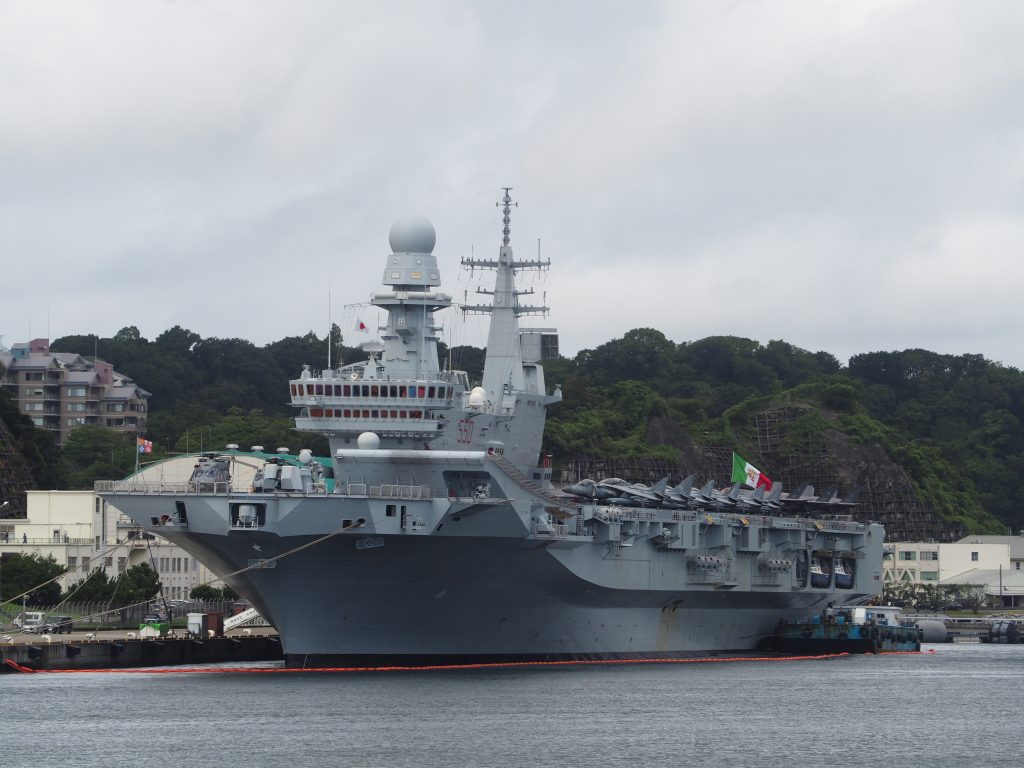
Japan has ordered 42 F-35Bs (as well as 63 F-35As which can’t be used for carrier operations). None have entered service yet. Italy has ordered 30 F-35Bs, of which evidently seven are already in operation, and 60 F-35As.
Gabriele Abbondanza, an international relations academic at the University of Madrid, the University of Sydney, and the Italian Institute of International Affairs, told me that “what sets Cavour apart from Kaga and Izumo is Cavour’s long-standing expeditionary experience and its condition of a fully-fledged aircraft carrier. Both these differences will gradually disappear in the next few years, with joint exercises further helping the operational transition of the JMSDF.”
It’s obviously worth pointing out that although Italy currently has two carriers, the older one, the Giuseppi Garibaldi, will soon be replaced by the Trieste, which although a much larger ship is primarily intended to operate as a amphibious assault vessel, with a secondary carrier capability if needed. Arguably then, Japan will operate two carriers to Italy’s one.
A big difference is that the Cavour has a “ski-jump” at the bow, to allow jets with heavier load-outs to take off. All European STOVL carriers share this feature. In comparison, the Izumo class lacking a ski jump puts them in the company of the U.S. Navy’s amphibious assault ships, which the U.S. Marines’ F-35Bs and Harriers fly off. It has been said that the reason not to have a ski jump is to preserve deck space for mass helicopter (or Osprey) operations, but it’s not clear whether this or other considerations were important for the Japanese Maritime Self-Defense Force.
In order to understand the modifications to the Izumo and Kaga, I spoke to Yoshihiro Inaba, a defense expert and commentator who has written about the conversion process for Naval News. He explained that the key modifications have been carried out in different orders for the two ships.
There are several different modifications. The most obvious is that the previously pointed bow is being squared off, or rather having corners added, to create a slightly longer and more regular takeoff surface. Additionally, the deck must be replaced with a new heat-resistant coating because of the extreme heat coming from the F-35Bs downward facing jet engines.
Beyond this, the internal hanger space is being reconfigured to better allow F-35 handling. The bridge windows of the Kaga have been enlarged for better views during flight operations. Last but not least, the ships will be fitted with the Joint Precision Approach and Landing System, JPALS, which will not only generally help Japanese planes land, but also will facilitate cross-deck operations with U.S. and indeed British and Italian F-35Bs.
As of summer 2024, the deck and bow improvements for the Kaga have been completed, and the ship is actually on its way to the U.S. for trials. The Izumo received the deck coating in 2021 but has not yet received the other upgrades. These will follow the Kaga’s trials, and then the hangars for the Kaga will be reconfigured after that.
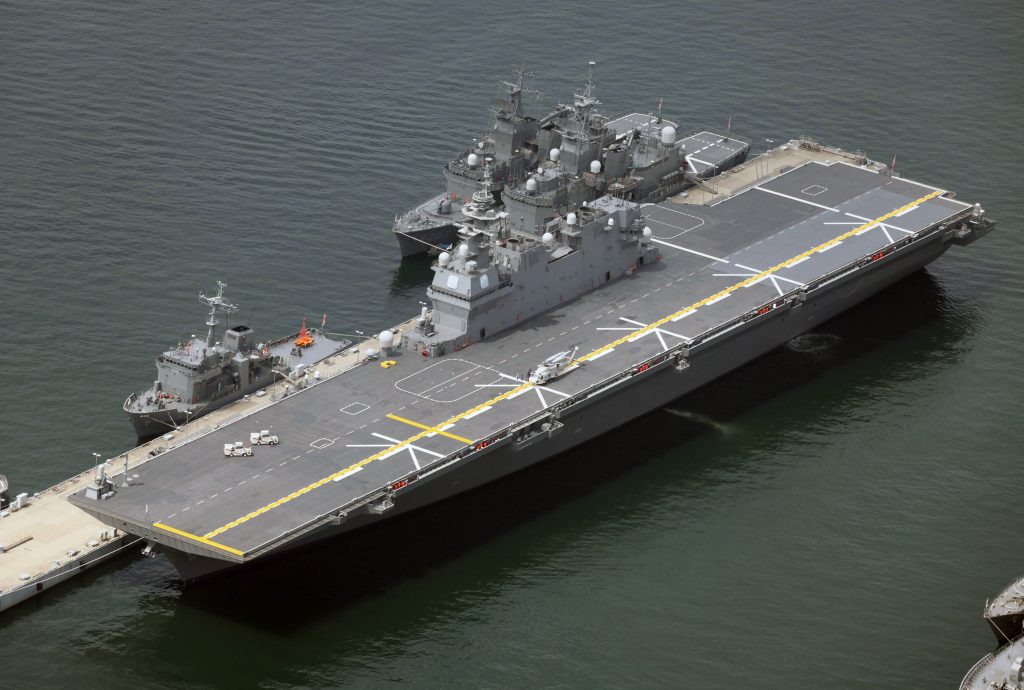
Tyler Rogoway reported in The War Zone that Japanese officials acknowledged that the Izumo class was built with the understanding that this conversion would be a possibility. However, Inaba pointed out something very interesting to me: In the end, the conversion was a “political decision,” and not something that the Japanese Maritime Self-Defense Force wanted. One of the core missions of the JMSDF is anti-submarine warfare, and having both the Hyuga and Izumo classes available as helicopter carriers gave them tremendous capacity. With the Izumo conversions, that capacity has been diminished.
The JMSDF recently announced a large-scale reorganization. Of particular interest here is that previously there were four main Escort Flotillas, each with either a Izumo-class or Hyuga-class helicopter carrier at its center. These will be reorganized in three Surface Battle Groups. But this presents some odd results.
One of those three Surface Battle Groups won’t have an aircraft carrier like the other two. Additionally, there is now a “leftover” Hyuga-class ship that the Japanese Maritime Self-Defense Force says will be placed with the minesweeping flotilla, not necessarily the obvious choice for it.
There is no sourcing or reporting for what I’m about to write. But putting together what has been reported, I don’t think we should be surprised if the Japanese Maritime Self-Defense Force orders a third “post-conversion” Izumo-class ship once it is satisfied with the condition of the Izumo and the Kaga, to occupy that slot in the third surface battle group. And quite possibly a third Hyuga-like helicopter carrier to allow one to be redistributed to each surface battle group as well, regenerating some of that lost anti-submarine deck acreage.
The Cavour has now left Japan, but presumably the lessons learned from joint operations that it left behind will be put to good use over the coming months and years as the Japanese Maritime Self-Defense Force starts to stand up its own F-35B force. And maybe, in the not too distant future, a Japanese aircraft carrier will enter the Mediterranean on a visit to Italian waters.


Leave a Reply