Given its soft spot for historical inevitabilities, the Chinese Communist Party is curiously selective about those it endorses. While it has convinced itself that Taiwan will be “reunified” with the motherland under its rule one day, it is less enthusiastic about the commonly held theory that dictatorships seed their own demise by censoring truth and criticism so severely that they lose themselves in the labyrinth of their own lies.
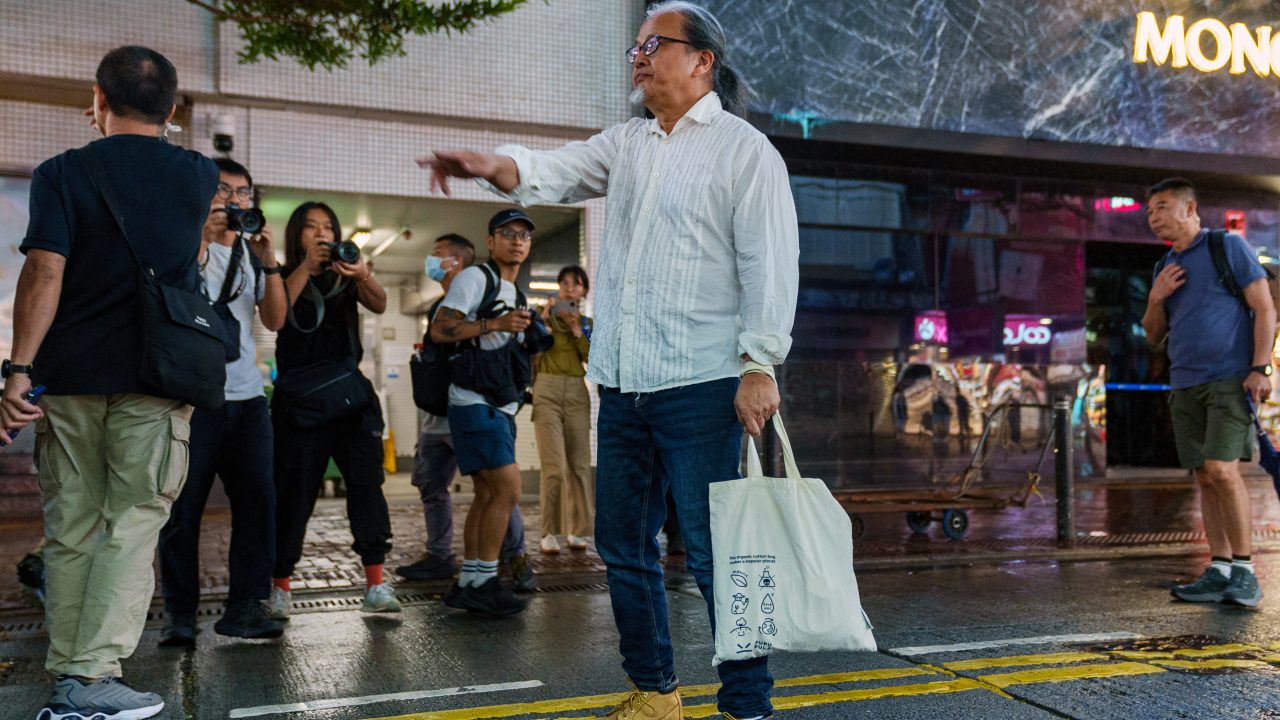
Those holding the latter view may soon have stronger evidence to back their claims from Hong Kong, where, last week alone, three members of the public were frog-marched from a soccer match to a jail cell for not standing up during the Chinese national anthem and another arrested for gesturing a historical date in the air with his hands. A fifth was trailed and harassed by police for possessing a sensitive number plate which the city itself had issued. Not for the first time.

These incidents and others mark the now annual cat-and-mouse games that surround June 4, when Hong Kong authorities attempt to assist Beijing in its coverup of the 1989 Tiananmen Massacre, and the public ensures that they fail. They also chart the paradox of power that the Hong Kong government has trapped itself inside: The more you persecute people, the more unworkable and buffoonish your society becomes until citizens reach the limit of their tolerance and rebel en masse.
So far, in order to crush dissent, Hong Kong has brandished two national security laws, enacted an ordinance to prevent insults to the national anthem, banned the song’s more popular alternative, “Glory to Hong Kong,” reactivated colonial-era sedition legislation, declared a fatwa on pro-democracy leaders overseas, rendered it impossible to elect political opponents and embarked on an alleged foray into international espionage.
However, this has simply inspired people to express themselves in ever more creative and diverse ways, auguring increasingly peculiar censorship and punishments in an arms race of absurdity. In reaction to slivers of protest in recent days, we can therefore half-expect outlandish new legislation to appear: the Anti Publishing Blank Squares in Church Newspapers Ordinance, the Prohibition on Smartphone Torches at Inopportune Moments Regulation, and the Injunction Order to Restrain the Criminal Act of Wearing Black.
But it is perhaps wiser not to joke. As attested by mainland China’s laws on picking quarrels and provoking trouble and the bizarre lengths to which its people have to resort in order just to talk about their own president online, the Hong Kong nadir is unlikely to yet have been reached.
For, while its dragooning of political opponents captures headlines, it has also recently been extending its targets to realms of expression that have little to do with red line topics like Tiananmen or universal suffrage. Mourners for dead cyclists, labor unions and critical economists have all been in the authorities’ crosshairs one way or another, and nobody knows who will be next.
In short, any words, symbols, gestures or movements related to any subject can now be deemed undesirable at any moment, so, before long, it may not just be supporters of democracy who hold up empty sheets of paper as the only way to express themselves, but victims of road accidents and the finance departments of major companies.
Under pressure to tell Hong Kong’s story well, it would be most surprising if every analyst was presenting an honest picture of the state the city is in, and authorities’ bias to Beijing renders their bellwether investigations into matters like the collapse of property giant Evergrande difficult to read.
Manifestly, a modern financial hub cannot function long term under conditions where facts and opinions based upon them are penalized, and neither can the Chinese economy. For years, Beijing has been able to get away with its false accounting, ruthless censorship and truth vacuum, in part because less varnished information in Hong Kong could oil the cogs of global investment for money to flow to the mainland with relative efficiency.
Now that even sitting down at the wrong moment is considered a jailable opinion in the city, there is simply no place where an accurate portrait of present-day China can be safely communicated to those whose capital can help it fulfill its ambitions. The system therefore has no reliable way to apportion resources or correct decision-maker errors, and it is delusional to believe that such governance can result in a happy ending.
While ridiculous in itself, the situation reaches new heights of absurdity when one considers that, sooner or later, without a change in direction, the authoritarian menace of such inflexible, unaccountable and humorless hierarchies in Beijing and Hong Kong will inevitably conjure into existence the very thing whose history they are determined to deny: another Tiananmen.



Leave a Reply