
The U.K.’s Ronnie “the Rocket” O’Sullivan, perhaps the greatest snooker player to have ever graced the game, declared himself a Hong Kong resident last week, as tennis’s quadruple grand slam winner Naomi Osaka served up a selfie for the city’s Beijing-curated M+ gallery.
A few days earlier, Patrick Keane, one of the few remaining barristers in all Australia who holds the esteemed — if colonial — title of King’s Counsel, rode out protests to steadfastly remain a non-permanent judge of the Hong Kong Court of Final Appeal.
For his part, O’Sullivan shot a promotional video with Benson Kwok (郭俊峯), the director of Hong Kong’s Immigration Department, presenting the latter as a lighthearted billiard-table whizz who welcomes newcomers to a relaxed and friendly tax haven with superb sightseeing and excellent cuisine. Ronnie is impressed. “If you want to live a life, a good life, come to Hong Kong,” he states, leaning back in an armchair, Benson chatting convivially to his side.

This and the other high-profile seals of approval will feel like an oxygen mask to Hong Kong’s suffocating leadership as it attempts to climb out from the pit it has dug for itself and clumsily tripped into. Having driven away a huge chunk of its workforce by threatening to jail them, spooked investors and convinced citizens never to give birth, it desperately needs to fill monetary, expertise and labor chasms in its economy.
Foreign figures, either famous and familiar or supposedly respectable, who can reassure the rest of the world that the city is open and desirable with a dependable legal system, just might be able to attract Middle Eastern moneymen and some 180,000 others to paper over the cracks in everything from to accounting to dentistry, where 110 of 370 positions in the public sector were vacant as of July this year. Hence a role for Ronnie, Naomi, Patrick and whoever else can tell Hong Kong’s story well.
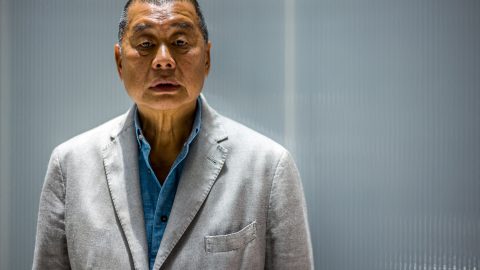
There is, however, a catch: While foreigners are hot property to give Hong Kong the thumbs up, they are expected to keep their eyes firmly on the ground and their hands tightly over their ears during their stay. Photojournalists who capture pro-democracy media mogul Jimmy Lai (黎智英) in chains, representatives for freedom of expression NGOs and human rights experts are decidedly less welcome.
And the same goes for witnesses for defendants in national security trials. On October 28, Chow Hang-tung (鄒幸彤), the often solitarily confined barrister and activist who has been instrumental in both maintaining the collective memory of China’s Tiananmen Massacre and pushing for citizen voting rights, was barred from calling overseas witnesses to give evidence in her forthcoming trial for inciting subversion of state power, even though such figures are permitted when other kinds of offenses are being tried.
Legal grounds for denying her this option were laid by Hong Kong’s homegrown “Article 23” legislation, passed amid dictatorial pomp in March this year, which prevents witnesses from giving evidence via a live broadcast for national security cases specifically. The underpinning logic is that people providing testimony from afar are vulnerable to coercive pressures.
Legitimate as this may sound, it is patently not the real reason why overseas witnesses are less attractive to Hong Kong in these cases than overseas judges, tennis aces and snooker stars. As pointed out by Chow in her challenge to the law, if intimidation was truly a justice concern, the same rule would surely apply to trials related to organized crime.
No, a convincing explanation for the block is not that authorities wish to preserve witness integrity. On the contrary, it is that they would like to safeguard the ability to tamper with witnesses themselves when targeting leaders of Hong Kong’s pro-democracy movement.
For transnational repression is still a work in progress for the Hong Kong government, and it is much more convenient to simply lock people up on home soil until they sing to the government’s tune or have them live with the outside chance of being bundled into mainland China, where torture is one of the tools of the trade. This requires them to be where authorities can easily get their hands on them, not half a world away in a more genuine rule-of-law jurisdictions.
Thus, for all the angles that O’Sullivan can see on the snooker table, Osaka on the tennis court and Keane in his courtroom, they will have to be very careful about the perspective they observe for as long as they wish to remain on pool-shooting terms with Hong Kong’s powerholders.
That is, if they ever want to speak about it afterwards.



Leave a Reply