
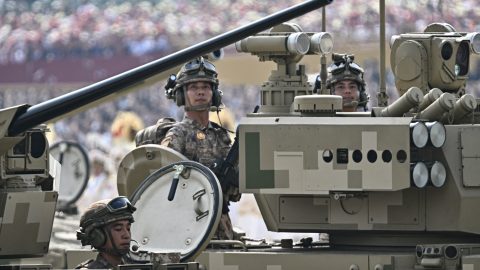
Chinese President Xi Jinping (習近平) presided over a massive military parade in Tiananmen Square on Wednesday, showcasing new weapons and equipment. What message is China sending to the world through this display?
From China’s perspective, the parade is intended to mark the 80th anniversary of the end of World War II and the Second Sino-Japanese War.
“China is using the parade to showcase the progress of its military modernization, which remains an important part of efforts to work toward reunification with Taiwan. The primary objective is to deter the U.S. and its allies in the Indo-Pacific region from potentially planning to intervene in a potential Taiwan contingency,” William Yang (楊皓暐), a senior North East Asia analyst for the International Crisis Group, told Domino Theory in an email.
China is also using this parade to showcase itself as a “great power, leading power and super power in the world,” said Satoru Nagao, a defense scholar and nonresident fellow at the Hudson Institute, told Domino Theory.
“China needs to legitimize their rapid military modernization, and Japan is a good source to pursue this purpose, so that’s why they try to overemphasize the threat of Japan, [and] the feeling from history that Japan is a bad guy and a threat,” Nagao added.
The guest list had big and contentious names like Russian President Vladimir Putin and North Korean leader Kim Jong Un. This was the first time Putin, Kim and Xi have been seen together in public.
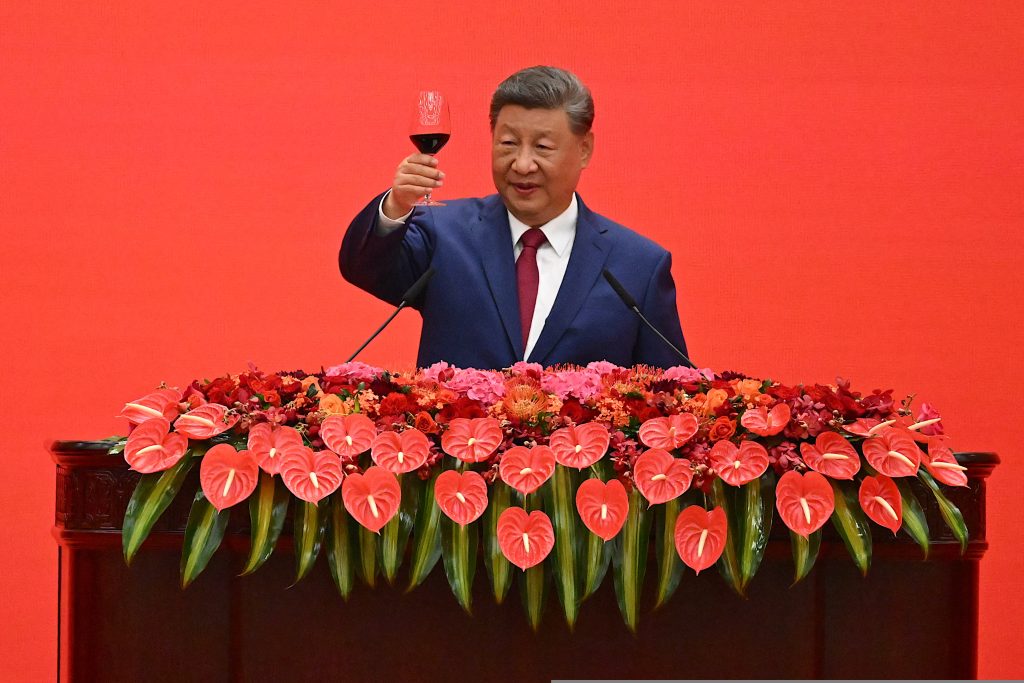
Yang pointed out that the gap between isolated autocratic countries and democratic countries is always there, but “for China to provide a platform to gather all of them in one place, and for Xi to lead the march toward the parade alongside Putin and Kim, that sends a clear message to the U.S. that China also maintains huge influence over a bloc of countries, which includes several that are known for being willing to use military forces to fulfill their ambitions.”
While China remains cautious about being too closely aligned with Russia and North Korea, Yang said, “Beijing also sees projecting an image of unity with them as momentarily useful to its attempt to seize the diplomatic opening created by the U.S. retreat from the international stage.”
Bryce Barros, an associate fellow at the GLOBSEC thinktank, told Domino Theory that another way to look at this development is that BRICS, the Global South alternative to the G7, has expanded so broadly that it might be undermining its own purpose.
As Barros noted, “maybe that group is getting a little bit too big, to the point where it actually … ironically it kind of undermines China’s messaging.” By including countries like Indonesia and Egypt that “didn’t really have anything to do with it before,” the group has lost its original focus.
Despite this, Barros still sees a powerful authoritarian alignment. “Having Kim Jong Un and Vladimir Putin on the dais with Xi Jinping is sort of a very strong signal” of what he calls the “authoritarian access, or sort of like convergence.”
U.S. President Donald Trump, responding on Truth Social to the parade, questioned whether Xi would acknowledge the sacrifices and support the U.S. gave China in its fight for freedom, stressing that many Americans died for China’s victory and should be honored. He closed by sarcastically wishing Xi and the Chinese people a good celebration and added a pointed remark about Xi’s ties with Putin and Kim Jong Un.
Xi also sought to reframe the history of World War II to amplify the role played by China’s ruling Communist Party, drawing strong objections from Japan and Taiwan. Interestingly, he did not mention Taiwan in his speech.
Nagao said the reason for not mentioning Taiwan is because China’s current strategy is to avoid escalating tensions, taking this opportunity to “rest” and extend diplomatic breathing room. The parade and Xi’s careful messaging reflect this approach of not pushing the U.S. too hard during a delicate diplomatic moment.
Barros pointed out that Xi should have mentioned Taiwan in the remarks because “it’s a good way for Xi to sort of double down on making the right people who will make sure that he gets a fourth term happy.”
Former Chinese Nationalist Party (KMT) Chairwoman Hung Hsiu-chu (洪秀柱) also attended the event. She told Taiwanese media she was participating in the parade to “carry forward the spirit of resistance,” and that “the War of Resistance Against Japan was a battle for the very survival of the Chinese nation, a war of life and death.”
Yang, the analyst for the International Crisis Group, noted that “some KMT politicians, especially those who no longer have outsized influence in the party, attend these events, they remain useful to the Chinese government in demonstrating to its domestic audience that friendly forces still exist in Taiwan and that peaceful reunification is feasible.”


Leave a Reply