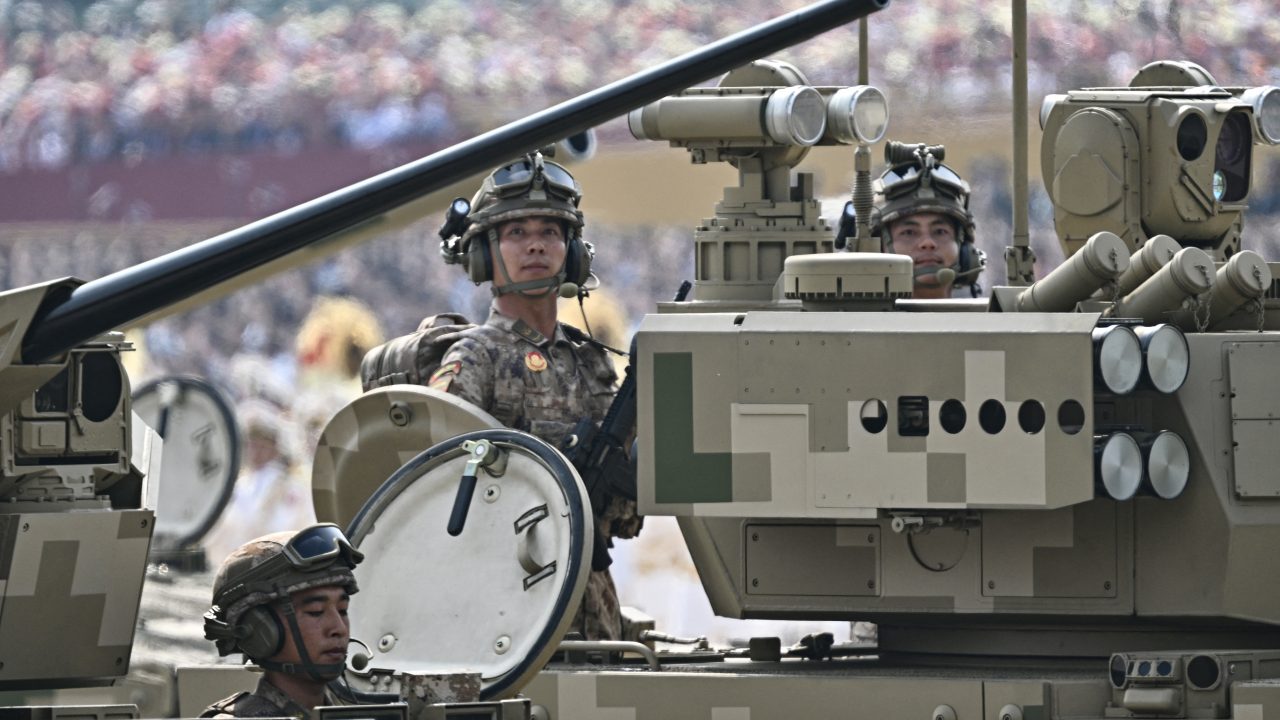
More than 130 million Chinese watched live on WeChat as the tanks and drones rolled past Xi Jinping (習近平) and assorted world leaders. Xi was clad in a Mao suit. Mao himself looked over his shoulder. Or at least his portrait on the Tiananmen gatehouse of the Forbidden City did. Some of the basic shapes and patterns on display would have been familiar to Mao, but the weapons themselves were new and updated.
The parade of military hardware on September 3 marked 80 years since the surrender of Japan at the end of World War II. Although China finds many occasions for this kind of display, the decadal anniversaries of the end of the war have taken on particular significance, and are seen as an opportunity for China to show new equipment to the world, communicating both political and military intent.
At today’s parade, there was a particular focus on a whole suite of new anti-ship and air-defense missiles, on uncrewed systems across all three domains, and on China’s nuclear deterrent. Many of those systems seem primarily intended for peer-to-peer conflict with the U.S. in the Western Pacific and beyond.
Many of the troops and weapons on display pertain to Taiwan much more directly. Some of the formations that paraded past Xi were those that would be at the very tip of the spear if China ever pulls the trigger on an invasion. Perhaps not coincidentally, three of these formations were grouped together.
China’s amphibious assault troops are its marines. Their formation contained three different variants of an amphibious wheeled armored vehicle. The variants were an infantry fighting vehicle, an armored assault gun for direct first support and a self-propelled howitzer for indirect fire support.
Following the marines was the airborne assault formation. This contained three variants of a new airmobile tracked armored vehicle. This has been seen for months but still has no name. The variants were an armored personnel carrier, an infantry fighting vehicle and a self-propelled mortar.
The rocket artillery that came after the airborne vehicles consisted of two variants of the Type 191, a multiple launch rocket system that has been compared to HIMARS. During the Strait Thunder military drills earlier in 2025, the PLA used this system to simulate attacks on Taiwanese infrastructure, firing from Fujian.
Overall, there was a relative lack of equipment on display from the Chinese army. “My impression was that the focus of the parade was on some naval stuff, especially missiles,” Alex Luck, a naval and defense analyst based in Australia, told Domino Theory. “[The army’s] technological development and modernization hasn’t quite kept pace with what the air force and the navy are doing. That’s not to say that nothing is happening.”
Luck pointed out that a lot of the decisions on what to show in a parade like this are made based on practical considerations rather than what would be best for political signalling. For example, the uncrewed ground vehicles, or UGVs, in the parade were carried on trailers driven by humans rather than simply traveling under their power with other armored vehicles. “It may look more impressive, but it comes at a significant risk of stuff going wrong,” Luck said. Disruptions caused by a malfunction are “the sort of stuff you absolutely want to avoid.”
So does that mean that some of these systems on display are not quite matured and in service?
“A system being in service can mean lots of different things,” according to Luck. He gave the example of the Hongdu GJ-11, an uncrewed combat aerial vehicle that is at least similar to the GJ-21 in today’s parade. “This system was shown in 2019 but it actually only supposedly flew first a year later, and the system itself has not been in active service with the air force in any significant numbers or even deployed to frontline units or anything like that. So the system has been in continuous, I call it, operational evaluation.” Luck later clarified that “that a demonstrator for the design that became GJ-11 flew first in 2013.”
Given that some of the vehicles described above don’t even have public names yet, some degree of caution is advised in evaluating how ready they are for widespread deployment.
“The thing that’s probably most dangerous to Taiwan, that stuck out to me, was the human-unmanned teaming,” said Bryce Barros, an associate fellow at GLOBSEC, a self-described global thinktank. He said that uncrewed combat aerial vehicles, or UCAVs, as well as different drone or autonomous weapons on the ground that were shown “clearly are integrated to be able to be used at the local, smallest level of whatever sort of unit you might be talking about.”
And the lesson from this?
“Taiwan needs to make sure it’s moving forward on evolving its own sort of drone and counter drone capabilities,” Barros told Domino Theory. “If Taiwan can get to the point where they’re able to produce these capabilities at an affordable price point,” then it can not only compete with China on the battlefield but also be an exporter of drone and counter drone capabilities.
“I think the bigger takeaway I took from this for Taiwan is that Taiwan needs to continue to evolve its own aspects of drone warfare at the doctrinal level,” Barros said, “and then also make sure that they produce more of these weapons.”



Leave a Reply