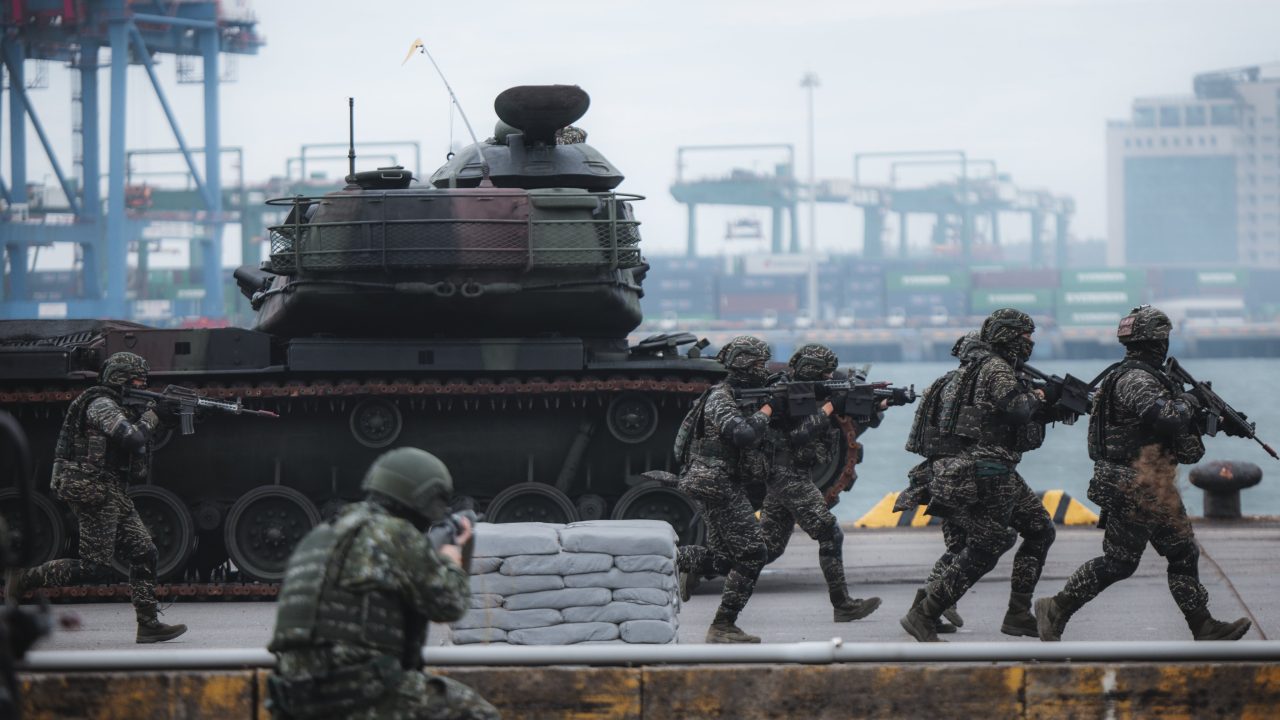
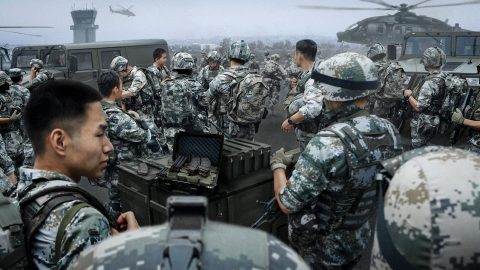
Taiwan’s armed forces currently stand at 80 percent strength, according to a recent report by the Ministry of National Defense. This is despite the government’s attempts, going back at least 15 years, to transition to an all-volunteer force of professional, reliable fighting men and women. The decline is not an outlier, but part of a trend, with troop levels in 2020 reported at 89 percent, dropping to 88 percent in 2021 and hitting the current level of 80 percent in 2022, where it remains. While this personnel shortage may appear bleak, the report, submitted to the Legislative Yuan for a budget review, may paint an incomplete picture of just how urgent the staffing and readiness situation is.
The figure of 80 percent represents an average taken from across all components, which means that administrative and bureaucratic positions are staffed at higher levels while combat units are lower, according to Kitsch Liao (廖彥棻), assistant director of the Global China Hub at the Atlantic Council in Washington. Liao estimates those levels at around 60-70 percent.
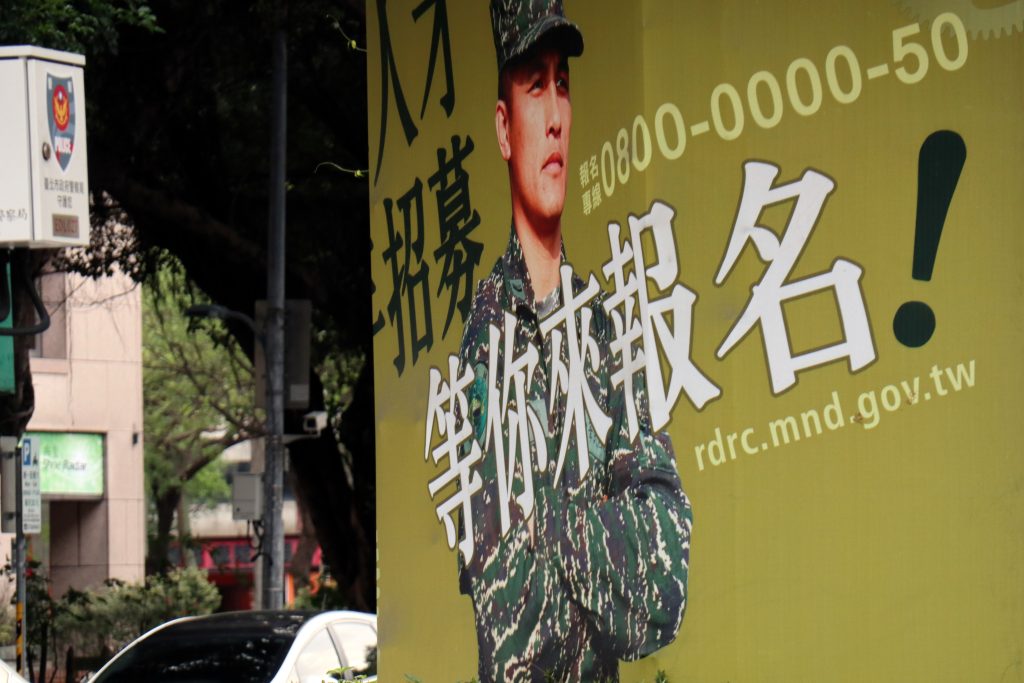
“The most significant implication is that the amount of paperwork and busywork has not decreased just because the staffing level is lower,” Liao explains. “Everything needs to look okay on paper, so the aspects that suffer the most would be the familiarization and qualification of actual combat skills, since those can relatively easily be faked on paper, and there’s very little external supervision due to the abhorrent lack of transparency of the ROC armed forces.”
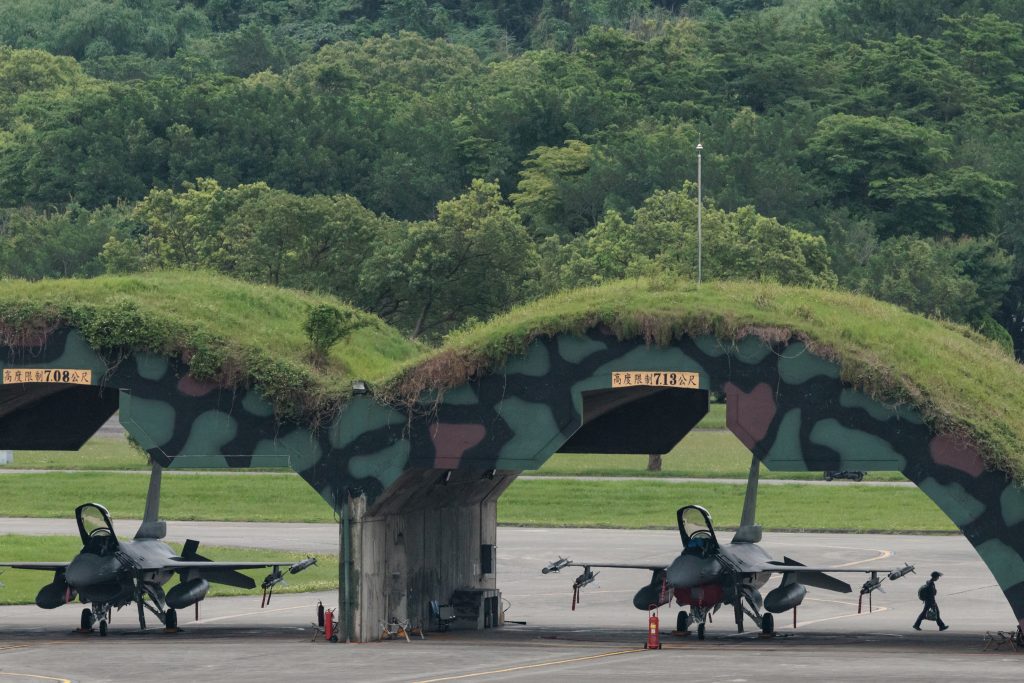
The situation is worse when one considers the more technically oriented services like the Air Force and the Navy — the very branches of the service that have to deal most directly with the constant harassment Taiwan is experiencing from the People’s Liberation Army (PLA). Army combat units can afford to close down a base and go on exercises due to manpower limitations, but the air force and navy do not have this luxury. “What this translates into in the air force would be something like having the crew sleeping in the hangar and experiencing constant burnouts due to the required sorties and manpower shortage,” Liao says.
The failure of the all-volunteer force transition and the current manpower shortage reflect not only the difficulties that the Taiwanese military has long been having with recruitment, but cold, hard demographic realities. According to T.H. Schee (徐子涵), who lectures on resilience in Taiwan and describes himself as a civilian defense reformer, the difficulty with military recruitment in recent years is down to several factors, with demographics top among them.
“The overall population is in fast decline. Taiwan’s birth rate is among the world’s lowest,” Schee points out. Indeed, the defense ministry’s report cites statistics from Taiwan’s Ministry of the Interior showing that the pool of military-age men dropped from 102,740 in 2022 to 97,828 last year. Demographics, as the saying goes, is destiny, and so this decline should not have come as a shock to government planners, who could have prepared for the current troubles by making the military a more attractive career option to Taiwanese youth. Instead, according to Schee, there is an increasing suicide rate in the armed forces this year, “and parents are less willing to encourage their kids to join the armed forces.”
Recruitment suffers from baked-in cultural issues as well. According to political scientist Wen-Ti Sung (宋文笛), much of the Taiwanese military’s recruitment woes are tied to the army’s historical legacy going back to the authoritarian era, when Taiwan was ruled by a one-party state under the Chinese Nationalist Party (KMT), and the military was seen as the KMT army. “Taiwanese society does not have the utmost reverence for the military as an institution,” he points out. “It was seen more as an arm of the authoritarian party-state, than a protector of the people.”

Sung, who works at Australia National University, offers a case in point: “Unlike the U.S., you will not hear the average Taiwanese civilian tell soldiers in uniform ‘thank you for your service’ when they encounter them on the streets.”
Whatever the cause of the military’s staffing problems, the more important question is how to solve them, or at least how to ensure that Taiwan’s readiness to confront and survive a kinetic action by the PLA is not reliant solely on its understaffed military, but with a whole-of-society approach. Schee believes the average civilians of Ukraine could serve as an inspiration to those in Taiwan, with their willingness to stand up to their Russian invaders, though he admits that much work needs to be done. “Civilian defense will need a huge revamp to make the society resilient to natural disasters and armed conflicts,” Schee says.
Another, albeit related, option would be for the creation of a Territorial Defense Force (TDF), as envisioned by former chief of the general staff, retired admiral Lee Hsi-min (李喜明). Lee’s concept of a TDF built around special forces units, trained in asymmetrical warfare, “may provide a potential civil-military dual-use labor force that can make up for the shortfall on the cheap,” concedes Sung, though he admits that this would be a “best-case scenario.”
Liao is less optimistic. “As it is currently envisioned, a TDF would not fall within the chain of command of any individual service,” he explains. “Thus if anything, it would have a negative impact on the armed forces’ manpower issue.”
It can be seen from the staffing shortages that the problems with Taiwan’s military cannot be fixed by purchasing shiny new weapons from America, but rather by remaking the military into an institution in which today’s young Taiwanese people would be proud to serve. Finding a way to accomplish this is not a simple task, but the constant threat from China means that these issues can no longer be ignored.




Leave a Reply