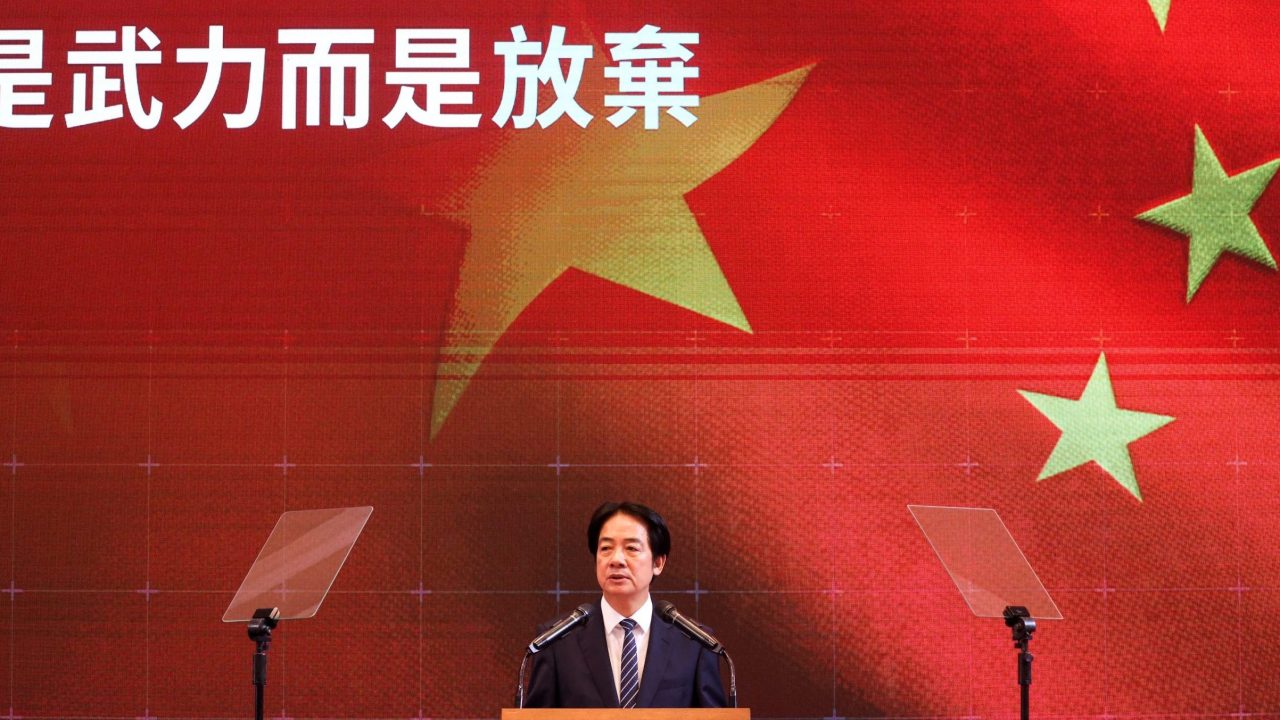
Taiwanese President Lai Ching-te (賴清德) penned an op-ed in The Washington Post yesterday in which he praised President Donald Trump’s “peace through strength” agenda and laid out Taiwan’s own plans to raise defense spending. While the commitments to spend 3.3 percent of GDP next year and five percent by 2030 were not new, one eye-catching figure hadn’t been seen before: “a historic $40 billion supplementary defense budget.”
Today Lai elaborated on the plan in a speech at the Presidential Office Building in Taipei. The supplementary defense budget will be known as the Special Act on Procurement for Enhancing Defense, Resilience, and Asymmetric Capabilities (強化防衛韌性及不對稱戰力計畫採購特別條例). Lai told listening media that “over the next eight years, we will allocate 1.25 trillion New Taiwan dollars to develop an advanced defense system,” with three hallmarks: the T-Dome air defense system, integrating AI into Taiwan’s defense, and defense industry self-reliance. It is the “over the next eight years” that is the key phrase.
1.25 trillion New Taiwan dollars, or $40 billion, in special budget spending is a new number. But that doesn’t mean that the spending plan is itself new, or that the $40 billion is additional spending on top of what is announced.
In August, Lai’s administration revealed the proposed 2026 defense budget. This contained a proposed spending hike from 2.38 percent of GDP to 3.32 percent, in accordance with NATO expenditure guidelines. As covered by Domino Theory at the time, it appears that Lai’s five percent by 2030 commitment means a hard 3.5 percent of traditional defense spending and a soft 1.5 percent of civil and infrastructure spending.
When Premier Cho Jung-tai (卓榮泰) explained how Taiwan is changing its defense spending calculation, he broke down the components of the budget, showing that 186.8 billion New Taiwan dollars ($6 billion) is allotted for special budget spending in 2026. Of that, $3.8 billion is assigned for future special budgets; the remainder is paying down the purchases of the new F-16 fighter jets, and other less specified systems.
Domino Theory believes that the $6 billion special budget already proposed for 2026 represents the first tranche of the $40 billion — the remaining $34 billion will be spread across the following seven years. Taiwan’s defense ministry has been asked to confirm this and the article will be updated when it provides a response.
Announcing the figure of $40 billion now looks like it has been done largely because this is a huge number.
The $40 billion is not, in a meaningful sense, a new commitment. If Taiwan wants to hit 5 percent of GDP defense spending in 2030, and continue that through to 2033, it needs to spend far more than $40 billion.
Taiwan is simply announcing that some spending that has to happen will be accounted for as a special budget, meaning some, but not necessarily all, of it will be used to purchase U.S. weapons. Furthermore, if Taiwan were to stick to this spending plan across the eight years from 2026 to 2033, on average its annual special budget spending as a stand-alone item would fall, not rise. That’s a little ill-fitting with Lai’s claim to increase overall defense spending.
To be clear, if Taiwan decreases its special budget but increases other parts of defense spending, that would likely be a good thing. Chieh Chung (揭仲), a fellow at the Institute for National Defense and Security Research think tank in Taipei, told Liberty Times in August that Taiwan risked “structural imbalances” in its military budget, due to the amount allotted for procurement dramatically exceeding that assigned to maintenance and personnel. Essentially Taiwan could be buying too much new equipment and not spending enough on maintenance and people to operate it.
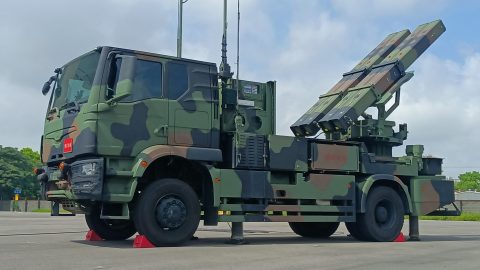
Taiwan’s defense ministry put out a general statement in a social media group for journalists after Lai’s speech, providing some extra details. The special budget will run from 2026 to 2033. The $40 billion figure is described as a “provisional ceiling” (預算上限暫匡). The items to be procured are “precision artillery; long-range precision strike missiles; air defense, anti-ballistic, and anti-armor missiles; unmanned vehicles and their counter systems; equipment to bolster sustained operational capacity; AI-assisted systems and C5ISR (Command, Control, Communications, Computer, Cyber, Intelligence, Surveillance, and Reconnaissance) platforms; and equipment and systems co-developed and procured through Taiwan-U.S. collaboration.”
Raymond Greene, the director of the American Institute in Taiwan, or AIT, the U.S.’s de facto embassy, put out an immediate statement saying that AIT welcomes Lai’s announcement of the “new” special budget, and the U.S. supports Taiwan’s “rapid acquisition of critical asymmetric capabilities needed to strengthen deterrence.”
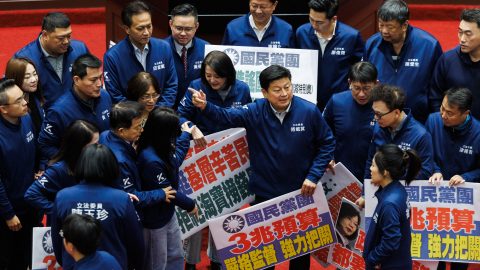
“Just as support for Taiwan is a longstanding U.S. bipartisan priority, I expect Taiwan’s political parties will find similar common ground,” he added, seemingly a pointed reference to the Chinese Nationalist Party’s (KMT) new chair Cheng Li-wun (鄭麗文), who has already said that she opposes Lai’s five percent defense spending plan. The KMT controls a majority in Taiwan’s parliament, which will have to approve the 2026 budget in January.
For her part, Cheng said this afternoon that Lai is “not only turning the Taiwan Strait into a powder keg but also Taiwan into an arsenal.” Frankly speaking, in “turn Taiwan into an arsenal” she could hardly have chosen a phrase more suited to marketing Lai’s defense policy to the U.S.
Update: A public relations spokesperson for Taiwan’s defense ministry told Domino Theory that he doesn’t have the answer to the question of whether the $6 billion special budget already proposed for 2026 represents the first tranche of the $40 billion, and that they need to wait for the Executive Yuan’s budget plan. When it was put to him that the budget plan had already been released in August, he replied that his superiors had no immediate answer to the inquiry.


Leave a Reply