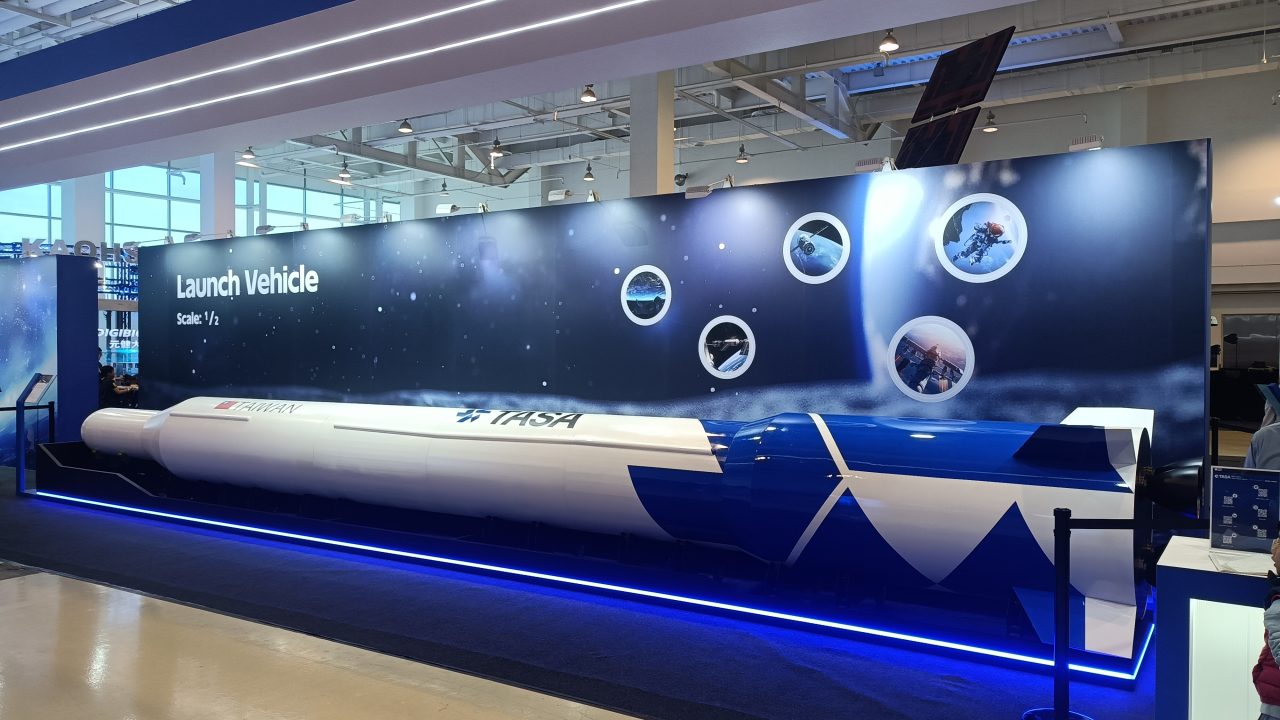
Taiwan’s National Science and Technology Council announced the location of the national launch site on March 26.
The launch site will be Taiwan’s first orbital rocket launch center and will be located to the south of Jiupeng Desert, a beach in Manzhou Township, Pingtung County on the southeast coast of Taiwan.
Taiwan currently has no orbital launch capability, and Taiwanese satellites launch on SpaceX rockets from Florida. TASA, the Taiwan Space Agency, has plans for its own indigenously developed rocket and says flight tests are planned for 2028.
Taiwanese President Lai Ching-te (賴清德) has said that Taiwan should become an “Asian Hub” for the satellite industry, but launching them is another matter. It’s not clear if the national launch site will be finished by 2028, but rocket science is hard and it would not be surprising if both dates slipped.
TASA Deputy Director-General Yu Shiann-Jeng (余憲政) told Domino Theory that the entire project is estimated to cost $300 million, or ten billion New Taiwan dollars, but he emphasized that this is a preliminary number. Tsai Miao-tzu (蔡妙慈), the director-general for Department of Foresight and Innovation Policies for the National Science and Technology Council, confirmed this number but again said that it is an early estimate that is likely to rise.
“The launch site will not only be for launching rockets, the entire site will become a major hub for Taiwan’s space industry. In the future, it will create a large number of job opportunities and integrate with local history and culture, promoting tourism, local revitalization and science education,” said Hsu Fu-kuei (徐富癸), the Democratic Progressive Party (DPP) legislator for Pingtung’s second electoral district, where the launch site will be located.
The location of the national launch site is driven largely by Taiwan’s geography. An orbital launch complex needs a particular combination of geographical factors.
First, it needs to have an uninhabited “down range” area, for safety reasons. In the event of a launch failure, the rocket should be destroyed rather than crashing in an uncontrolled manner. But an area where debris can fall safely is still required. Unless a country has large uninhabited deserts, tundras or forests, this typically means launching out to sea.
Second, it is much better to launch with the rotation of the Earth rather than against it. This means that the rocket adds the Earth’s rotational angular momentum rather than subtracts it. So launching eastwards rather than westwards is extremely preferred.
Third, generally speaking it’s better to have the launch site be as close to the equator as possible. There is a slight momentum bonus to this, too, but more importantly many satellites are intended for equatorial orbits, and the lower the altitude of the launch site, the less fuel is needed to reach that kind of orbit.
These three factors combined mean that most countries in the Northern Hemisphere locate their launch sites on their southeast coasts. (There are of course notable exceptions.)
Taiwan is therefore in theory well situated because it lies on the southeast edge of the Asian continent with the Pacific Ocean stretching away to the east. However, there is another issue: space.
Because Taiwan is so mountainous, most flat ground tends to be relatively developed already. A launch site complex has a certain size, because in addition to the actual launch pad support, facilities are also required. But what is equally important is that the area around the launch site is uninhabited. This is because rockets can and occasionally do explode on the launch pad before they take off.
Countries like Japan and South Korea which have similar constraints to Taiwan have put their launch sites on pretty hilly coastlines far from population centers. This is similar to what Taiwan has chosen to do, but there is one more constraint which is particular to Taiwan.
On the southeast coast of Taiwan, the mountains rise straight out of the sea. It’s dramatic and beautiful, but it means that the coastal highway which runs along the shore is really the only link between communities in southeast Taiwan and the rest of the island.
If the launch site was situated anywhere near this road, it would have to be closed during launches, and that would be unacceptable.
This means that when you consider the entire island, which is really not that small in the grand scheme of things, and you apply all these criteria, you are left with a short 30-kilometer sliver of coastline right at the southern tip of Taiwan. Half of that coastline is inside Kenting National Park.
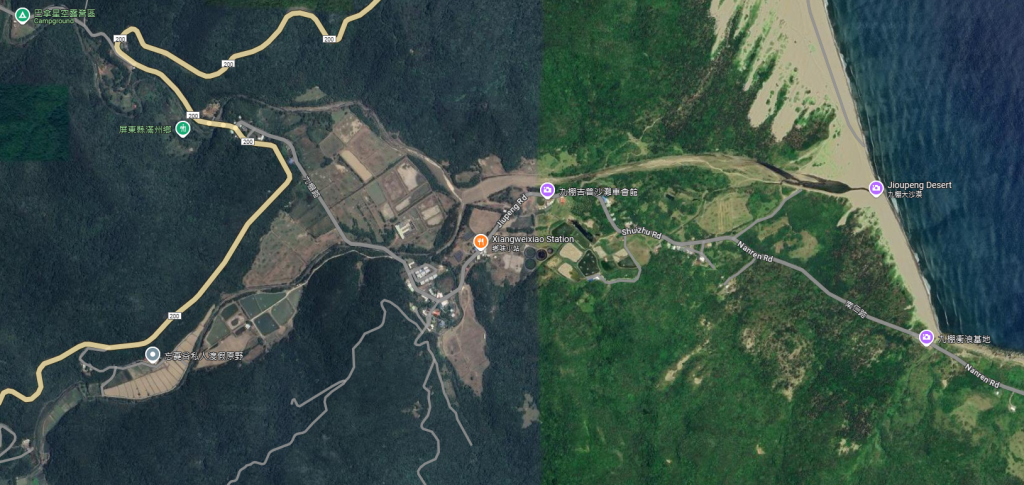
The site that Taiwan announced today fits all the above criteria, and is right in the middle of the 30-kilometer stretch.
The marked site on the map distributed by the National Science and Technology Council locates the site just outside the national park, right on its border. This seems likely to be a deliberate choice intended to avoid environmental concerns and challenges.
Immediately to the north of the site is a beach that is itself a tourist attraction. That presumably will have to be closed during launch operations.
Another concern or complicating factor may be access to the site. It can be reached by County Road No. 200 from the south, but this is a relatively small and winding access route.
Loren Chang (張起維), a professor at National Central University’s Department of Space Science and Engineering, who led the development on Taiwan’s first lunar payload, said the area is already the site of a missile test range and a rocket test site for scientific research.
“[T]here is really not a lot of space for launch facilities on the scale you would need for an orbital launch vehicle,” Chang said, noting that the area is only accessible by narrow winding mountain roads, making it difficult to ship an assembled orbital class launch vehicle in one piece by road. Such a launch vehicle would either have to be shipped disassembled and reassembled on site or by sea, though the existing fishing harbor is very small.
Chang also noted that since the area is on indigenous land, approval by the local tribes would be needed for its use as a launch site or for construction at this scale. “Challenges I can see are very limited real estate to work with for launch and supporting facilities, as well as limited transportation options for large launch vehicles or supporting equipment.”
“I think moving forward there would be more discussion with the local communities,” said Andie Wang (王安棣) president of Taiwan Space Generation, an NGO focused on young people’s participation in space science and space industry. “Understandably it will take time and discussion, but it would be great to see this bringing benefits to the local [community], and new energy to the Taiwanese space economy.”
Whatever the challenges and complications that will arise during the construction of the national launch site, its completion, and, eventually, the first Taiwanese rocket to reach orbit will be an important and exciting step.
This article was updated on March 26 at 9:42 p.m. UTC to include comments from Loren Chang and Andie Wang.






Leave a Reply