Twenty-one years since the Iraq War began, there is a strong case that its lack of legitimacy helped nudge the world toward multipolarity.
During the early stages of the war, China opened strategic discussions with Middle East energy exporters and chaired multilateral nuclear talks with North Korea. Then, in 2006, it was a founding member of BRICS grouping, which formed partly in response to the war. Throughout this time, the fact that the U.S. and U.K. invaded without a second U.N. Security Council mandate has been a pillar of China’s rhetorical defenses against criticism of its human rights policies.
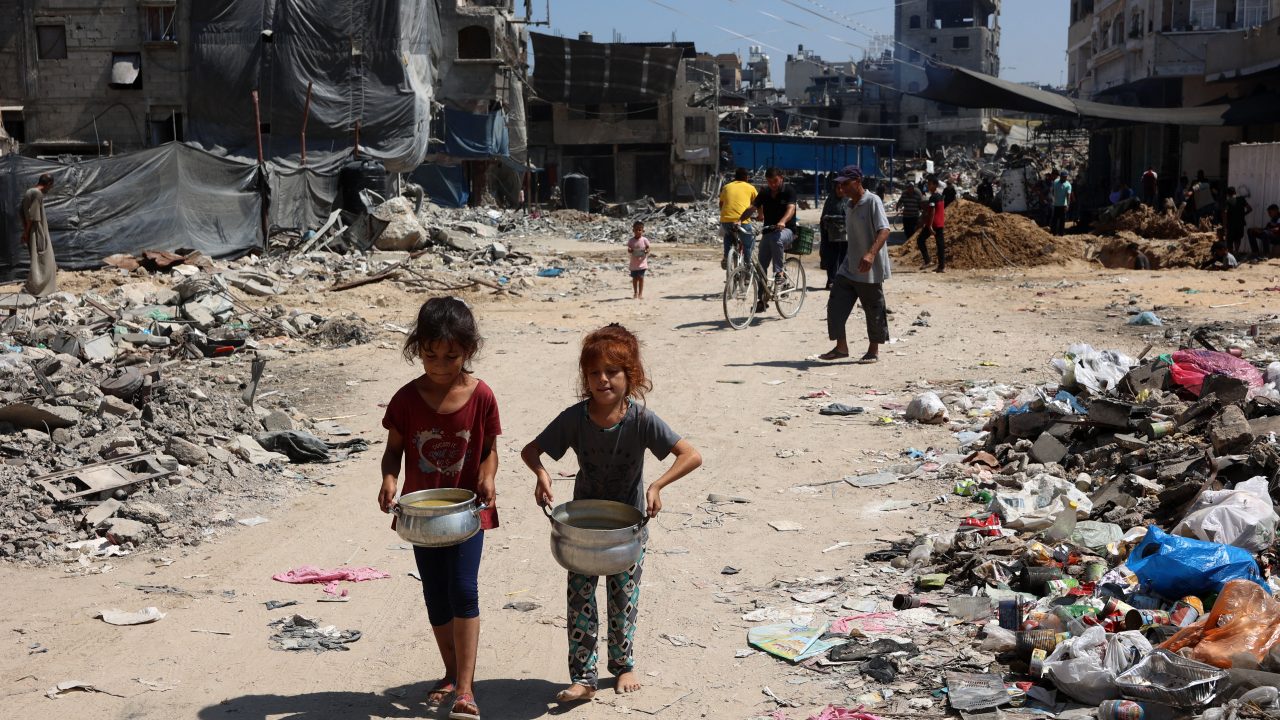
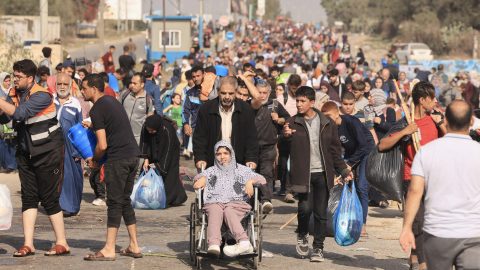
This is relevant now because various parallels are appearing in another Middle East war. Israel’s war in Gaza has killed tens of thousands of people. Its occupation has been classified as unlawful by the International Court of Justice. And an increasing number of experts believe that the U.S.’s support is damaging to both its popularity and credibility — and that China’s international operating space will grow as a result.
Popularity
The most straightforward part of this equation comes down to popularity. Between 2023 and 2024, respondents with a favorable opinion of the U.S. dropped off “dramatically” in five Middle Eastern countries polled by the Arab Barometer research network. At the same time, views of China went in the opposite direction.
“As reported, our data show that support for China is increasing in many Arab countries. We do not explore in detail the drivers of increased favorable attitudes toward China. But we know that China is investing economically in many of these countries, and I think many people like the fact that China is not trying to interfere in the affairs of their country or of the Middle East and North Africa region,” Mark Tessler, one of the co-authors of that research told Domino Theory by email.
The last point is critical to understanding what’s going on. China appears to primarily be benefitting from the U.S.’s lack of popularity rather than its own policies being especially popular.
“China’s primary engagement with the Arab region has been economic. Mainly, it wants to [be] better able to do business across political divides,” said Michael Robbins, a co-author of the same research. “For example, it has strong relations with both Iran and its strategic adversaries like Saudi Arabia and the [United Arab Emirates]. It’s also tried to balance its sympathies with the Palestinian movement with its economic ties to Israel.”
This approach has largely meant staying out of more direct politics, which Robbins said is reflected in polling data which showed few in the Arab region believe it is standing up for Palestinian or Israeli interests.
“More recently, it has been a bit more engaged in the political arena working to broker a detente between Iran and Saudi Arabia and also seeking to bring together Hamas and the PLO [Palestine Liberation Organization]. However, its economic interests remain paramount and its decision to wade into the complex politics of the region are mostly designed to further its economic interests,” Robbins added.
Credibility
Compounding this apparent strategic advantage is the perception of human rights double standards from the U.S. The Iraq War gave smaller states the impression that the U.S. would ignore rules it enforced on others when it suited it to do so and there are many who now read this into its response to the war in Gaza.
In February, National Security Memorandum 20 reiterated that the U.S. wouldn’t sell weapons to countries that harm civilians or do anything to prevent humanitarian aid entering a warzone. However, despite rights organizations providing large numbers of verified examples of these violations taking place in Gaza, the U.S. has continued to sell weapons to Israel, while both presidential candidates continued to state their support for that policy in this week’s debate. The explanation from the U.S. State and Defense departments’ joint report in May was that the violations weren’t systematic and that Israel was investigating them.
“[I]nternational law is being violated by Israel Defense Forces, but U.S. law is being violated by Israeli forces and ignored by the Biden administration … And what this means is, of course, tens of thousands Gazans are being killed. But it also means that any administration coming in after Biden can do the same thing for any conflict that it thinks is important enough. So really, as Americans, we should expect that U.S. laws will be followed and they are not being followed,” Sarah Yager, Washington director at Human Rights Watch told Domino Theory on a video call.
The geopolitical results of this will be seen over months and years, but there are already indications of a direction of travel.
In June, a survey of Middle East scholars saw 86 percent say U.S. President Joe Biden’s response to the war negatively affected the U.S.’s standing in the world. In March, Assistant Secretary of State Bill Russo told Israeli foreign ministry officials that the U.S. and Israel face a “major credibility problem.” And practical effects are emerging on the ground, too.
“We have a lot of civil society partners around the world who … now refuse to have anything to do with the United States. They are giving up funding, leaving it on the table, because they’re so ethically opposed to ever working with the United States again,” Yager said.
It may seem odd to suggest that this could be to China’s strategic benefit given that, as Yager points out, “China says it doesn’t care about human rights.” But a central tenet of Biden’s presidency has been an attempt to frame the world as democracies, which respect rule of law and human rights, versus authoritarian states, which don’t. If they are at all sincere, attempts to build coalitions around the former are surely hit by TV images of U.S.-made bombs killing Palestinian civilians and aid workers.
“If for example, a President Harris was there and said, ‘I want to do human rights stuff,’ I don’t think that she’s going to get a lot of traction. You know, there’s not going to be a lot of legitimacy there … And that’s exactly as it should be. If you’re going to talk about human rights and say that it’s at the center of your foreign policy, you actually have to live that. And the United States has not been living that,” Yager said.
A ‘Massive Own Goal‘
In other words, there is potential for the U.S.’s position to act a “massive own goal,” as Jane Kinninmont, policy and impact director at the European Leadership Network put it during a Chatham House webinar earlier this year.
But with all of these strategic downsides increasingly widely acknowledged, how can the U.S.’s position differ so much from the U.N. Secretary General’s, who this week once again called for “dramatic violations of international humanitarian law” to stop?
One answer is that Israel is simply held to be such an important strategic ally that a huge amount of sacrifice is considered worth it in maintaining the relationship. Another answer may be in looking back at Iraq again. In an essay marking the 20-year anniversary of the Iraq war last year, author Robert Kaplan suggested the war would have “crippled” less powerful states, but the U.S. was still able to “lumber forward.” This “wide margin for error,” Kaplan said, “breeds a certain amount of decadence in Washington.” Perhaps its presence is being felt again.


Leave a Reply