Drones rose out of trucks parked thousands of miles from Ukraine and flew through the air towards nearby Russian air bases. Minutes later, Russian aircraft were burning on the tarmac.
These planes were not the only casualty of that morning. Fundamental assumptions about how long-range strikes in modern warfare can be conducted were also lying in tatters.
The Ukrainian attacks on June 2 were meticulously planned over a year and a half. Four Russian air bases spread across 2,400 miles were targeted and multiple bombers and early warning aircraft were destroyed.
It was a huge operational success for Ukraine, one that will force Russia to adjust and rethink how it conducts security for all strategically important sites, no matter how far they are from the frontlines.
But it isn’t only Russia that needs to learn from this. Taiwan must absorb the similar lessons, both offensively and defensively.
The first move of a Chinese invasion of Taiwan has long been assumed to be a huge missile barrage fired across the strait by the People’s Liberation Army Rocket Force, targeting the Taiwanese military as well as key infrastructure.
Taiwan actually has an extremely dense long-range air defense system, although there are questions about how deep its magazines are. For decades Taiwan has prepared to face the airborne threat that missiles launched from China present.
Taiwan’s short-range air defense system is far less developed and was not designed with drones launched from within Taiwan itself with no warning in mind.
The new threat that is enabled by UAVs that are small enough to be concealed in large numbers in shipping containers, and even in smaller vehicles, presents a clear danger to Taiwan and its defense.
China has signalled that it has been thinking about weaponizing shipping containers for almost a decade. In 2016, a system that allowed rockets and cruise missiles to be concealed in a container was displayed at the Zhuhai Airshow.
American naval analyst Tom Shugart painted the following scenario to The Economist: “Imagine, on game-day, containers at railyards, on Chinese-owned container ships in port or offshore, on trucks parked at random properties … spewing forth thousands of drones that sally forth and at least mission-kill the crown jewels of the [U.S. Air Force].”
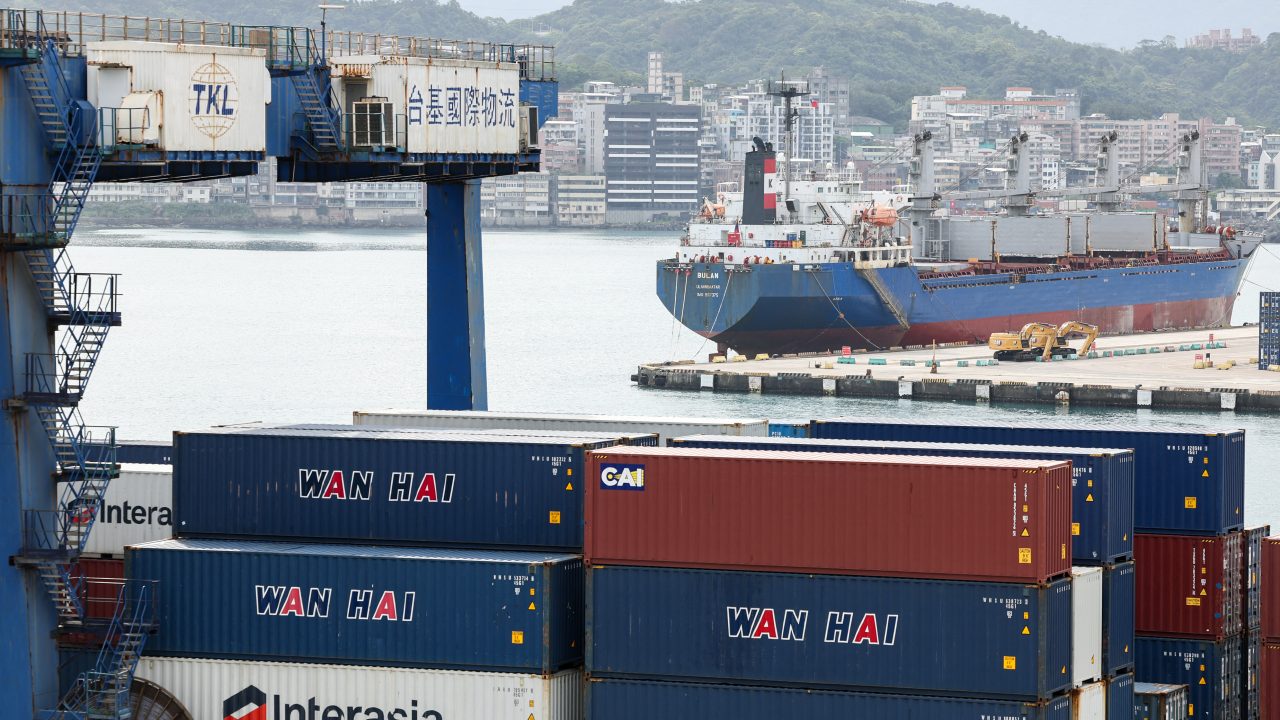
Taiwan has four important container ports, and much of their traffic comes directly from China. Two of them, Kaohsiung and Keelung, are co-located with key Taiwanese naval bases. One, Port of Taipei, is next to one of Taiwan’s most vulnerable invasion beaches at Linkou in New Taipei. Kaohsiung port has one of Taiwan’s only oil terminals. All four are strategically valuable in their own right.
Drones or missiles smuggled into these ports in containers could be devastating to military and civilian infrastructure.
But the threat extends much further than this. The Ukrainian attack on Russian bases shows that almost any space where drones could be concealed could be used as a staging ground for an attack.
Unfortunately for Taiwan, its unique geography means that defending against this threat will be challenging. The west coast is one of the most densely populated areas in the world. Housing, industry, agriculture, infrastructure and military bases often directly abut onto each other.
A factory building in the hands of a fifth columnist could host thousands of drones within a stone’s throw of their targets.
The same is true on a smaller scale for trucks left in parking lots, and even high-rise apartments overlooking key sites.
“A coordinated attack against Taiwanese radars, telecommunication systems and/or power grid,” would be one possibility, according to Jakub Janovsky, an open source intelligence analyst currently focused on the Russian invasion of Ukraine. He told Domino Theory via email that although the military has redundant communications, “if the civilian population loses their communication systems and/or electricity, the resulting disruptions would hurt military coordination of the island defenses — and limit/prevent civilian population from helping the military.”
Developing a new generation of short-range air defenses that are effective against small drones would be one part of the solution. Another would be developing procedures to frequently “sweep” areas near to sensitive sites to make sure that buildings and parked vehicles do not contain threats. Clearly, that is easier said than done.
However, there is another side to this coin. While China would have to preposition and conceal drones on Taiwanese territory, Taiwan would be able to hold some Chinese assets at threat with far less effort. Kinmen Island, controlled by Taiwan, is situated within Xiamen’s harbor, and short-range drones could be positioned there as a deterrent, much as the Matsu islands close to Fuzhou further north already host Taiwanese anti-ship missiles.




Leave a Reply