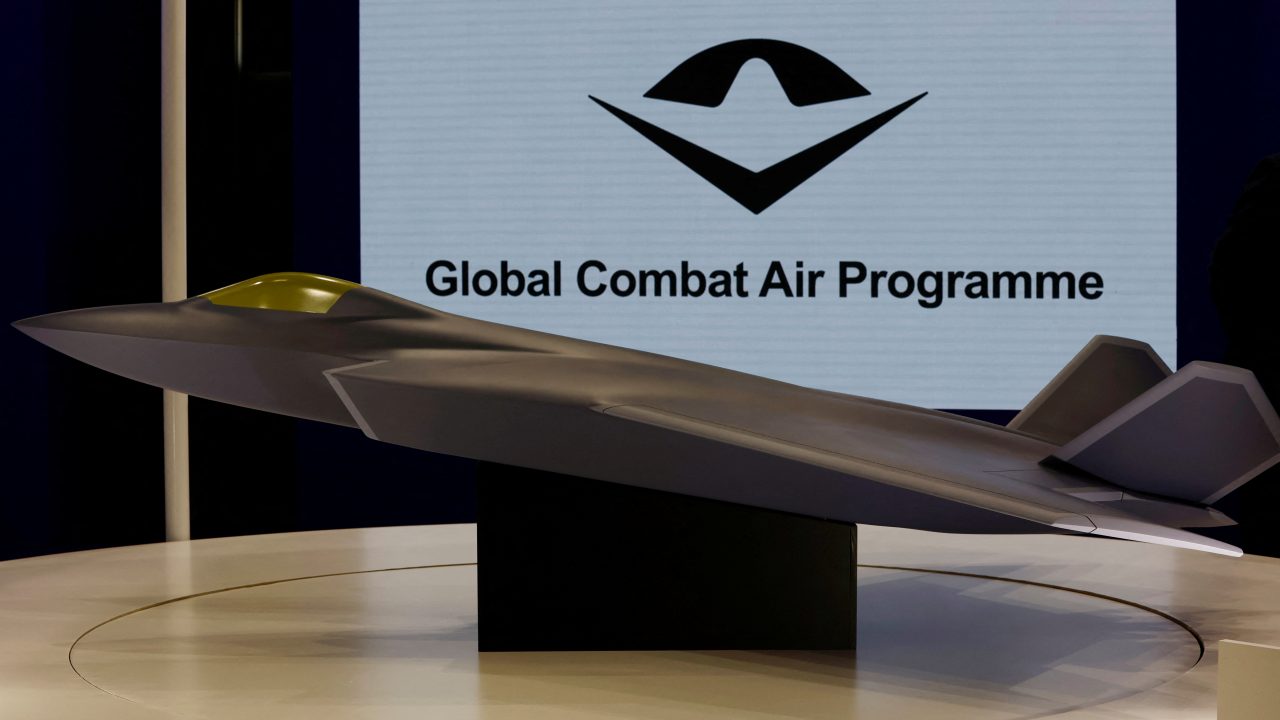
GCAP, the Global Air Combat Programme, is a multilateral effort between Japan, Italy and the United Kingdom to develop a new sixth-generation fighter jet for the three countries’ air forces. For Italy and the U.K., the new jet would replace their Eurofighters. For Japan, it would replace the F-2, a domestically developed version of the American F-16. No sixth-generation fighters have yet finished development. A companion piece discusses what will likely define an aircraft as “sixth generation.”
Because of GCAP’s multinational history, there are many terms, acronyms and other programs associated with it that can be confusing to even the well-informed reader. This article will walk through some of the most important ones and explain what they are, what they are not, and what their relation to GCAP is.

Created with draw.io
Starting small, GIGO, the GCAP International Government Organisation, is a program headquarters that will be established in London and headed by a Japanese official.
Then, it is important to delineate what GCAP is not. It is very common to refer to sixth-generation fighters as being a “system of systems,” but GCAP itself is very specifically a program to only develop one aircraft — a large, almost certainly crewed aircraft.
While it is not confirmed, it is very likely that in Japanese service this aircraft will be called the F-3 (the third Japanese-developed jet fighter). In British service it is likely to be called Tempest because the initial solo British effort to start development of a sixth-generation fighter was called Tempest and the name has been carried through. For Italy, it seems plausible that they would follow the British example on this but it can only be said with less confidence.
The previous Japanese program to develop a sixth-generation fighter was called F-X. This effectively merged with Tempest to create GCAP. F-X was preceded by an actual flight demonstrator, the Mitsubishi X-2, which first flew in 2016.
GCAP is not itself a system of systems. The separate national efforts to develop the uncrewed combat aerial vehicles (UCAVs) or loyal wingmen aircraft that would fly with GCAP are one of the ways that complexity has slipped into this topic.
Firstly, it appears that Italy currently has no official development program for its own loyal wingman. However, Leonardo, the Italian aerospace company, does have some conceptual plans to develop one. Regardless, this will be a need for Italy that will be filled either domestically or by an international purchase.
The U.K. has a program called FCAS, the Future Combat Air System. FCAS is currently the overall British effort to deliver a system of systems. GCAP will deliver an aircraft, Tempest, that will be a part of the British FCAS, but GCAP itself is not within it.
Confusingly, FCAS was previously commonly used to refer to the British-Italian effort to develop Tempest, before the Japanese joined and it was merged with F-X and renamed GCAP. This has led to some misunderstanding that FCAS disappeared when GCAP was announced in 2022. Sweden was briefly a part of this British-Italian FCAS, but left instead of joining GCAP.
To make matters much worse, FCAS, Future Combat Air System, is also the name of a Franco-German-Spanish program to develop a rival European sixth-generation fighter, but SCAF, Systeme de Combat Aerien du Futur, can, and perhaps should, be used.
Finally, Japan is pursuing a loyal wingman aircraft by joining with the American Collaborative Combat Aircraft (CCA). Retired Japanese Air Self-Defense Force Lieutenant General Sadamasa Oue told Domino Theory: “At the same time [that] the Japanese government declared this GCAP program, the U.S. embassy and Japanese Ministry of Defense made a public announcement. Together with GCAP, Japan and the United States are going to develop a Collaborative Combat Air [Aircraft], which is an unmanned vehicle to work together with the new GCAP. This is kind of part of the system of systems with allies and partners.”
This CCA uncrewed aircraft will also form part of the U.S. Air Force’s NGAD, Next Generation Air Dominance, program, but the trials and tribulations of that program, not to mention further confusion, are a story for another day.






Leave a Reply