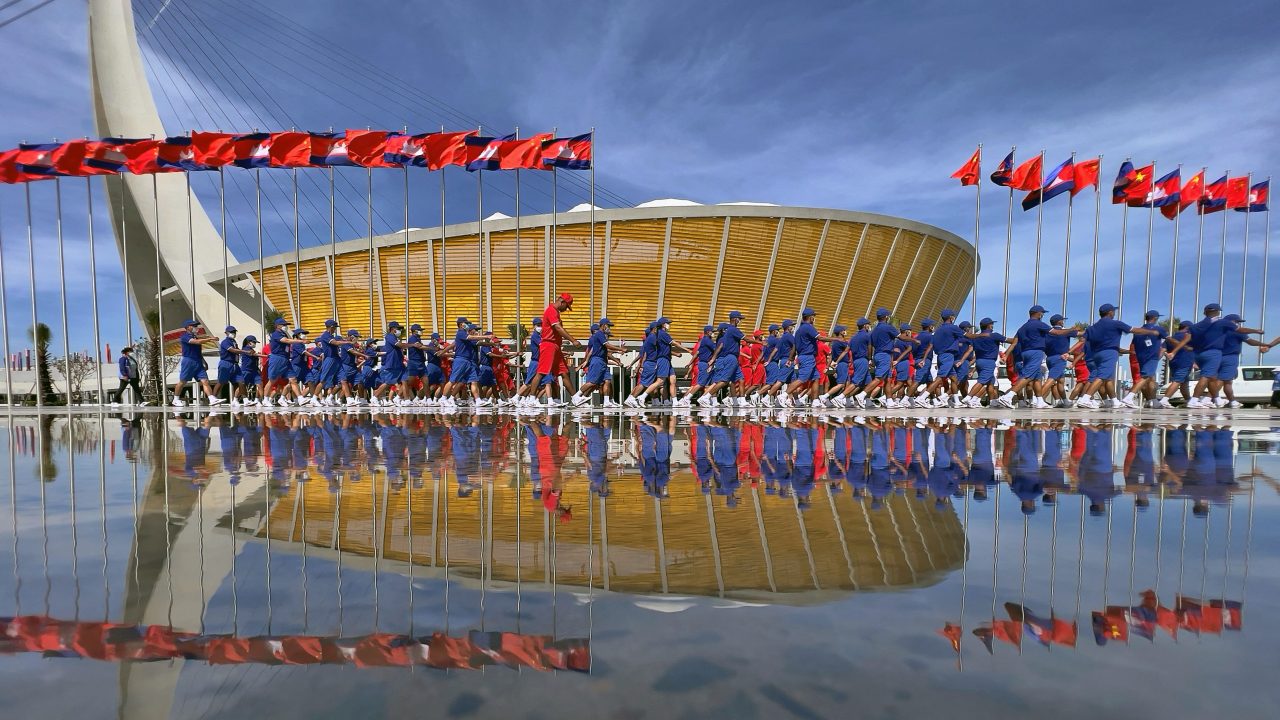
At the U.N. General Assembly last month, China presented itself as the voice of developing countries. “China is always a member of the Global South and always stands with all countries of the South through thick and thin,” it said in its position paper.
The rhetoric highlighted the strength of China’s relationship with developing countries. It operates in the U.N. and elsewhere as part of the “G77 plus China” coalition. It has pushed to expand the BRICS coalition to include more and more developing countries. And it runs large infrastructure projects such as the Global Development Initiative and the Belt and Road Initiative.
But the emphatic words also covered a tension. China is attempting to lead the world’s developing countries while developing its own economy beyond that category. And this isn’t just symbolically awkward.
Trade Surplus
As developed countries have sanctioned China, it has increasingly relied on developing countries to diversify its markets and looks on them as “future consumers,” explained Winne King (金婉玲), senior lecturer in Chinese International Political Economy at the University of Bristol, at a Chatham House event last week. But this has skewed the relationships, and may be a source of irritation.
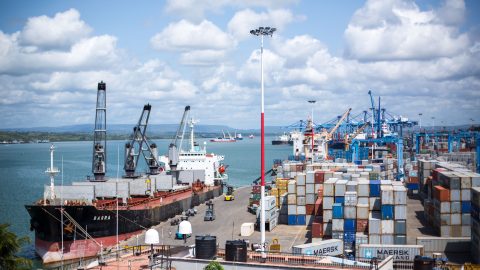
“[T]he most rapidly growing part of China’s trade surplus is with developing countries. Developing countries now account for about half of China’s trade surplus and that’s not been true in the past,” said David Lubin, senior research fellow at Chatham House, at the same event. “What you also see when you look at hostile trade policies implemented against China is that the fastest-growing source of trade hostility towards China is not coming from the G7, it’s coming from emerging economies.”
For Lubin and others, trade conflict is now “sewn in” to China’s relationships because what China calls “win-win” relationships are ultimately not simply win-win. China made up 35 percent of gross production in 2023, according to OECD figures, and others want a piece of this pie.
“You’ve got this kind of optimistic view that if Brazil, say, can import tons of cheap solar panels then that should create the conditions for manufacturing revival in Brazil. Maybe that’s true. [But] I think it’s a bit too optimistic. I think the reality that we’re actually seeing is that more and more developing countries are becoming irritated with this effort that China is making worldwide to dominate global manufacturing,” Lubin said.

Staying Onside
If that logic holds, it undercuts contested individual complaints about the likes of the Belt and Road initiative and presents a more fundamental tension. “What about the rest of [the] world? How much more of market share can you take?” as Hong Kong businessman Desmund Shum (沈棟) put it at the Chatham House event.
The rhetoric employed in China’s latest U.N. position paper thus forms a part of a battle to stay onside with developing countries that has already played out in one fight for a number of years: the fight over China’s own classification.
Last March, the U.S. House of Representatives declared that China shouldn’t be considered a developing country. In 2019, the Trump Administration ordered its trade representative to the World Trade Organisation (WTO) to “use all available means to secure changes” to WTO rules that allowed China to self-identify as a developing country. And from the “developing” perspective, India chose not to invite China to the Voice of Global South Summit 2023. China, on the other hand, has fought to maintain its status in as many forums as possible.
Underdog Allignment
This matters because the overall alignment matters — diplomatically and economically — and, crucially, it is not unconditional.
Speaking to Jeremy Raguain, a member of the Seychelles negotiating team for the U.N. High Seas Treaty last year, he described the basis of China’s close relationship with the G77 developing nations like so: “I can’t tell you what happens behind [closed doors], but they do have this immense presence around the world and from my view it aligns more with the philosophies of the underdog because again it’s not always in their interest to be always on the side of the [United] States or the sides of the EU. Just fundamentally from how they look at the world they are going up against these guys economically or militarily.”
That goes some way to explaining why China remains so close to developing countries. But it also opens up the question of what happens when it is no longer the underdog.


Leave a Reply