
Vietnam, Mexico and Taiwan have emerged as the main beneficiaries of the ongoing U.S.-China trade conflict, as firms shift assembly and investment away from China without fully decoupling from Chinese supplies.
The United States and China last week extended their trade truce until January 10 and agreed to cut tariffs on up to $30 billion worth of goods in each direction. The limited deal eases pressure on some exporters but leaves the wider contest over technology, supply chains and critical minerals unresolved.
“Vietnam, Mexico and Taiwan have gained the most. The U.S.-China deficit fell, but the overall U.S. deficit simply moved,” said Alicia Garcia-Herrero, chief economist for Asia Pacific at Natixis.
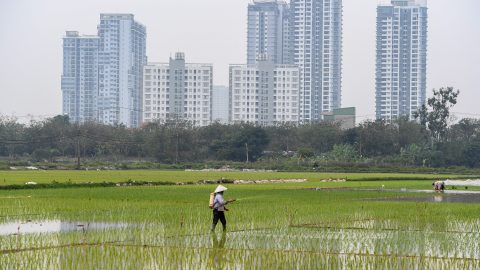
Vietnam has gained most in the short term because it has become a major assembly and shipping hub for goods headed to the U.S., Garcia-Herrero said. She cited a U.S. goods deficit with Vietnam of about $178 billion in 2025 as evidence of the shift. Mexico and Taiwan may gain more in the long term because they add more value to the supply chain, rather than just providing a new export route, she added.
Since 2018, the U.S. goods deficit with China fell by 52%, from $419.5 billion to $202.1 billion in 2025. Over the same period, the deficit with Vietnam rose by 351%, from $39.5 billion to $178.2 billion.
The latest U.S.-China trade truce gives a modest political win for both sides. China plans lower tariffs on selected U.S. farm goods, timber, seafood, cosmetics and medical devices. The U.S. list of goods exempted from tariffs includes Chinese toys, small appliances, tableware and holiday decorations.
But the package does not cover the sectors at the center of the U.S.-China strategic rivalry, including advanced semiconductors, artificial intelligence, electric vehicles, batteries and critical minerals.
The arrangement is a limited adjustment rather than the end of the tariff conflict, said Henry Gao (高樹超), a China analyst at Singapore Management University.
“The U.S. and China didn’t agree to stop hitting each other on trade, nor did they agree to stop hitting each other with AI. All they agreed to was letting the other side know — after striking the blow,” Gao said on X.
For Washington, the trade war has reduced direct imports from China. But it has not removed China from the global supply chain, Garcia-Herrero said.
“Washington has cut direct imports from China, not China’s role as the parts supplier behind those new export platforms,” she explained.
Many products assembled in Vietnam, Mexico or elsewhere still rely on Chinese components, machinery and suppliers. This means the trade war has made supply chains longer and more complex, rather than fully decoupling the U.S. and Chinese economies.
Vietnamese investment firm VinaCapital’s own assessment showed the shift is neither fully a decoupling nor a relabeling operation. It is a partial diversification in which new factories and export capacity have emerged in Vietnam and Mexico, while Chinese components, capital and supplies remain central to many of the goods they ship to the U.S. market.
Gao has said U.S. concerns about Vietnam go beyond its tariff policy to Chinese transshipment and China’s role in global supply chains. That could put Vietnam’s gains at risk if Washington tightens checks on where goods are made.
China’s record trade surplus has strengthened its hand in the trade conflict, but Garcia-Herrero said it also points to a deeper weakness in its economy.
“Firms adapted to new markets, lower prices, more high-tech goods — after U.S.-bound exports fell about 20%. It also reflects weak domestic demand and excess capacity, which pushed unsold output abroad.”
Europe could face the biggest pressure from this economic shift. Chinese exports to the European Union have risen, and the EU’s trade deficit with China reached about $408 billion, Garcia-Herrero said.
“The risk is overcapacity hitting European autos, steel and machinery,” she explained. “The opportunity is cheaper green-tech inputs — if Europe does not become the residual market for goods the U.S. has shut out.”
Europe could become the next front for the trade conflict. Brussels has imposed duties on Chinese electric vehicles and is pressing Beijing to curb hybrid-car exports, raising the risk of wider retaliation as Europe tries to protect its industries.
Taiwan has gained more from the AI investment boom than it has lost from the effort to reduce production that still relies on China, she said. “Record chip and server exports have dominated the numbers.”
Wu Chia-hsuan (吳佳勳), a deputy director and research fellow at the Chung-Hua Institution for Economic Research in Taiwan, said Taiwan had also benefited from firms shifting some operations out of China, but much of the lower-cost production had moved to Southeast Asia.
“The firms that relocated back to Taiwan tend to be higher value-added,” Wu said. “Taiwan’s growth is also driven by the global demand for semiconductors.”
The conflict has not produced a clear U.S. or Chinese victory. Washington has reduced direct imports from China and kept a high tariff barrier. Beijing has preserved global export markets and its role in supply chains.
“China lost the U.S. as a direct customer,” Garcia-Herrero said. “It did not lose globally.”



Leave a Reply