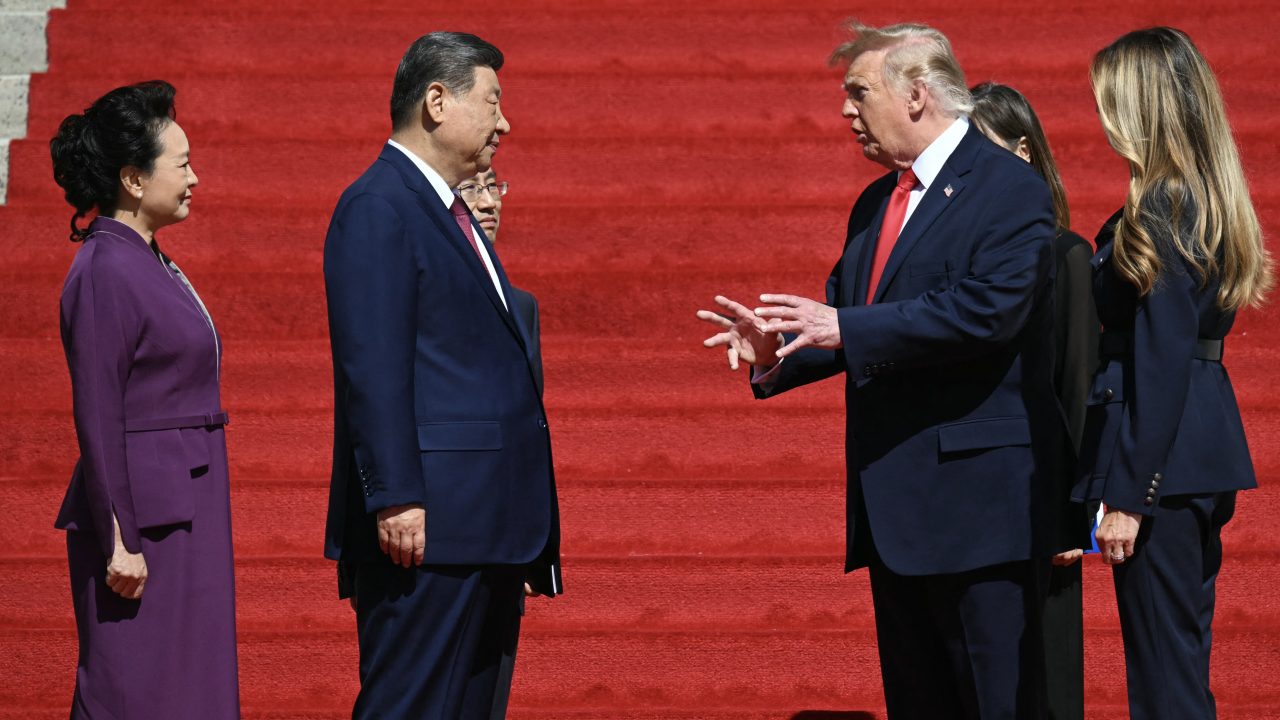
They were meant to be olive branches — harmless gestures toward an era or aspect of U.S.-China relations less defined by suspicion and competition. But as Donald Trump and Xi Jinping (習近平) tried their best to make nice in Washington this week, even the most platitudinous gestures could provoke controversy.
At the arrival ceremony on Thursday, Trump invoked the history of the Flying Tigers, a group of volunteer American airmen who joined forces with China during World War II. Actually, it was the Republic of China that those pilots were helping to save, Taiwanese outlet UDN was quick to respond. The People’s Republic of China, of which Xi is the leader, didn’t exist until 1949.
“China has successfully persuaded Trump to believe in the CCP’s historical perspective and even agree with China,” UDN wrote, referring to the Chinese Communist Party. “This is not only a successful example of the other side persuading the United States to make concessions, but also a powerful demonstration of Xi Jinping’s influence over Trump.”
At the national archives on Friday, Trump showed Xi important historical documents including the Declaration of Independence, the Constitution and a series of treaties signed by the two countries during the 19th and 20th centuries, according to NewsNation. The gesture appeared to be an attempt by Trump to impress Xi with the founding documents of America’s long-envied system of government, and to suggest that China and the United States have historically found ways to make peace despite their conflicting values.
But not everyone took it that way.
“The historical documents presented are considered deeply humiliating in Chinese diplomatic memory,” Henry Gao (高樹超), Professor of Law at Singapore Management University, wrote on X. “The 1844 Treaty of Wanghia … is widely regarded in China as the first unequal treaty between the US and China. The 1858 Treaty of Tientsin is viewed in much the same way.”
John Moolenaar, chairman of the House Select Committee on the Chinese Communist Party, spun it a different way. “America’s values are life and liberty for all people, while the values of Xi Jinping and the Chinese [Communist] Party are tyranny, genocide, and oppression,” he said in a statement. “We can only hope that Xi Jinping’s visit to the home of America’s founding documents inspires him to end his cruel policies and allow the Chinese people to have freedom of expression, freedom of religion, and free, prosperous lives.”
Xi, for his part, sought to make overtures that, if underwhelming, were at least slightly more concrete. He announced that his government would welcome 100,000 American exchange students back to China, a cohort whose numbers have plummeted since Covid. He also announced that China would gift two giant pandas to the Atlanta zoo.
The study abroad offer, while uncontroversial to the uninitiated, also provoked its fair share of disagreement.
“The US Govt has [not] thought through the potential responses it should have for protecting students/researchers if things go badly,” Jamestown Foundation President Peter Mattis wrote on X. “Maybe it should do this before encouraging a lot more students.”
While acknowledging Mattis’ concerns, conservative writer and China analyst Tanner Greer responded that his time studying in China was probably still worth it. “America has gained more from my personal experience in China than the MSS has gained from whatever dossier they put together from observing my activities there,” Greer wrote, referring to the Ministry of State Security, China’s largest intelligence agency.
If the two leaders had actually addressed the very real tensions dividing their two countries, experts paid to know about China would have bigger things to argue about.
But in the meantime, if Xi and Trump want to make everyone happy, they should just stick to pandas.





Leave a Reply