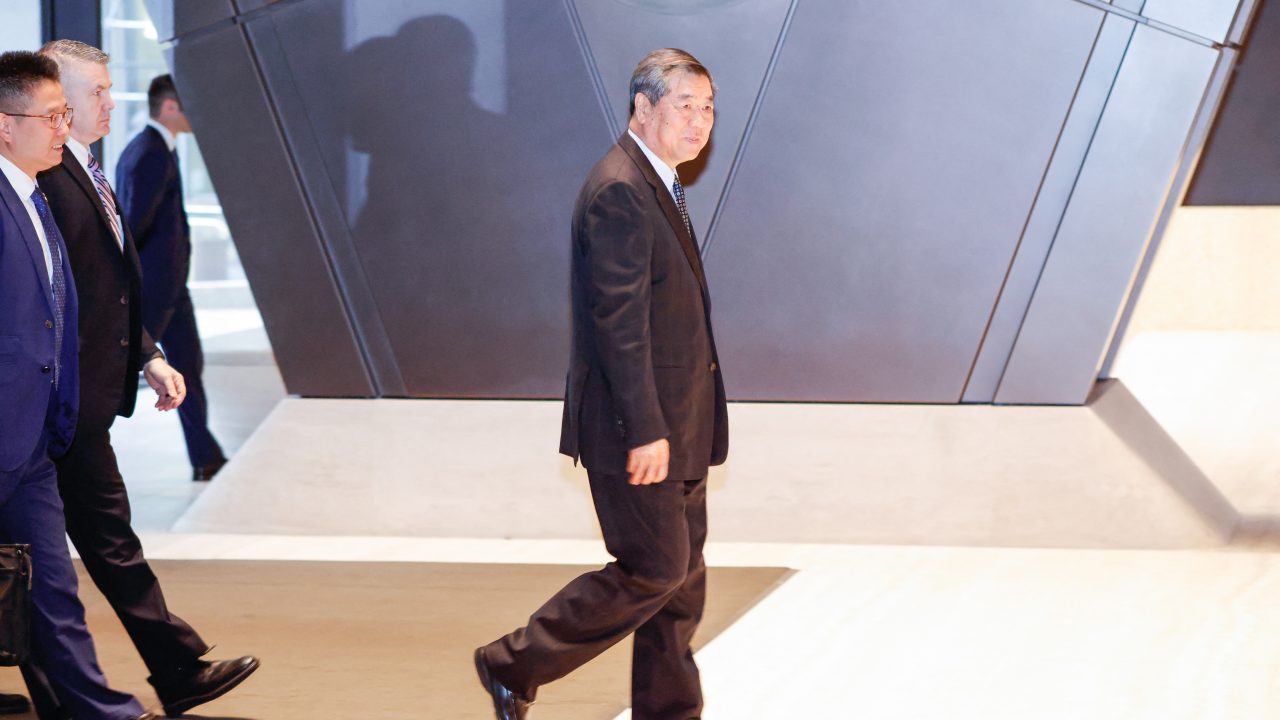
Last week’s summit between President Donald Trump and Chinese leader Xi Jinping (習近平) came and went without either an agreement to slow the AI race or a bargain on chip export controls. But during trade talks in advance of the summit, Treasury Secretary Scott Bessent and Chinese Vice Premier He Lifeng (何立峰) did agree to establish an “AI hotline.”
It’s not as substantive of an outcome as many would have hoped. In Bessent’s words, the hotline is a communication line to be used in the event of some kind of AI “incident.” The Chinese readouts provide no further clarity on how the hotline will work or what will amount to a reportable incident.
“I think of like the red phone between the Kremlin and the White House during the Cold War,” U.S. Trade Representative Jamieson Greer told CBS. After the Cuban Missile Crisis, Washington and Moscow established the hotline to prevent nuclear escalation.
Others in the administration have compared the AI hotline to the U.S.-China dialogue between former Treasury Secretary Hank Paulson and former Chinese Vice Premier of Finance Wang Qishan (王岐山), Wired reported. Paulson has credited the hotline with helping convince China to continue holding U.S. securities during the 2008 financial crisis.
In any case, it seems that the AI hotline currently amounts to a channel for Bessent and He to talk in the event of a national security-level emergency. This isn’t enough.
For one, an emergency hotline will require Washington and Beijing to have reliable mechanisms for receiving incident reports from the private sector. “The United States needs to designate who receives an incident report, under what legal or voluntary authority, using which taxonomy, and with what protections for proprietary and national security information,” wrote DGA Group partner Paul Triolo in a post for his Substack, AIStackDecrypted. “A bilateral incident line cannot be more reliable than the domestic reporting pipelines feeding it.”
For its part, Beijing also does not appear to have a body that gathers and analyzes incident reports across labs, distinguishes between different types of incidents and publishes findings, according to Triolo. “Nor is it clear whether companies such as DeepSeek, Alibaba, Zhipu, Moonshot, ByteDance, or Huawei would be authorized to disclose sensitive incidents to a foreign government channel without prior political and security review,” he wrote.
The U.S. and China are set to discuss AI again sometime before the end of November. “The next two months should therefore be treated less as preparation for another diplomatic meeting than as a deadline for building basic institutional plumbing,” Triolo wrote.
Aside from institutional plumbing, significant progress on AI safety will require the U.S. to find clarity on the direction of its domestic AI policy, according to Aalok Mehta, director of the Wadhwani AI Center at the Center for Strategic and International Studies. “Washington has prioritized support for the AI industry over responding to growing popular skepticism and creating a cohesive national regulatory framework,” Mehta wrote.
Despite the recent thrum of warnings from both AI safetyists and the leaders of the top American AI labs, Trump continues to downplay fears about the risks of AI. “Super Intelligence (SI) will be a big topic of discussion, but I want to leave it exactly where it is,” Trump posted on Truth Social on Thursday, using his recently rebranded term for AI. Trump later told reporters that the two sides did not spend much time discussing the topic.
While there is ample room for progress on domestic AI policy and the mechanisms needed to oversee it, AI still seems to have emerged from last week’s meetings as an area for genuine cooperation. “The biggest takeaway for me from the Trump-Xi summit is that both countries see AI as a top issue for the U.S.-China relationship,” Kyle Chan, a fellow in the China Center at Brookings, wrote on X. In comparison to zero-sum trade or military issues, AI offers more space for common ground.
“Right now is a pivotal moment to at least try to find some degree of cooperation, even just on communication,” Chan wrote.






Leave a Reply