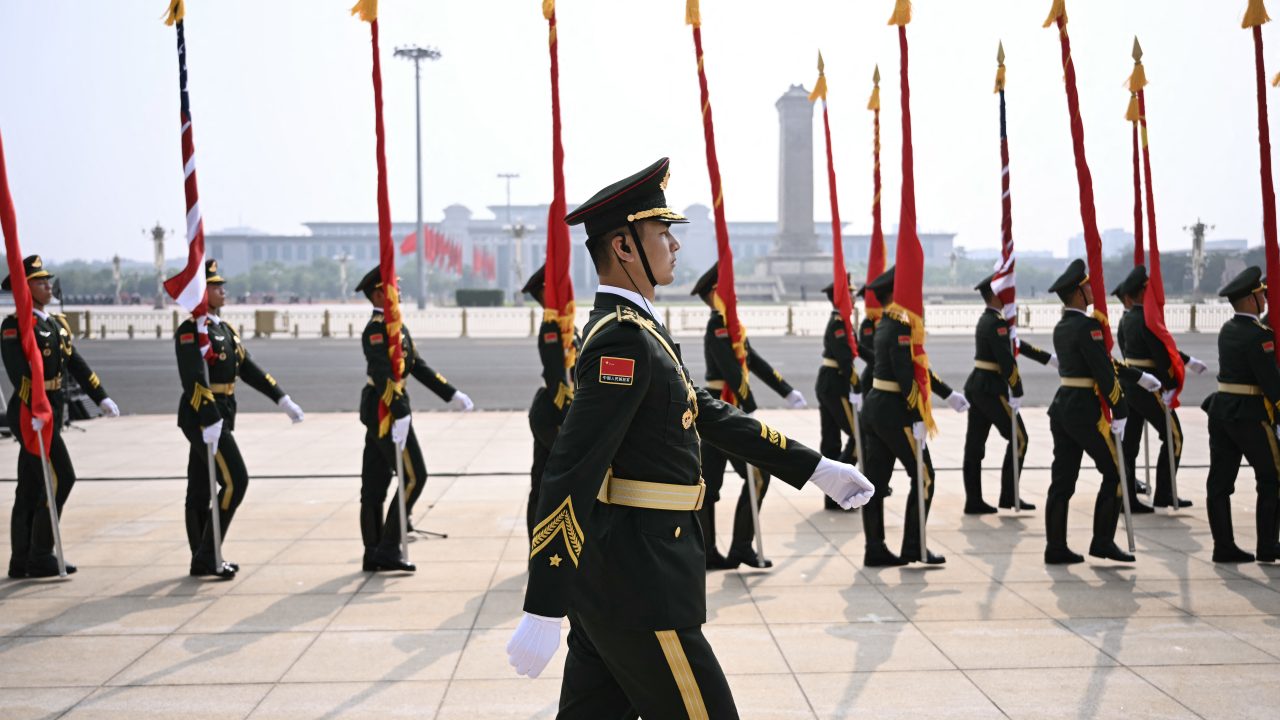
China has passed a series of amendments to its National Defense Mobilization Law, bringing more clarity to how the country would enlist the help of its economy and broader society in the event of conflict.
The amendments, which were approved by the Standing Committee of the National People’s Congress on August 28 and will go into effect on October 1, define defense mobilization as actions that “guarantee a rapid transition from peacetime to wartime and transform economic and social capabilities into national defense strength.”
The revisions grant China more power to seize and exploit private property. The original version of the law, which took effect in 2010, granted Beijing the authority to conduct “requisition” of private property. The new version gives the government powers of “expropriation,” a term that implies broader powers of control over civilian firms and assets, according to a briefing from the Institute for the Study of War.
Some experts said that the new law could be interpreted to apply to foreign firms that operate in China. “It is essentially giving them a blank check,” Yang Tai-yuan (楊太源), chairman of Secure Taiwan Associate Corporation, told Radio Taiwan International. Whether a company is state owned, foreign invested, or privately owned, he said, it could be expropriated or requisitioned if it operates in China and authorities consider such action necessary.
The Institute for the Study of War’s briefing also noted that the new amendments expand the range of situations in which the law can apply. “The revisions outline when the PRC may invoke the law, such as when the PRC’s national sovereignty, unity, territorial integrity, security, and development interests are under ‘direct threat,’” the briefing said, using an acronym for the People’s Republic of China. “This language likely broadens the cases to which the law applies, potentially allowing the PRC to invoke it below the threshold of war.”
The new amendments also specifically strengthen Beijing’s control over emerging technologies that are becoming increasingly central to modern warfare, including drones and AI. China currently controls roughly 70% of the world’s drone production capacity. But according to a recent report by researchers at the Beijing Institute of Technology, the country’s drone industry could meet just 60% of the country’s wartime needs.
The deficit owes mostly to the difficulty of mobilizing civilian firms to support military logistics and applications, according to an article published by Beijing-based defense think tank Dong Fang Hong and reported on by the South China Morning Post. “No matter how big the economic scale and how many social resources there are, if they can’t be quickly identified, precisely organised and legally allocated … then they are just potential resources and not actual defense capabilities,” the article said.
China’s judicial system is not meaningfully independent from the Communist Party, and its national congress acts as a rubber stamp on party priorities. Yet Beijing still often relies on national legislation to codify and streamline practices that are already common at the local level. When it passed its new ethnic unity law earlier this year, human rights activists were alarmed, but described the new measure as a consolidation of existing efforts to silence religious and ethnic dissent.
After the new military mobilization measures garnered widespread attention in the Taiwanese and parts of the Western press last week, Beijing’s state-backed English-language newspaper, the Global Times, pushed back.
Criticism of the new law comes in part from “Western figures who make a living by hyping the so-called ‘China threat,’” the editorial declared. “They need a China portrayed as ‘engaging in militarism’ to lever political capital for themselves.”
The next sentence, directed at what Beijing refers to as “Taiwan independence” forces, took a decidedly militaristic tone. “They fear businesses in Taiwan feeling secure, they fear closer ties across the Taiwan Straits, and even more, they fear that the sword of Damocles hanging over their heads could one day suddenly fall.”






Leave a Reply