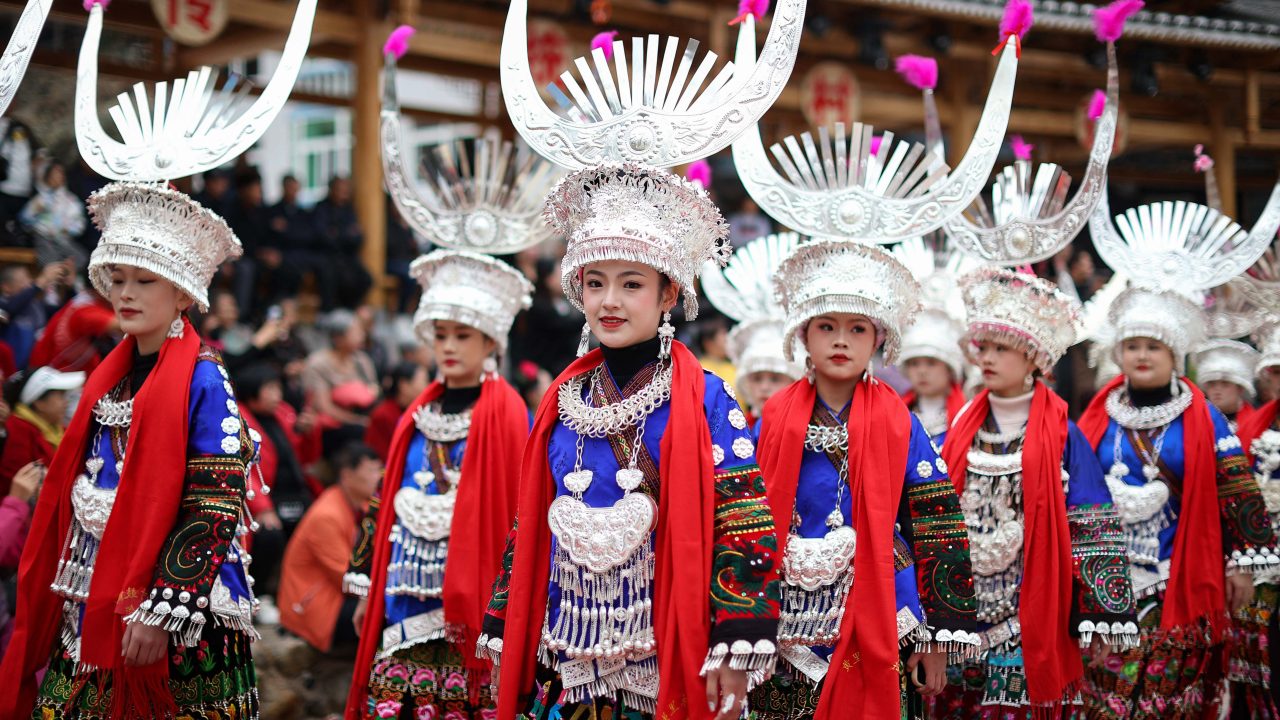
On Thursday, China’s ceremonial legislature approved a sweeping new law to promote what it refers to as “ethnic unity.” The law calls on all sectors of Chinese society to promote solidarity between the country’s officially recognized ethnic groups and the Han majority, and to resist any foreign attempts to “divide” China.
“The people of each ethnic group, all organizations and groups of the country, armed forces, every Party and social organization, every company, must forge a common consciousness of the Chinese nation according to law and the constitution, and take the responsibility of building this consciousness,” the law reads.
China’s ethnic minorities make up roughly 9% of the country’s 1.4 billion population. The Chinese government first officially recognized 39 of them in 1954. By 1979, it had expanded the list to encompass the 55 minority groups, often referred to as “minzu” (民族), that it still recognizes today.
The new measure, which the Chinese government calls the law for “Promoting Ethnic Unity and Progress,” mandates that Mandarin be used as the primary medium of education from before kindergarten until the end of high school. The law also encourages intermarriage between Han and other ethnicities; calls for the integration of villages and neighborhoods traditionally home to a single ethnic group; and urges parents to “educate and guide minors to love the Chinese Communist Party.”
“My strong sense about this new law is that it’s really just a codification of practices that were already in place,” said Gerald Roche, an anthropologist at La Trobe University in Australia.
Roche has studied the politics of language oppression in China for decades, including years of fieldwork in Qinghai Province, which is home to large numbers of ethnic Tibetan groups. On Thursday, I called him to ask about the impact of this new law, and to better understand how it fits into the broader sweep of China’s state-building project.
(The following conversation has been edited for length and clarity.)
Harry Saunders: Are there any places where the new rule about ethnic languages being taught as the primary language will change anything? Is there anywhere where that isn’t already the practice?
Gerald Roche: I’m mostly familiar with Tibetan areas outside the Tibetan autonomous region. For example, in the Tibetan-dominated areas of Qinghai, when I was living and doing my research from 2005 until I was blacklisted in 2018 or 2019, Mandarin was the medium of instruction already. In a few prefectures, they still used Tibetan. I haven’t seen what’s happening on the ground there recently, but if they were still teaching Tibetan, they would have to switch to Mandarin under this new law.
In practice, the situation on the ground was actually more complicated. There were studies showing that in the classroom, even if a school was formally designated as a Tibetan medium school or a Mandarin medium school, they would use both languages in almost equal measure, because it’s quite challenging to teach children in a language they don’t understand at all. Even in the Tibetan language schools, they know that Mandarin is the national language, the language of economic success. So they would bring in as much Mandarin as they could.
HS: Under this new law, do you think that kind of flexibility, that kind of pragmatic approach to things, can continue on the local level?
GR: This is the $1 million dollar question: How enforceable is the new law going to be? What goes on in the classroom between teachers and students is so far outside the purview of Beijing. There are all these mechanisms they can put in place: punitive measures to make sure that the schools, the principals and the teachers are meeting their targets. But the everyday realities are beyond their control. So even if this law is saying that Mandarin has to be the formal language of education, the enforcement of that law is a very different issue.
I’m not trying to say that the law isn’t significant or that it’s not going to have impacts. Those impacts will be felt over time. If you look at the linguistic practices of people across China, you will start seeing the impact from this law 10 years from now. But those impacts will be permanent.
China is a country with about as much linguistic diversity as Europe. There are about 300 languages in China. The official minzu recognition system only recognizes 55 nationalities, each of them with a single language. So when they were building the education system from the middle of the 20th century onwards, they were only building it to support those 55 languages. The constitution says that minorities have the freedom to use and develop their own languages. It only means those 55 languages. No one has the freedom to use or develop the other 245 languages spoken in China, including in education. So they started to build their education only to service those 55 languages and mostly Mandarin Chinese. 40 years later, the education system really started to be implemented in minority areas.
In Qinghai, where I lived, education was compulsory, but people didn’t go to school because they were too poor and they had other stuff to do. The government didn’t try to enforce it. But then in the ’90s and early 2000s, they started to enforce it. When that education system was imposed on people, if their language wasn’t recognized by the government, within about 10 to 20 years people would stop teaching that language to their kids, and they would start teaching whatever the dominant language is.
You always see these policies taking effect, but because of the way language works, it takes time. So, yeah, we’re going to see the impacts of this ethnic unity law in about 10 to 20 years. It will be seen at the level of the family and the home. Parents will stop teaching these languages to their kids. And that’s how you kill a language.
For a long time the primary mechanism that the party has used to assimilate minority languages was just to pretend that they don’t exist. They would call them dialects instead of languages, provide some limited support for the main 55 ethnic languages and everything else gets nothing. The reason we have this ethnic unity law now is that those previous policies have done their job. They’ve worked. All of those smaller languages have collapsed. They’ll be gone soon, and now the government is focusing on those remaining larger languages, like Tibetan and Uyghur and Mongolian.
HS: Some people have highlighted the idea that Xi Jinping (習近平) is taking a harder line, that it’s something special about his time in power that would cause the CCP to do this. But it sounds like what you’re saying is that they’ve been doing this for a long time.
GR: I would say both positions are correct. Xi Jinping’s policies since the very beginning have been a lot harsher. But it’s just a different phase of the old program. One of the ways that people describe this is with a phrase called “double assimilation.” First, you take the small groups. And then you assimilate them into the minzu. Then you take the minzu and you assimilate them into the Chinese nation. Those two processes are connected, because the aim is to have this homogenous nation of everyone speaking Mandarin Chinese.
Phase one is finished now. This is phase two. It looks like a break with the past. It looks like something more intense and severe, but it’s just applying the same methods from phase one to different groups in phase two. People talk about the good old days when there was genuine ethnic autonomy, and now they say that’s being taken away. But most minorities in China never had ethnic autonomy on any level, even on the superficial level. Hundreds of languages never had any support, were never used in education, never appeared in science, never had any media, were never recognized by the government. Just nothing.
There really never was a good old days of ethnic autonomy in China. Ethnic autonomy was designed from the beginning to assimilate smaller groups into bigger groups.
HS: What is the difference between having ethnic policies that are implemented in different ways in different places versus having one big ethnic unity law?
GR: The policies are there to set the broad direction of the agenda, and there’s acknowledgment that things will be messy and complicated on the ground. 100% of the time for policymakers, there will be resistance from individual people in particular contexts. But so long as momentum keeps on moving in the same direction, then the change is inevitably going to be achieved.
You saw this with the National Language Law, which started promoting Mandarin Chinese really aggressively in 2000/2001. They were setting targets for driving up the percentage of people in China who could be classified as knowing Mandarin, but they didn’t define what that meant. Around 2007, they breached above the 50% threshold for the first time. From there, the number just keeps on going up because they keep setting targets and investing resources.
Even though there’s pushback, even though there’s resistance, even though things don’t always go as planned, the sheer constant force means that all of those little variations will all just get swept up in the end. In Qinghai, when the government started pushing for Chinese-language textbooks, there were big protests about it. And then the government was like: “Okay, you don’t have to have Chinese textbooks anymore because you protested too much.” Then they just try again in a few years. They keep on pushing until people are too exhausted to fight back.
HS: Let me ask you about the age component here. Because over time, the amount of compulsory education has changed, right? And now we’re seeing this push into the kindergarten level. What’s the importance of that component?
GR: The importance of the kindergarten component is that it gets children into the system earlier, when their capacity to acquire language is more flexible than later on. It makes those kids more vulnerable to having the dominant language imposed on them.
There’s also the social aspect, where you have lots of kids coming together, doing what kids do, teasing each other, forming cliques, bullying, and things like that. That also contributes to the process. There’s quite well-known research from Papua New Guinea that shows that the language shift from a minority to a majority language happens faster when kids are off on their own more often.
The Chinese state is creating those conditions deliberately. They’ve got the kindergartens where the kids are all together being exposed to dominant languages. They’ve got the boarding school system where kids are away from their families. So they’re really putting a wedge between children and their families and the language that connects them.
Similar things were done in the U.S., in Canada, in Australia. They’re being done today in India where they have massive boarding schools for Adivasi people, where the kids are separated from their families. We know what happens in these contexts. You separate the child from the family, you separate them from the community, you put them together in a place where they are vulnerable and alone, and you expose them constantly to the dominant language, and you punish them for using the minority language. It is an extremely effective form of coercion. It works very well, and it works very fast.
HS: Which of the minority groups in China do you think will be most resilient in the face of this?
GR: The groups that we hear most about in the news are the ones that probably have the most resilience, and that’s in part because they have a transnational diaspora. Uyghurs, Tibetans, Mongolians. They are larger and more visible. They have prior literary traditions that put cultural importance on the language. They’re going to be the longest holdouts. But they’re coming under strong assault now.
A comparison between the Tibetans and the Yi (彝) is always instructive. The Yi are another minority ethnic group about the same size as the Tibetans, so around 6 million people, very linguistically diverse, never had a centralized political system. They have no transnational diaspora to help draw attention to their plight in international spheres. So no one knows about the Yi. No one knows what’s happening to them. The government has nominated one official language for the Yi. All the languages that aren’t being recognized are just being eroded, totally washed away. But there’s no one standing up in UN forums to put pressure on China to protect the Yi. There’s no protest movement. They don’t have an exile government.
HS: Do you expect to see pushback from international groups having any impact on the implementation of this ethnic unity law?
GR: I would say two things. First, yes, there has been a lot of pushback against previous policies of the Chinese state, in the United Nations and other international forums, but it’s only been on a very limited handful of issues and has never taken into consideration the larger scale of the project.
I think the most powerful antidote to what is proposed in this law would be the United Nations Declaration on the Rights of Indigenous People. It has the strongest protections for indigenous languages, anywhere in the world. If you analyzed what is happening in China in terms of those language rights, it would really highlight how extensive the problem is. However, you will not find a state willing to stand up and use that declaration to attack China because most states are unable or unwilling to adhere to the declaration in their own country.
Recognition and protection of self-determination is a fundamental principle of the declaration. If China had democracy and people were allowed to vote for what languages they wanted, that problem wouldn’t exist. China is a conquest empire that turned into a country. The Han, the Qing dynasty, conquered Xinjiang, conquered Mongolia, conquered Tibet, conquered Southwest China, and then it just turned into a country. They have indigenous people. There are indigenous people in China. China legally refuses to acknowledge that. If they can refuse, if they can deny that that history is colonial, if they can deny that they have indigenous people, then they don’t have to address the problem of self-determination.
HS: The last thing I want to ask you relates to the internet, because, as I’m sure you’re aware, young people today live their lives as much online as they do in physical classrooms and on the playground. How does that impact the resilience of these languages and the government’s efforts to essentially eradicate them?
GR: I’m gonna start out by slightly taking a left turn to your question, which is to say that the internet and the way it manifests in the West is also relevant to this dynamic. If international support and transnational activism is important, it would all be helped by people in the West having a better understanding of these issues in China. Instead, what you see now is Chinamaxxing. “I’m at a very Chinese point in my life.” You see these influencers posting content where it’s like, “look at these drones, look at the Shanghai skyline, look at this high-speed train.” China’s winning the social media war for how we think about China in the West, and that’s undercutting the effectiveness of those transnational forms of advocacy in really, I think, significant ways.
The rise of social media has been important, particularly the video streaming platforms and voice messaging because a lot of these languages are unwritten. They’re just spoken languages and in many cases, they’ve tried to get state support to develop a writing system to use in schools, and the state has refused to give that. So these video platforms are useful, but they’re also controlled, and there are two parallel systems of control. One is the formal system of control, where algorithms and potentially human censors will cut the stream if you are not using Mandarin. Sometimes you have to chuck in a word of Mandarin every now and then to stop the censors from kicking you off. Sometimes you might have to only speak in Mandarin and you can’t use any other language.
The second one is social control. These policies get reinforced by social stigma, where a language that the state is trying to assimilate will be a language that people consider less prestigious, funny sounding, backwards, silly or whatever. You get people reproducing these prejudices through streaming platforms as well. That contributes to the state’s goals. If you’re constantly being insulted and told that your language is no good, that’s a powerful psychological driving force to push you towards dominant languages.
I do hear, when I’m in touch with people from there, that the video streaming platforms in particular have broadened awareness of linguistic diversity and broadened appreciation for linguistic diversity in Tibetan areas. That’s important. It’s great that Tibetans now know more about the languages that other Tibetans speak.
But there’s only so much that awareness and positive attitudes can do when you have a powerful centralized state, willing to deploy its military, send you to prison, and torture you to death for language activism. Those platforms do have a role. They are changing things. I don’t think it’s enough to offset what the state is aiming to do. The state is just a snowplow, pushing ahead. There might be pebbles that get in its way, but they’re not going to slow it down.





Leave a Reply