
U.K. Minister of State for Security Dan Jarvis told the U.K. Parliament on Tuesday that he was “deeply concerned” by the fact that bounties have been placed on four Hong Kong activists residing in the U.K. It was not the first time the U.K. government had expressed concern.
Yet the activists themselves continue to urge the U.K. government to do more to protect them — and have harrowing stories about how the bounties have affected their lives.
Since December, when Hong Kong police offered rewards for information leading to the arrests of six pro-democracy campaigners, with four of them living in the UK., those activists and others have been subject to various forms of harassment, including physical assault, being followed and intimidated both online and in person, and more official actions such as having bank accounts frozen.
First-Hand Accounts
“Last week, my M.P. actually got [contacted] by his constituents — AKA my neighborhood. They’ve been receiving a wanted note of myself … encouraging them to bounty hunt on me and [take] me into the Chinese embassy,” Carmen Lau (劉珈汶), an activist working with the U.S.-based NGO Hong Kong Democracy Council, told a Committee for Freedom in Hong Kong Foundation webinar on Tuesday.
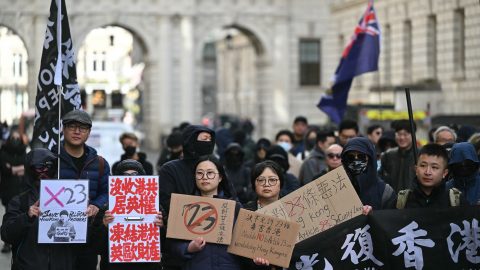
Lau also said her family in Hong Kong had been questioned in apparent retaliation for her recent role in protests against a proposed new Chinese embassy in London.
“There are trolls on the internet … but there are also people who are in real life, either hired by the CCP [Chinese Communist Party] or [who] feel completely compelled to to work for the CCP voluntarily,” Frances Hui (許穎婷), policy and advocacy coordinator at the Committee for Freedom in Hong Kong said at the same event.
“I received a call from a man speaking Mandarin and asking ‘Oh, are you single? I got your contacts from so and so,’ and they’re able to name me and I’ve been getting these calls regularly from different phone numbers … [O]bviously it’s a coordinated effort that they get these numbers for one time use,” Hui added. She also said she and colleagues had been followed home and to work.
U.K. Response
In response to questions about this kind of treatment in parliament this week, Dan Jarvis said it was “not acceptable,” adding: “The safety and security of Hongkongers in the U.K. is of the utmost importance, and the U.K. will always stand up for the rights of the people of Hong Kong.”
Jarvis also made the commitment that “wherever we identify such threats, we will use any and all measures, including through the use of our world-class intelligence services, to mitigate the risk to individuals.”
However, those who have been subject to harassment feel the protection has not been substantial enough.
Falling Short
Responding to a question from Domino Theory, Carmen Lau said she felt “very disappointed” in the U.K. government and police response. “The counter-terrorism police shared with us a so-called ‘blue book’ — guidance for a targeted person under the counter-terrorism team. [But] it’s nothing related to transnational repression and whenever things happen the police suggest … just call the 999 [U.K. emergency number].”
Nineteen year-old Chloe Cheung (張晞晴), one of six activists to be newly listed as wanted in December, shared a similar experience with U.K. police. After an incident where two Chinese men followed her to a restaurant after an event last month, she said she had called the police but heard nothing back when they had said they would investigate — “as usual.” She also said she had simply been told to call 999 in future.
Requests for Improved Protocols
What these activists are asking for, and what they say is currently lacking, are official protocols to deal with these specific forms of harassment.
“[I]n the U.S. … compared to the U.K. it seems like the situation is much worse,” Frances Hui said, before describing a “pressing need” to “tackle and address this issue in a more social society-wide approach including providing more protections and more communications with victims of transnational repression.”
Hui added that transnational repression should be criminalized in national law and there should be multilateral collaborations to trace the patterns of such repression.
Anna Kwok, executive director of the Hong Kong Democracy Council, put forward several further steps.
First, countries should “create a mechanism that fully helps with communication and coordination across agencies and also across federal and state levels such that when something happens they’re equipped to respond immediately.”
Second, they need to “reach out to the community because there are actually a lot of intelligence and information within the Hong Kong Community,” as they often have information that they do not share because of a lack of trust in law enforcement institutions.
Third, after an event has taken place, an investigation should be launched and the “status” of people involved — harrassors and harassed — should be taken into consideration. What Kwok means by this is that in the case of those facing harassment, uncertain asylum status should not count against them. What she means in the case of harassors, she did not elaborate on.
An Opinion
Clearly, some of these suggestions cannot be separated from international politics. But there are surely some areas around personal safety which can be widely agreed upon.
“I think the idea is to isolate all of us,” Frances Hui said. “The Chief Executive of Hong Kong, John Lee (李家超), has said very explicitly that they would chase us down everywhere around the world like ‘street rats.’” One does not need to agree with a political view to believe that peaceful protesters should not be subject to that kind of treatment.



Leave a Reply