When BuzzFeed News published its 2020 expose on the scale and architecture of China’s crackdown on Uyghurs in Xinjiang, the report didn’t just touch off a furor in the West. It also inspired Guan Heng (關恆) — an ordinary Chinese man who evaded China’s internet firewall to read the story — to make a daring trip across Xinjiang to see the camps for himself.
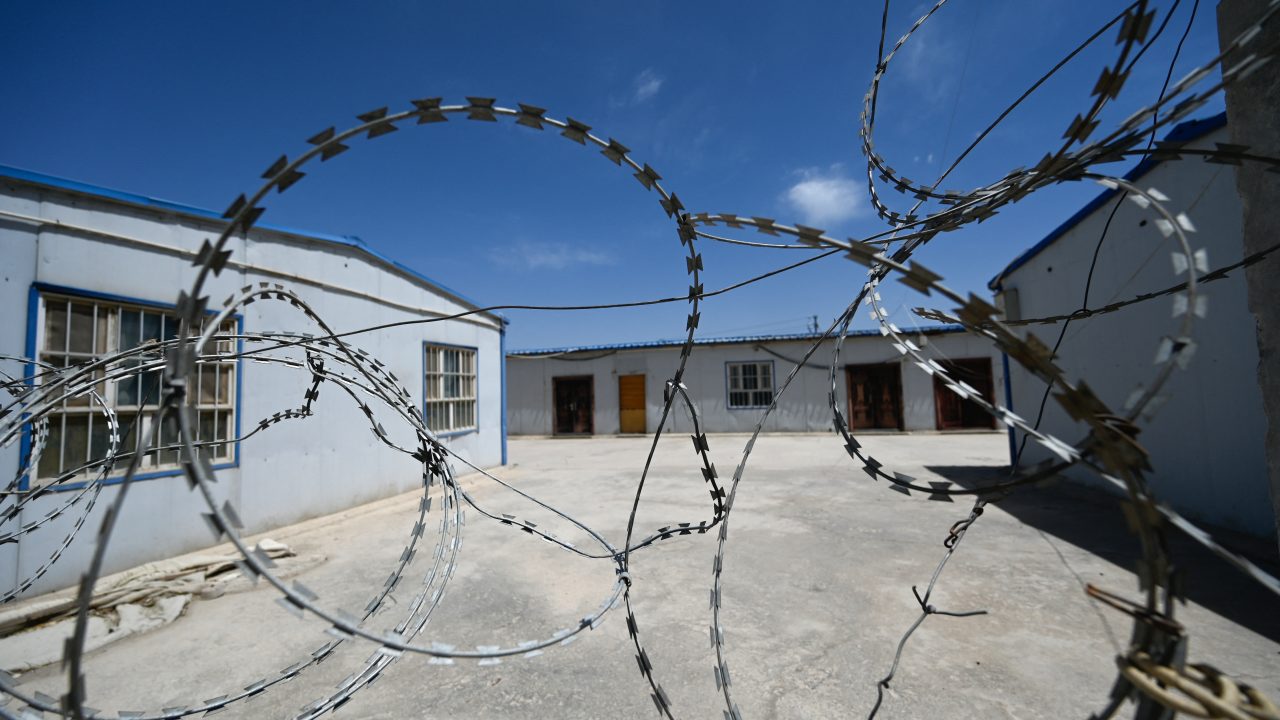
The BuzzFeed report had drawn on satellite imagery. Guan’s amateur documentary, which he posted on the internet after fleeing to the United States in 2021, provided the view from the ground: menacing gray compounds surrounded by watchtowers and concrete walls topped with barbed wire. Now, four years and 1.2 million YouTube views later, Guan is perilously close to ending up in a Chinese prison himself.
Earlier this year, Guan was living in a small town in upstate New York when he was arrested by U.S. Immigration and Customs Enforcement (ICE). He had applied for asylum soon after arriving in the U.S. by boat from the Bahamas in 2021, but the case was still pending when ICE knocked on his door.
The case is still pending. The second hearing in his case is set for Monday, but Guan’s lawyer has said that he doesn’t expect a decision unless the authorities drop the charges. Guan’s situation appeared to have been resolved last month, when pressure from U.S. media outlets and members of Congress prompted the Department of Homeland Security (DHS) to abandon a plan to deport Guan to Uganda, where he may have faced extradition back to China. But now DHS is pushing for him to be sent directly to China.
“I would rather die than face imprisonment in China,” Guan told the German outlet DW in an interview from the ICE detention facility where he is being held.
The spotlight on ICE’s aggressive enforcement tactics — already a contentious issue when the Human Rights in China substack page first publicized Guan’s case — has intensified in recent weeks with the killing of Renee Good, a 37-year-old woman who was shot by an ICE officer in Minneapolis. But Guan’s is a predicament of a more bureaucratic sort.
Despite a strong statement of opposition to Guan’s arrest from Raja Krishnamoorthi, the ranking democratic member of the House Select Committee, as well as multiple righteously indignant articles from the Wall Street Journal’s traditionally conservative editorial board, Guan’s fate still rests in the hands of an immigration judge in Binghamton, New York.
The controversy over Guan’s case has brought a renewed interest in his original documentary footage, and the massive apparatus of repression that it depicts. A repost of the footage by a prominent Chinese-language X user last month has garnered 3.3 million views in less than a month. At the same time, another group of Chinese-language social media influencers have attempted to discredit Guan’s work.
On December 13, a day after the original Human Rights in China article, an X user with the handle “Sunset Pirate” (落日海盗) posted a single frame from Guan’s footage and claimed that what he had filmed was military base, not a concentration camp. The post has received more than 450,000 views. The user, who described himself in his bio as “a relatively unknown pet and relationship blogger on YouTube,” was later revealed to be Jin Liang (金亮), a former reporter for a state-owned media outlet. The “Sunset Pirate” account stopped posting soon afterward.
China has denied the true nature of its Xinjiang crackdown in official statements for years, but the information war playing out on X over Guan is characteristic of a newer strategy. As Human Rights in China described it, China has increasingly turned to “infiltrating overseas information spaces through disguised, ‘gray-zone’ identities in order to achieve political influence in a manner designed to be subtle, ambient, and difficult to detect.”







Leave a Reply