
Compromises between Western academia and China are hardly news. From augmenting the Chinese Communist Party’s claims over Taiwan to censoring student criticisms of its repressive policies, examples are numerous enough to fill a shelf of their own in any university library still brave enough to host such material.
Some skim over Beijing’s crimes, perhaps with an eye on future revenue streams. Others risk complicity in them, such as by taking advantage of data harvested from highly vulnerable groups. But another category crosses a line that is arguably even more alarming: legitimizing and encouraging the Chinese government to proceed in what amounts to the destruction of peoples.
One such paper, “Gospel or curse: the impact of religious beliefs on energy poverty in rural China,” appeared on the website of Nature, among the most cited journals in the world, towards the end of May. Published in “Humanities and Social Sciences Communications” by Nature Portfolio, a division of Springer Nature, the paper has three authors, two of whom are affiliated with Germany’s Leibniz Institute of Agricultural Development in Transition Economics, including its director. The Sino-German Center for Agricultural and Food Economics in Yanling, China is also represented.
Aside from presenting obvious falsities as fact, such as the “Chinese government’s advocacy for religious freedom and protection of the five major religious faiths,” and relying on data from a survey that straight out asked people whether they are religious in a country where answering “yes” could serve as a indicator for future torture, the paper seeks to establish a causal link between religiosity and reticent uptake for clean energy.
Treading more lightly with Buddhism (which is actually judged to lower energy poverty), it identifies adherence to Islam as having a propensity to hold back China’s energy reform due to the religion’s “relatively conservative nature” and finds that religious beliefs in general impede people’s access to clean energy and “exacerbate” issues with its affordability, especially among ethnic minorities.
It then opines that “religious beliefs appear to hinder residents’ progress towards prosperity” and, in its conclusions, calls upon the Chinese government to “continue its efforts in targeted poverty alleviation” and policymakers to “promote the integration of religions with modernity and technology.”
In Xi Jinping-era China and its colonies, where the state has a flagship energy transition policy that cannot be seen to fail and reports emerge daily of religious persecution so extreme that, in some cases, it contributes to suspected crimes against humanity, these are extremely dangerous sentiments. Yet nothing in the paper’s ethics declaration serves as a warning.
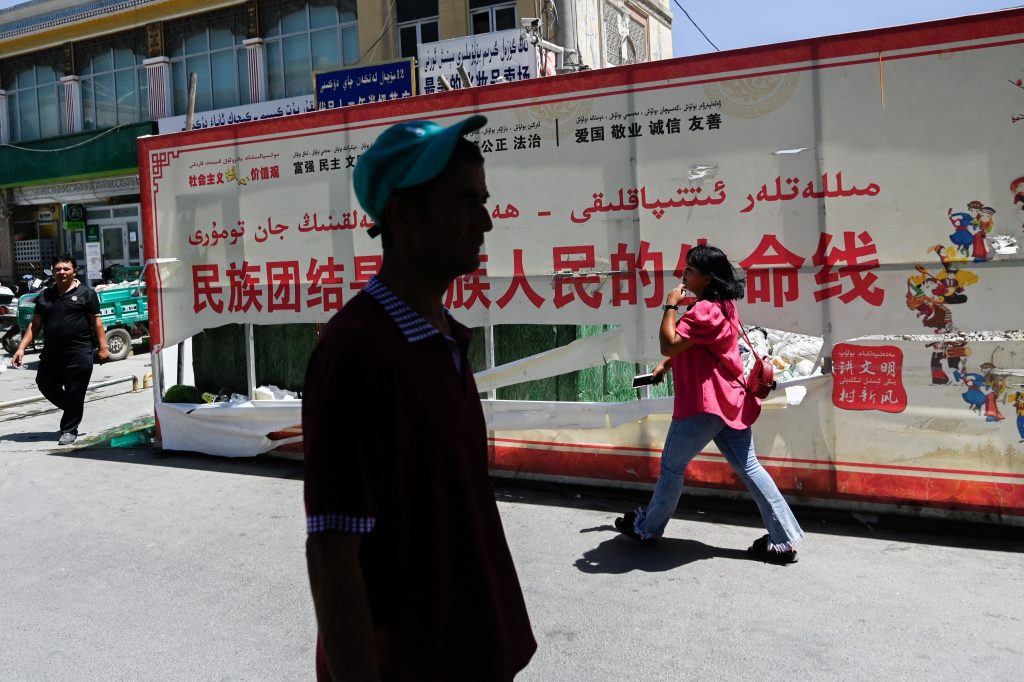
Are the journal editors not aware that poverty alleviation slogans are daubed on the walls of the camps that intern followers of Islam in East Turkestan (Xinjiang)? Do they not know how easily integrating religions with modernity in a Chinese context can become a euphemism for weaponizing surveillance tech and remodeling entire cultures towards Han norms? Has it not come to their attention that pressganging Uyghurs into cottonfields is one of the ways that China pretends to enrich its Muslim poor?
If they do not have knowledge of these and similar matters, then they should: The paper comes in the immediate aftermath of a report by the New York-based NGO Human Rights Watch that documents how China addresses impoverishment in rural Tibet by compelling people from their homes, detaching them from their livelihoods and resettling them in communities where they often lack the skills to adapt.
It also follows sizeable protests this year reacting to construction of the Gangtuo Dam on the Drichu (Jinsha) River in eastern Tibet, which resulted in between 100 and 1,000 monks and laypeople being arrested and beaten. They were opposing removal from their villages and historic monasteries to make way for hydropower infrastructure, i.e. the purported foundations of clean-energy prosperity.
This latter is precisely the kind of incident whereby victims of the Chinese state can be miscast as hindering progress as a result of their “backwards” beliefs, fusing Xi Jinping’s (習近平) benign-sounding policies of poverty elimination and transition to renewable energy with the suffocation of religion and the disintegration of the peoples it unifies.
The subtext is China’s colonial-style occupation and exploitation of land and resources in the name of the green economy, and relocated Tibetans elsewhere are already being told to “tone down” the negative influence of their faith to achieve a “civilized lifestyle” while systematic efforts are made to disconnect their children from their heritage. As mentioned before, the fate of Turkic Muslims is even more sinister.
This is what happens when Beijing moves to consolidate its power. It takes seemingly noble aims like achieving sustainability or basic living standards and entwines them with rights abuses against groups it sees as threats or whose members possess something it wants. To do so, it needs experts to join the dots, and academic publishers and respected institutions should be taking every precaution to deprive it of the logic it craves to justify and propagandize its crimes, not lending their names to prejudicial excuses that blame the religious poor for their own impoverishment.
Irresponsibility at its most acute is telling the extreme Islamophobe dictator of a homicidally atheist regime that his legacy projects are being bogged down by religious believers and advising him to target them and their religions with methods already known to incorporate reeducation camps, rewriting scripture, forced labor and turfing them out of their ancestral homes. It is incredible, then, that icons of learning like Springer Nature and the Leibniz Institute are propagators of such recklessness.






Leave a Reply