
English Premier League rivals Arsenal and Tottenham Hotspur are the latest soccer clubs set to play each other in Hong Kong this summer, in a move that helps affirm “business as usual” in the territory.
Although the match is not yet officially scheduled, local reports in Hong Kong have suggested a deal for the game has been agreed, adding to plans for several major games, including one reportedly agreed with Liverpool as part of their tour of Asia. The likely date for the Arsenal game is July 31, and the new 50,000-capacity Kai Tak Sports Park will act as the setting.
This would be the first time Arsenal have travelled to Hong Kong since 2012, well before the imposition of the 2020 National Security Law, and it fits a strategy of Hong Kong becoming an “events capital” as part of projecting an image of “business as usual” in the city. Prior to this, the controversial visit of Lionel Messi to Hong Kong last summer and the filming of a Nicole Kidman project with Amazon Prime were high-profile examples of the same concept.
The news runs in notable contrast to the ongoing U.K.-based pressure campaigns against the Chinese government’s actions in Hong Kong and treatment of Hong Kongers more broadly.
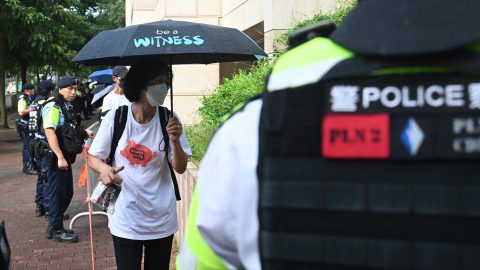
Hong Kongers were among hundreds of demonstrators who protested against the building of a large new Chinese embassy in London earlier this month, for instance, with complaints centered around the prospect that the embassy could be used as a focal point for cracking down on dissidents who have fled Hong Kong.
“It will be like a headquarters [for China] to catch the [Hong Kong] people in the U.K. to [send them] back to China,” one anonymous demonstrator, who was a member of HongKongers in Leeds, told AFP.
At the same time, U.K.-based Chloe Cheung (張晞晴) became one of six activists to be newly listed as wanted by the Hong Kong government at the end of last year, which brought the total of exiled Hong Kongers with arrest warrants and bounties against them to 19. Cheung told The Times that many of her former classmates in Hong Kong have cut ties with her over concerns for their own safety.
Yet the attempt to project business as usual appears to be accepted by many soccer fans. When Domino Theory asked fans on one of the largest Arsenal forums their opinion of playing in Hong Kong, there was near total agreement with the club’s position.
“No place is perfect. Choices are US (bad), China (bit more bad), Middle East (quite bad). Heck staying at home is bad too, not like [the] UK didn’t pass anti-protest laws under good ol Boris [Johnson],” user Huckleberry said.
“I choose to see it as being ultimately for fans. They’re already being oppressed by the government and on top we would deny them having their favourite clubs visit their country in what may be the only chance they may have to ever see them play live, over what?”
Another user, xk_1991, emphasized an acceptance that pressure campaigns would have no effect anyway.
“We need to be realistic and recognise that this doesn’t work. Arsenal had a training camp in Dubai who have influenced some truly awful crimes in Sudan, we break bread with the Rwandans despite their crimes in Congo, Arsenal players will be at a World Cup that is going to be held in a country that will have snipers on the roofs of stadiums and the old nasty orange man might even threaten to impose sanctions on teams that don’t let the US win,” they wrote, concluding “Speaking up won’t do the footballers any favours.”
With these views as a backdrop, targeting sporting events as an avenue to increased legitimacy on the international stage appears to be a shrewd move. The Premier League is one of the most popular sporting products in the world, and its touch brings both financial weight and prestige.
This is also not the first time in recent months that the Premier League and its member clubs have proven willing to work closely with the Chinese government. The Premier changed all references to Taiwan on its online platforms to “Chinese Taipei” earlier this year after a review that followed its decision to open an office in China.
Arsenal Football Club did not respond to a request for comment.




Leave a Reply