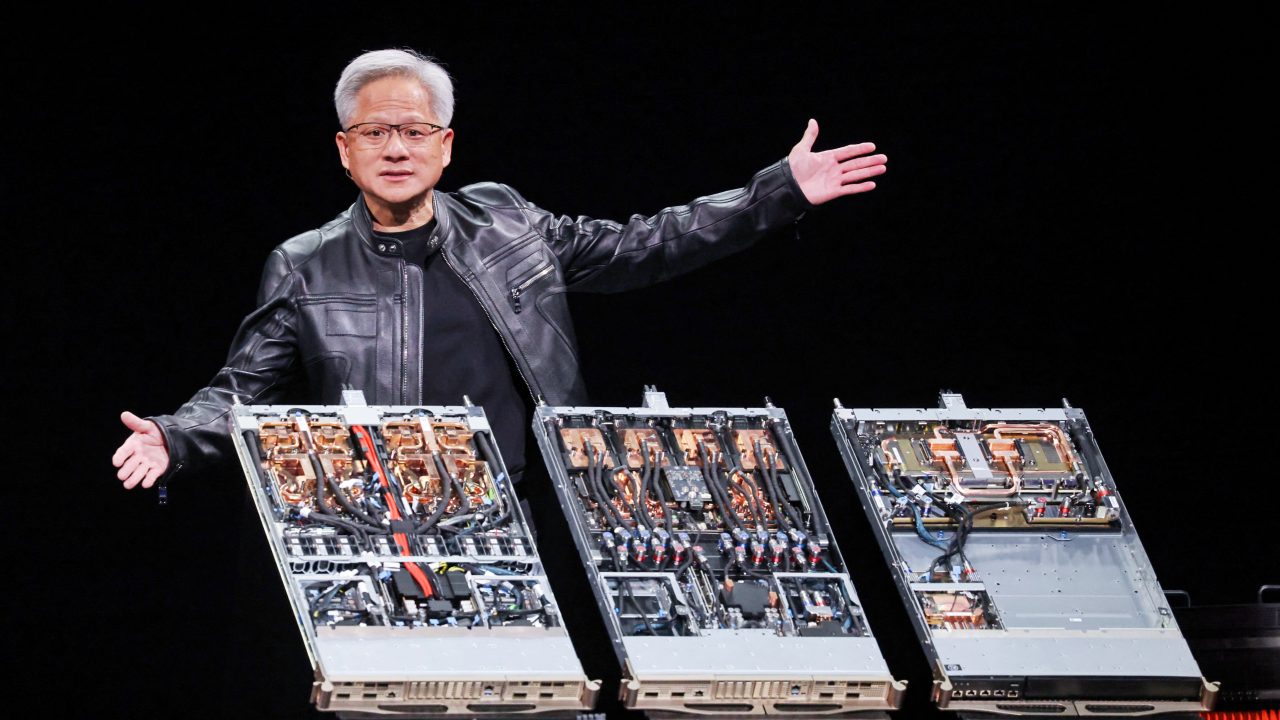
Nvidia chief executive Jensen Huang made a cinematic entrance at the Computex AI exhibition yesterday as he jogged onto the stage of the Taipei Music Center to the loud tune of a Star Trek-esque orchestral composition, evoking the idealism of the USS Enterprise. During his 90-minute keynote, Huang gave an in-depth look into the technology behemoth’s cutting-edge offerings in quantum supercomputing, robotics and artificial intelligence, building up to the grand reveal for what he called one of “one of the largest products [Nvidia] has ever built”: Nvidia Constellation.
“It’s parked right outside,” Huang said, jogging off to the side as video played of a spaceship zooming into Earth’s orbit. As the ship landed in Taipei, it became clear what it really was — Nvidia’s new Taiwan headquarters. Nvidia has finished negotiating the transfer of the lease for land in Taipei City’s Beitou District, he said.
A superstar in Taiwan, Huang delivered a speech that felt quite patriotic. He presented multiple bespoke videos for the Taiwanese audience, highlighting Nvidia’s heavily embedded local supply chain. He also spoke some Mandarin and gave a shout out to his parents in the audience. On multiple occasions, he thanked Taiwan and talked about its centrality in the global technological ecosystem. The packed crowd ate up Huang’s jokes, easy charm and evident pride for Taiwan.
Huang, who holds dual Taiwanese and American citizenship, as well as being a master salesman and CEO of the second most valuable company in the world, might be the best person to advocate for Taiwan’s sovereignty. But he stays apolitical when it comes to Taiwan. When Huang called Taiwan “one of the most important countries in the world” at a night market in Taipei last year and subsequently received backlash in China, he clarified that he was not voicing an opinion on a geopolitical issue. Huang’s public persona is one of a globe-trotting techno-optimist whose loyalty is to his company. By his own admission, Huang follows the money.
Sometimes, this means that Huang follows China. Just a few days ago, on the same day that he flew into Taiwan for Computex, the Financial Times reported that Nvidia is planning to set up a new R&D center in Shanghai. Its purpose is to figure out how to better serve the interests of the China market, although a spokesperson for Nvidia clarified that this research center would not receive restricted technology from the U.S.
Huang flew to Beijing last month to discuss this R&D center shortly after U.S. President Donald Trump restricted the sale to China of Nvidia’s H20 chip, a weakened AI processor designed to comply with former U.S. president Joe Biden’s October 2023 export controls for the China market. Huang told business and tech analyst Ben Thompson yesterday the ban has cost Nvidia $15 billion in sales. Huang also said the H20 chip cannot be downgraded any more, which means further innovation for the China market would require the development of a completely new chip. The stakes are high — competition with homegrown chip makers in China is heating up, and Nvidia is eager to maintain its dominance in a market that could soon be worth $50 billion to the company.
Other times, following the money leads Huang to whip up patriotic sentiment in various other countries as part of his pitch for sovereign artificial intelligence. By Nvidia’s definition, sovereign AI is built domestically using a country’s own data and computing infrastructure. Huang is a proponent of countries choosing not to export their data — perhaps entrusting it to hyperscalers like Microsoft, Amazon and Google — just to create AI solutions that aren’t sufficiently tailored to their linguistic or cultural contexts. While in Thailand last December, Huang said, “The digital data of Thailand encodes the knowledge, the history, the culture, the common sense of your people. It should be harvested by your people.” Over the past several months, Huang has made similar statements in India, Japan, Vietnam and Saudi Arabia.
National AI infrastructure across the world would be a boon for Nvidia’s bottomline — the company has said as much in earnings reports. Artificial intelligence requires data centers, and these data centers require Nvidia chips and other computing infrastructure. Additionally, increasing the penetration of Nvidia’s CUDA technology around the world contributes to a positive feedback loop for Nvidia’s AI ecosystem. CUDA, which stands for compute unified device architecture, is essentially a software development platform that allows developers to harness the power of Nvidia’s GPUs. At Computex yesterday, Huang spoke about the importance of making CUDA “as pervasive as possible so that the install base is all over the world.” The more CUDA there is, the more developers want to build applications with CUDA. Better applications make customers happy, and in turn, create more demand for CUDA.
Huang said in March that CUDA “is already everywhere,” but he must also be aware that this dominance is not guaranteed. Nvidia competes with hyperscalers, which are not only developing their own chips (creating an alternative to Nvidia’s ecosystem) but are also providing ready-made and scalable cloud computing and AI solutions. Hyperscalers can provide a less costly and risky option than Huang’s sovereign AI pitch, particularly for countries that are lagging in AI infrastructure.
Even though Huang has pulled on the patriotic heart strings of many other countries besides Taiwan, the bottom line for Taiwan coming out of Computex 2025 is that Constellation will be another crown jewel for it to showcase its tech prowess and central role in the global chip industry.
It is already apparent that this won’t come without complications. While Taiwanese President Lai Ching-te (賴清德) lauded Constellation as Nvidia’s new “center of global operations” during his address at Computex this morning, Huang and a statement by Nvidia called it a “Taiwan office.” This may be a case of crossed wires, or maybe Huang downplayed the announcement so as to not send a ripple across the Pacific, in either Trump’s direction or Chinese leader Xi Jinping’s (習近平).
At the end of the day, Taiwan needs to do its best with what it’s got. Lai most definitely appreciates having Huang as a cheerleader, even if he doesn’t exclusively shake his poms for Taiwan.

Leave a Reply