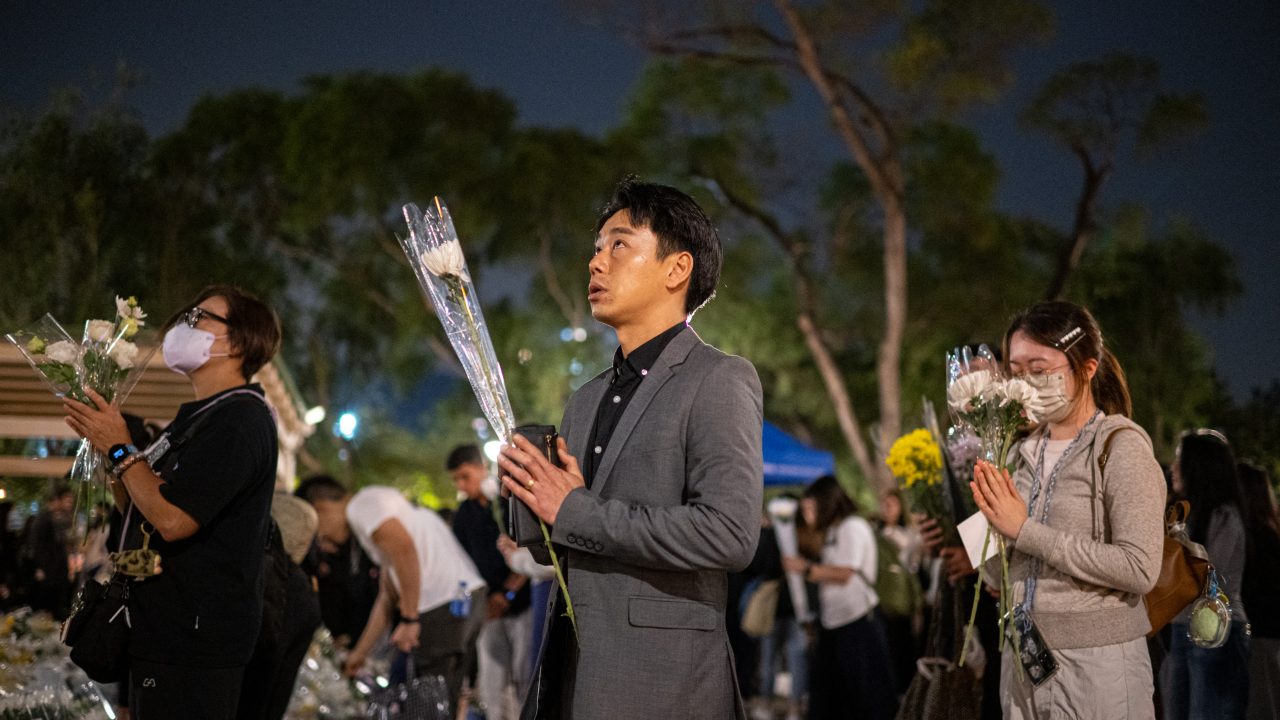
In the aftermath of the Wang Fuk Court fire, Hong Kong’s deadliest in decades, the Chinese authorities have warned citizens not to speak about the institutional failures that led to the disaster. Much of the outrage has focused on shoddy construction materials and corrupt people.
But according to former politicians and community organizers from Wang Fuk’s district, many of whom have now fled abroad, the erosion of accountability began years ago, as Beijing tightened its grip on the city, undermining institutions designed to respond to citizen concerns.
Wang Fuk Court lies in the long-time democratic stronghold of Tai Po. From 1998 until 2021, Tai Po was part of New Territories East, one of Hong Kong’s five geographical constituencies, the city’s term for electoral districts. The city’s old political system allowed 35 of the Legislative Council’s 70 members to be directly elected by popular suffrage. In 2016, New Territories East sent six pro-democracy representatives to the legislature, more than any other district.
Democrats were influential at the neighborhood level as well. In addition to its legislature, Hong Kong has 18 district councils, local bodies without administrative power that are nonetheless meant to act as a liaison between ordinary citizens and the city’s government. Tai Po’s district council has 19 seats. In the 2019 local elections, as mass pro-democracy protests swept across the city, democrats won all 19.
Chow Yuen Wai (周炫瑋) was one of the 19. He served as district councilor for Po Nga Court, an apartment complex two kilometers west of Wang Fuk Court, from 2016 to 2021. He remembers that an important aspect of his job was dealing with homeowners associations, which are in charge of building renovations.
Chow said that the pro-establishment camp understood early on how powerful these organizations were. “They strategically placed their people into these corporations from the beginning,” he said. “Because these positions are unpaid, most ordinary residents are not willing to serve.”
Most residents did not have the time to attend every homeowners association meeting, either, which led to the development of proxy voting. “Originally, proxy votes existed for good reason,” Chow said, “If a homeowner couldn’t attend a meeting, they could authorize someone they trusted to vote on their behalf. But now, the system has become distorted.”
Chow explained that since most homeowners don’t want to attend the meetings, the pro-establishment management companies and building staff go around collecting proxy forms. “They will go door to door,” he said.
Homeowners associations have also long been plagued by a phenomenon called bid-rigging. When the association posts a renovation tender, “several companies bid, but in reality only one is the real one,” explained Raymond Wong (黃毓民), a member of Hong Kong’s legislature from 2008 to 2016. “The others are just fronts or other tricks.” In reality, homeowners associations often have a favored contractor in mind from the start, regardless of what residents might prefer.
“To make the bid-rigging a success, [contractors] must have the assistance from the ownership association,” said Ricky Hui (許家民), former chief investigator at Hong Kong’s Independent Commission Against Corruption. Hui called the corruption of the homeowners association a “catalyst” for the fire in Wang Fuk Court. “Without this,” he said, “the fire will not burn.”
Hui said another catalyst was the decline of commercial building projects in Hong Kong, brought on in part by the city’s decline as a global financial hub. With Hong Kong’s boomtime long past, focus has shifted in recent years from constructing new buildings to renovating old ones. Renovations are where homeowners associations flex their muscle.
With the associations dominated by pro-establishment interests, it was left to the district councilors to act as a counterbalance. “When we were in office, our job was to monitor these corporations and avoid getting too close,” Chow, the former Tai Po district councilor, said.
But by the time the Wang Fuk Court homeowners association granted a renovation contract to Prestige Construction and Engineering Company in early 2024, the checks and balances were gone. Chow and many of his democratic colleagues had been forced to resign their posts in 2021 as Beijing imposed new restrictions on who could hold public office. In 2023, when the next district council elections were held, pro-Beijing politicians won every single seat.
Yam Kai Bong (任啟邦), who served the Tai Po District Council from 2004 until 2021, said that 2023 was a turning point for local government accountability in Hong Kong.
“If there was a genuine community issue before 2023,” he said, “both pro-establishment and pro-democracy parties would compete to speak up for residents.” But the pro-Beijing shift in the district councils changed things. “After 2023, since there are no longer any opposition lawmakers, pro-establishment legislators may not provide immediate responses because there is no competition.”
Lau Yung Wai (劉勇威), another former Tai Po district councilor, said that the decline of real competition in district councilor elections has transformed the institution into nothing more than a “cheerleading squad” for the city government. He elaborated: “The discussions on matters are generally unremarkable, with meetings often adjourning in under 3.5 minutes, serving merely as a rubber stamp.”
Read the second part of this series to learn how the Wang Fuk Court homeowners association, in the absence of a democratically elected district council, ignored residents’ concerns over the hiring of Prestige. The company was later found to have used substandard materials in the Wang Fuk Court renovation project.





Leave a Reply