In June 2024, residents of the Wang Fuk Court in northern Hong Kong received a notice from Prestige Construction and Engineering Company (宏業建築工程有限公司), the contractor performing renovations on their apartment complex. “All air conditioners must be removed to facilitate external wall refurbishment,” the notice read. “After removing the air conditioner, the resulting opening will be sealed with a cover panel, and sealant will be applied to the surrounding gaps for waterproof protection.”
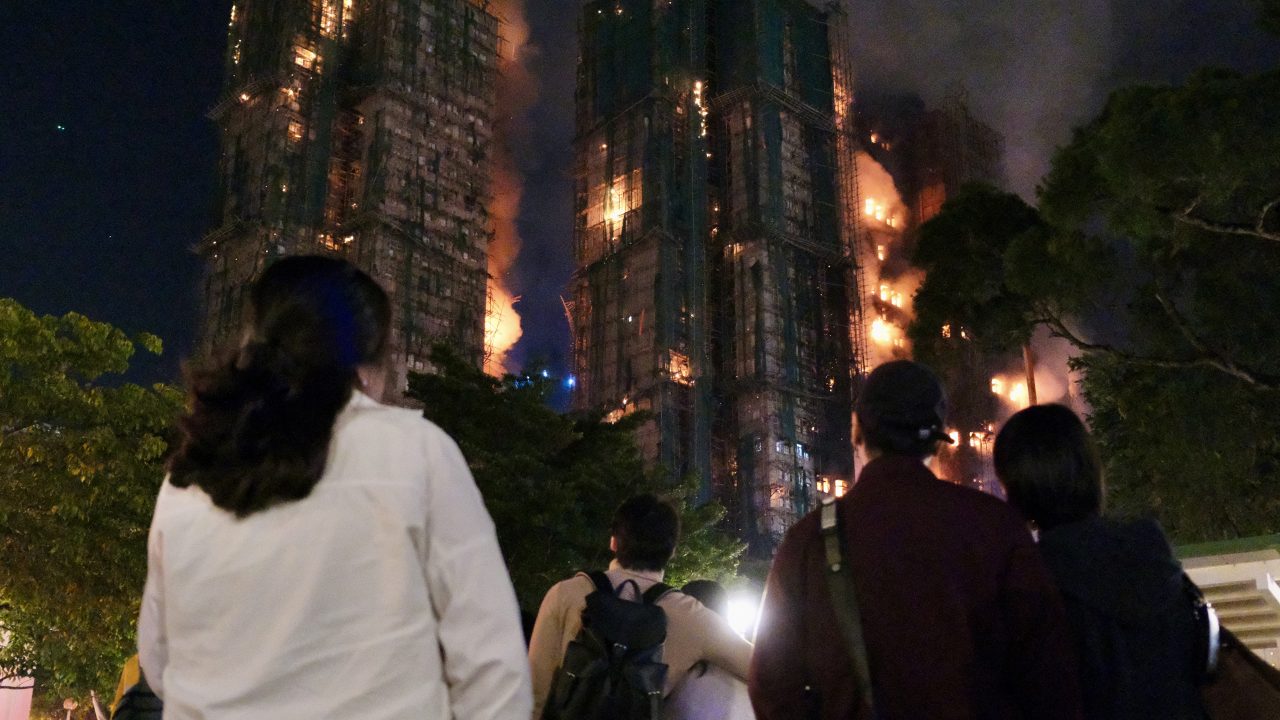
Hong Kong authorities now believe that the highly flammable polystyrene panels, which were applied to protect windows across the eight-building complex, helped accelerate the spread of the fire that killed at least 151 people last week. Domino Theory has found that Prestige also used the panels to patch gaps left behind by the window air conditioner units, which the company had pressured residents to let them remove.
Drawing on three years of notices that Prestige sent to the Wang Fuk Court (宏福苑) home owners association, this article recounts the key moments in the renovation project that led to the deadliest fire in Hong Kong in decades.
January 19, 2023: Tender Document for Prescribed Repair Works
Wang Fuk Court issued a tender for repairs prescribed under a local building inspection scheme. In the typhoon-battered city of Hong Kong, most buildings are made of reinforced concrete.
The buildings in the Wang Fuk complex, which finished construction in 1983 and housed roughly 4,600 people, require both structural and superficial repairs. Prestige later wins the contract, despite a history of safety violations.
June 27, 2024: Prestige Explains Plans to Remove Tenants’ Air Conditioning Units
Prestige issued a notice telling residents that all of their air conditioner units must be removed. Residents with multiple units are allowed to stagger their removal so that they can keep at least one unit running.
At the time of the 2021 government census, nearly 40% of Wang Fuk Court’s residents were 65 or older. Summer temperatures in Hong Kong routinely reach into the 90 degrees Fahrenheit (approximately 32.2 degrees Celcius), with extreme humidity.
Images included in the notice showed the foam panels that Prestige planned to use to patch the openings left by the air conditioners. On Sunday, Hong Kong’s secretary for security, Chris Tang (鄧炳強), said that police had been looking at the highly flammable foam panels as a potential accelerant for the fire’s spread.
July 16, 2024: Blessing Ceremony, Scaffolding Construction Begins
After a ceremony to bless the renovation project, scaffolding construction begins at three of the 32-story towers: Wang Cheong House (宏昌閣), Wang Shing House (宏盛閣) and Wang Chi House (宏志閣). The scaffolding is made out of bamboo encased in a protective green mesh. In a later document, Prestige explained that the horizontal work platforms will be installed as close as possible to the middle of the apartment’s windows, in order to prevent thieves from climbing into the building from the scaffolding.
In September 2024, residents raised concerns about the flammability of the mesh. When the fires break out more than a year later, Wang Cheong House will ignite first.
September 9, 2024: Work Schedule Shows Foam Panels Installed on Windows
Prestige issued a three-month work schedule for September to December, describing how the bamboo scaffolding and foam boards will be installed over the windows. The document explains that the foam boards will be used to protect the windows from debris. When the fire begins to spread, the heat from the burning foam will cause the glass windows to shatter, allowing the blaze to pass into the inside of the buildings.
September 27, 2024: Wood and Hollow Plastic Boards Used for Extra Protection
A notice from Prestige explains that their workers are about to undertake “hacking” work, which involves chiseling or chipping away loose or damaged concrete from the external walls. The document explains that during the hacking work, wooden and hollow plastic boards would be installed over apartment windows as an extra layer of protection.
On Monday, Hong Kong’s Chief Secretary, Eric Chan (陳國基), told reporters that Prestige skimped on material quality in order to boost profits. “They just wanted to make money at the expense of people’s lives,” Chan said.
October 2, 2024: A Warning to Residents
A notice from Prestige describes the procedures the company will follow for its hacking work. But the message also comes with a warning. Any delay or refusal to comply with the temporary removal of an air conditioner unit will not only halt work at that specific location, the notice declares in bright red font. It will also delay work on all the floors below it, leading to significant cost increases. Images on the document show how the foam panels will be used to seal any openings left by the air conditioner removals.
November 22, 2024: Air Conditioner Removal Progress Update
By later November, 242 of the 248 households in Wang Cheong House had had one of their air conditioners removed. It was up to residents to schedule a time for contractors to visit and complete the removal. Yellow means the air conditioner’s removal has been scheduled but not completed. Blue means the residents removed it themselves. White means the removal has yet to be scheduled. At other buildings in the Wang Fuk complex, a few residents refuse outright.
May 15, 2025: Project Schedule Update
In May of this year, Prestige provided a work schedule update for the renovation project. Tasks planned for November 2025 included external wall washing, installation of air conditioner drainage pipes, and the removal of living room air conditioners. Prestige planned to finish the renovations by May 2026. But last Wednesday, for reasons that are still being investigated, Wang Cheong House burst into flames. Before long, the fire had spread to seven of the eight buildings.





Leave a Reply