In eras of divided government, Taiwan’s legislature frequently passes bills that the ruling party does not like. Ordinarily, the president and his premier — lacking the veto power granted to executives in some other democracies — would begrudgingly approve these measures.
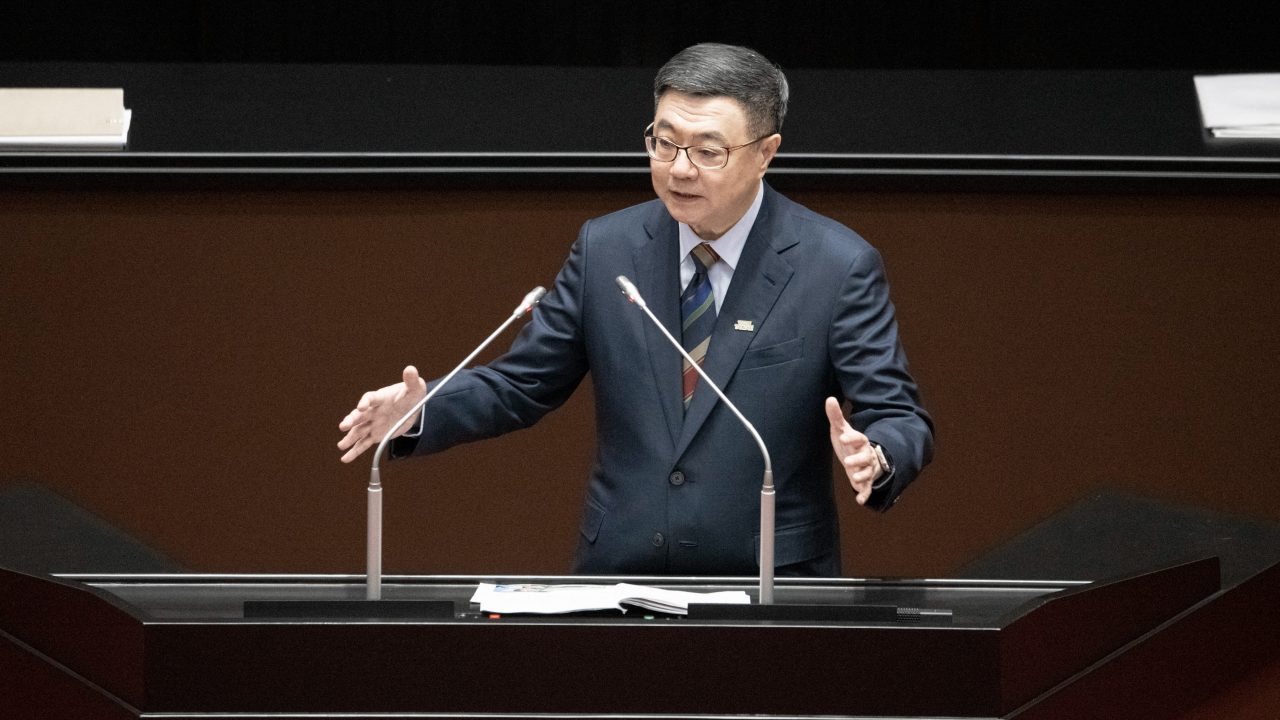
But in the past year, Premier Cho Jung-tai (卓榮泰) of the ruling Democratic Progressive Party, or DPP, has taken the unprecedented step of refusing to countersign legislation to which he objects, on grounds that Cho has described as constitutional, but which his political opponents say are purely partisan. This week, Cho rejected amendments to Taiwan’s Cable Radio and Television Act that came across his desk, marking the eighth time he has taken the drastic step during the current legislative session.
Cho’s action is part of a broader trend of intensifying partisan gridlock that has plagued Taiwan’s government since President Lai Ching-te (賴清德) took office in June 2024.
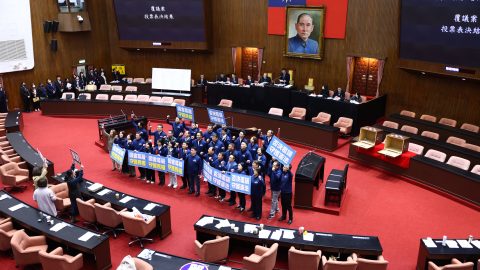
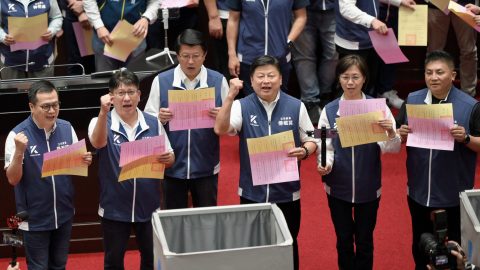
The legislature, which is controlled by the Chinese Nationalist Party, or KMT, has fired its own shots. Last week, it approved the government’s 2026 annual budget, but only after delaying it for a record 351 days. The KMT has resorted to similar grandstanding in the fight over defense spending, twice refusing to approve special budgets that the government says are essential to Taiwan’s survival in the face of growing Chinese pressure.
But the premier’s appropriation of what is effectively veto power — without the approval of Taiwan’s Constitutional Court — strikes at the heart of what, to many, makes Taiwan worth defending in the first place. The growing conflict threatens to destabilize the constitutional framework that allowed Taiwan to peacefully transition from a martial law dictatorship into one of Asia’s most vibrant democracies.
The conflict has come to a head over the last two weeks, after Cho refused to countersign two more pieces of legislation, and the legislator passed a resolution censuring him for his actions.
If Cho’s behavior continues, KMT legislative speaker Han Kuo-yu (韓國瑜) said on Tuesday, it not only hollows out a single law, but risks undermining the entire constitutional order. Cho shot back the next day, saying in a speech that while Han is well-read in ancient classics, he has not spent enough time studying the constitution.
Cho first refused to sign one of the legislature’s bills last December. The bill in question would have reallocated tax revenue from the national government to local municipalities — a move advantageous to the KMT, which has been relatively more electorally successful at the local level in recent years.
Taiwan’s constitution stipulates that when the premier feels he cannot effectively enforce a bill — either because it is unclear, or unconstitutional — he can return it to the legislature for reconsideration. Cho did this, but when the bill returned to his desk a second time without any changes, he resorted to a tactic not clearly spelled out in Taiwan’s constitution: refusing to sign it.
“The countersignature was never meant to be a weapon for the premier to block legislation,” said Yung-djong Shaw (邵允鍾), assistant professor at Academia Sinica. “If we accept that the premier has the power to withhold his signature, he can block legislation at will, which in turn tilts the balance of power heavily in favor of the executive branch.”
Defenders of Cho’s actions argue that it is a reasonable reaction to an increasingly strident legislature, which is willing to increase its own power by any means necessary. Chen Fang-yu (陳方隅), assistant professor of political science at Soochow University, said that Cho has a responsibility to help maintain a balance of power between the executive and legislative branches. “The legislature is out of control right now,” he said.
According to Su Yen-tu (蘇彥圖), a research professor at Academia Sinica, the premier’s decision is a result not just of the aggressive actions of the legislature, but also the inherent weakness of the executive branch itself.
“There’s a huge defect in our constitutional system because the previous veto mechanism is just too weak to protect the executive branch,” he said. “So they have to resort to other means.”
When Cho first refused to sign the revenue reallocation bill in December, he cited a rule that prohibits the legislature from exceeding the government’s legal borrowing cap. His justifications for subsequent refusals to countersign have gotten more creative.
Su is skeptical that Cho will be able to muster a convincing rationale for his latest refusal, which targets the amendments to the Radio and Television Law. “Essentially, it’s about whether we should relax the restrictions on party or political money in the media industry,” he said. “So, certainly, some people would say that it’s not obviously, patently unconstitutional. It’s debatable.”
The debate over the proper role of Taiwan’s premier arises in part from the fact that the role has changed over time. When Taiwan held its first democratic presidential election in 1996, the position of premier was both stronger and weaker than it is now. Bills that the premier sent back to the legislature for reconsideration could only be overridden by a two-thirds supermajority, similar to the veto override process in the United States. But the premier’s appointment was subject to confirmation by the legislature. That made the position a check on the power of the presidency, which the reformers of the time — who had just emerged from a decades-long dictatorship — were intent on limiting.
A series of constitutional reforms in 1997 removed the parliamentary confirmation process, while dropping the veto override threshold to a simple majority. The changes left the premier as a close ally of the president, but one who had little ability to block legislation.
Shaw, the assistant professor at Academia Sinica, said that Taiwan’s mix of presidential and parliamentary constitutional structures has left the premier in an awkward position. “In the old days,” he said, the premier’s position “did not cause much trouble, because the constitution required the premier to be confirmed by parliament.”
“But after the constitution was amended, the president no longer needed parliament’s consent to appoint a premier. This has created considerable tension between the executive and legislative branches in times of divided government, which is exactly where we are now.”
It is not clear how Taiwan’s government can emerge from this quagmire. The KMT-led legislature could decide to hold a vote of no confidence against Cho. But that would give President Lai the power to dissolve the legislature, leading to new elections that would be costly for the KMT, and far from certain to improve their political position.
Ideally, the Constitutional Court would step in. But it, too, has fallen victim to partisan brinksmanship. The KMT has refused to confirm President Lai’s judicial nominations. More than two years into his term, only eight of the court’s 15 seats are filled. Three of those justices have refused to participate in any rulings.
Su, the Academia Sinica professor, says that the court’s diminished state has left it without the level of public trust that would allow it to issue the kind of definitive ruling that the situation calls for. “It’s a matter of political authority or social legitimacy,” he said. “The court knows that. So they refrain from hearing politically salient, controversial cases.”
The other factor allowing Taiwan’s constitutional crisis to persist is less obvious: The public does not seem to care. Despite unprecedented levels of government dysfunction, Taiwan’s economy is riding the AI boom to an 11% growth rate. Lai’s approval rating, according to a recent poll, is at its highest level in more than a year. And unlike the United States, where legislative gridlock leads to government shutdowns and real economic pain, Taiwan has provisions that allow it to operate according to old budgets while the legislature fails to approve new ones.
Shaw said that he was surprised at the lack of public outcry when the premier first refused to countersign legislation last year. “I expected large-scale street protests, but there were none,” he said. “Perhaps the eight laws blocked by the premier so far are simply too removed from the daily lives of ordinary citizens … But as a constitutional scholar, I have to say this is a very worrying development.”


Leave a Reply