
After more than a decade of purges and over a million corruption investigations into his fellow Chinese Communist Party officials, a concerted call for party discipline from Chinese President Xi Jinping (習近平) might seem like overkill. But that is exactly the message Xi is expected to deliver when the party’s top figures convene in Beijing this week.
The fifth plenum, as it is known, is China’s most important political meeting this year, with over 300 of the party’s elite gathering behind closed doors in Beijing to refocus efforts ahead of next year’s Communist Party congress. Early reports suggest the focus will once again be loyalty.
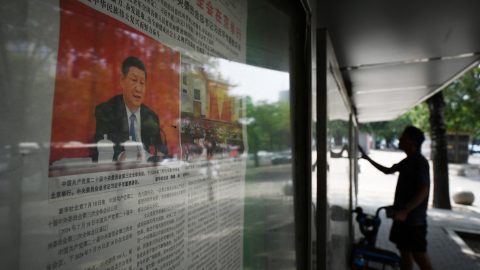
On Monday, Xi opened the meeting with a work report covering “full and rigorous party self-governance,” according to China’s state-run Xinhua News Agency. According to experts, that language is code for absolute loyalty to the party, and “Xi Jinping Thought” — the leader’s personal governing ideology — in particular.
Xi’s emphasis on self-governance in the party suggests that his definition of corruption has evolved beyond simple allegations of fraud to encompass insubordination on matters of policy.
“During leadership transitions, we must keep our eyes sharp, elevate good cadres who are truly loyal and reliable, consistent in word and deed, and willing to take responsibility, and never allow ‘two-faced people’ or those driven by self-interest to slip through,” Xi said at a high-level meeting earlier this year, as quoted in the Central Committee publication Qiushi Journal.
On the domestic policy front, Xi has doubled down this year on his favored export-driven growth strategy, even amid loudening calls for China to prioritize consumer demand and a liberalization of its financial system. The sprawling nature of the party’s governing bureaucracy makes discipline and loyalty key factors for determining whether Xi’s directives continue to be executed at the provincial and local level.
Anti-corruption campaigns have been a primary focus of Xi’s rule since he took power in 2012. As a political tool, corruption charges are dual use: Xi has used them to both tighten party cadre adherence to his policy initiatives and purge perceived rivals to his grip on the party.
Since Xi appointed himself for a third five-year term as China’s leader in 2022, the party’s military has borne the brunt of his continuing crackdown.
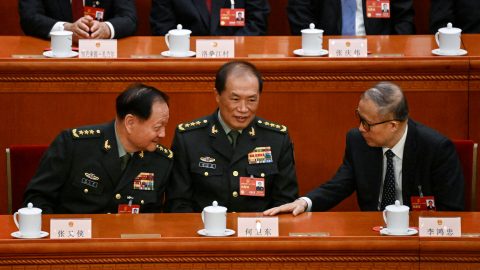
According to Neil Thomas, a senior fellow at the Asia Society Policy Institute, 42 of the 44 military-affiliated officials elected to the Communist Party’s Central Committee in 2022 have now been purged. That includes high-profile members of the Central Military Commission Zhang Youxia (張又俠) and He Weidong (何衛東), officials long viewed as Xi loyalists but who in recent years may have clashed with Xi over the Chinese military’s readiness to take Taiwan.
Xi’s latest anti-graft push comes as he prepares to secure a fourth term in office at the party’s congress next fall. As that meeting approaches, no clear successor to Xi has emerged, raising questions about his desire to govern for life.
In the meantime, Xi has gathered all the key members of China’s political elite in a single room to once again demand their absolute loyalty to himself.




Leave a Reply