On Friday, August 9, the Africa-China Research Network in Taiwan reading group held one of its semi-regular meetings in Kaohsiung. A small group of Taiwan-based scholars, the majority of them African, met for a day’s discussion. The topic was a comparison of two books on Africa and China by the Zambian-British academic Dambisa Moyo. This report of the discussion follows the Chatham House Rule, where what was said during the meeting is unattributed.
Dramane Germain Thiombiano, assistant professor at National Yunlin University of Science and Technology and one of the founders of the Africa-China Research Network, told me that it is the first research community of its kind established in Taiwan dedicated to the study of Africa-China relations. It brings together a small group of interested scholars based in Taiwan, some of whom have already researched and published on the topic independently. He said the goal of the network is to promote academic conversation and collaboration through reading group and workshop panels, and to contribute to broader public awareness and understanding about Africa-China relations in Taiwan. The network also aims to highlight Taiwanese perspectives on Africa-China relations by focusing on research into the history of Africa-Taiwan relations and their relationship to Africa-China relations.
Dambisa Moyo, Baroness Moyo of Knightsbridge if you prefer, is a world-renowned economist. She studied at Oxford and Harvard, then worked for the World Bank and Goldman Sachs. She has published five books and became a member of the U.K.’s House of Lords in 2022.
“Dead Aid,” published in 2010, is a controversial book. In it, Moyo argues that the provision of aid to African countries by the “developed world” is holding the continent back. Her thesis is relatively simple and comes in two parts: One is that the provision of “free” goods and capital wrecks the local economy; and the second part is that because aid is often provided to the government, it allows kleptocratic leaders to support themselves without being in anyway beholden to their citizens.
Moyo makes her own case with her classic mosquito net example:
“There’s a mosquito net maker in Africa. He manufactures around 500 nets a week. He employs ten people, who (as with many African countries) each have to support upwards of fifteen relatives. However hard they work, they can’t make enough nets to combat the malaria-carrying mosquito. Enter vociferous Hollywood movie star who rallies the masses, and goads Western governments to collect and send 100,000 mosquito nets to the afflicted region, at a cost of a million dollars. The nets arrive, the nets are distributed, and a ‘good’ deed is done. With the market flooded with foreign nets, however, our mosquito net maker is promptly put out of business. His ten workers can no longer support their 150 dependants (who are now forced to depend on handouts), and one mustn’t forget that in a maximum of five years the majority of the imported nets will be torn, damaged and of no further use. This is the micro-macro paradox. A short-term efficacious intervention may have few discernible, sustainable long-term benefits. Worse still, it can unintentionally undermine whatever fragile chance for sustainable development may already be in play. Certainly when viewed in close-up, aid appears to have worked. But viewed in its entirety it is obvious that the overall situation has not improved, and is indeed worse in the long run.”
Moyo’s prescription is quite simple. Over a very short period, no more than half a decade, external aid should be progressively reduced to zero to force African countries (and leaders) to develop their own economies. Obviously, the consequences of them failing would be catastrophic, something Moyo acknowledges but doesn’t really deal with.
Moyo then suggests various alternative ways for African countries to be supported in their economic development. Prominent among these is the idea that instead of Western aid, African governments should accept Chinese money, which Moyo argued, in 2009, would take the form of foreign direct investment that would be inherently directed into economically productive activities, avoiding the issues outlined above. It’s not unfair to say that Moyo was enthusiastic about these Chinese loans.
What was most interesting about the meeting of the reading group is that the scholars, as a whole, accepted Moyo’s central thesis that aid has failed Africa. In fact, one participant described her as “feeling the pulse of Africa” on aid. The group also developed certain themes: Aid organizations are not incentivised to end the state of aid being necessary, for example. Aid that is provided with conditions can bind the hands of governments in ways that prevent them from being able to respond to the desires of their populaces.
The group seized on Moyo’s use of the phrase “benevolent dictator.” It was pointed out that Africa already has dictators, and few of them are benevolent. In all fairness, this is a point that Moyo makes herself in the same paragraph. Nevertheless, it was suggested that as an “elite”, even as a member of the House of Lords, Moyo may have developed a certain naivety.
By 2012, Moyo wrote “Winner Take All.” In this book, she describes China strategically cornering the market on many vital minerals and raw materials, including, obviously, in Africa. While the reading group meeting had intended to argue why in three years Moyo went from broadly positive on Chinese investment to broadly negative, members found that this was not the case, and that Moyo’s shift toward negativity on China had come much later on, in more recently published material.
Even so, frustratingly, I don’t think that a consensus was ever really reached on Moyo’s “shift,” as the flow of discussion continually drifted toward African solutions for African problems. However, I was able to ask several questions along the way that prompted interesting micro-answers.
The point was advanced that many of the loans China has provided to African countries will probably never be paid back. Moyo did not understand this in 2009. It’s also clear from the text of “Dead Aid” that Moyo had no idea that the prevailing view in 2024 would be that Chinese investment would almost exclusively fuel Chinese jobs for Chinese companies in Africa. This is a viewpoint that was also espoused at the meeting. However, in an email after the event, Derek Sheridan, another co-founder of the Research Network, gave me a more nuanced view. He said that “the data doesn’t really support that claim. In absolute terms, most of the people hired by Chinese companies are African, but it varies by country and industry. It is also true that some companies hire more Chinese than they are legally supposed to, and there are also issues with who are the managers and who are the lower level workers … Nonetheless, the belief and suspicion that only Chinese are being hired is a very persistent one.”
The African contributors mostly viewed China’s behavior in Africa as opportunistic and self-interested, and in this it is “no different than the West.” Unlike some viewpoints advanced in other quarters that China didn’t really know what it was getting into loaning in Africa, the consensus here was that it definitely did, but that it had assessed countries’ rare minerals rather than their ability to pay back a loan.
I asked participants whether Chinese construction projects were inherently low-quality. The view was that African countries get what they ask for. If they hold the contractors to a high standard, it is delivered. If “slapdash” is acceptable, you will certainly get it.
After the event, I asked Germain Thiombiano: Why do African countries keep accepting loans? He said that “the main problems that could make loans less effective and lead to more borrowing and an overreliance on loans and foreign aid are corruption, political instability and bad leadership.”
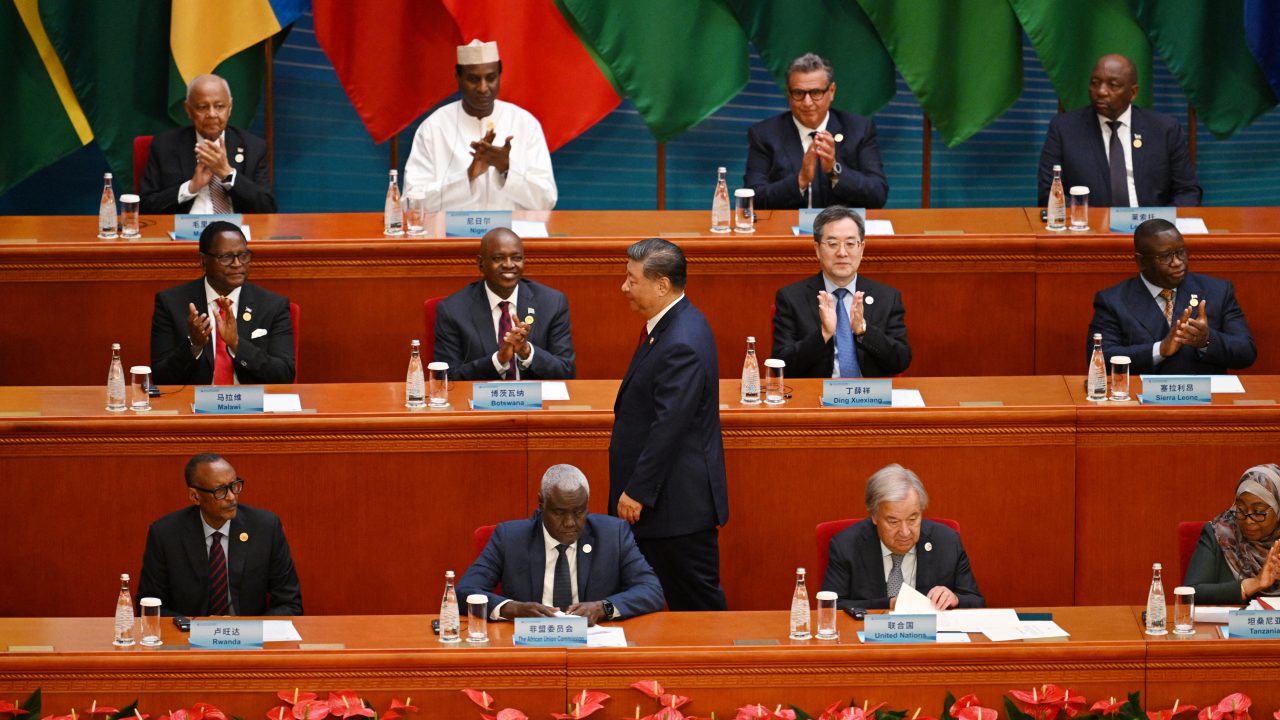
Almost a month later, Chinese President Xi Jinping (習近平) addressed the Forum on China-Africa Cooperation in Beijing. He pledged over $50 billion in financing for Africa over the next three years. Chinese money in Africa isn’t going anywhere.
The Africa-China Research Network will host a film screening and discussion on September 23 featuring the artists Musquiqui Chihying and Lou Mo presenting their short film “The Link” from their recent exhibit “The Ghost in the Sea,” which looks at Asian labor migration and China’s digital capitalism in the Indian Ocean and on Mauritius.



Leave a Reply