
This is one situation where a shallow understanding might actually be helpful.
New “invasion barges” or landing platforms caused alarm when they were first spotted in January satellite footage by naval analyst H I Sutton, amid increased Chinese military activity around Taiwan. The vessels could help China get reinforcements and heavy vehicles onto Taiwanese beaches without capturing a port.
But new analysis of open source intelligence by Domino Theory reveals that the three platforms seen so far might be too “short” for many of the beaches suitable for amphibious landings on Taiwan’s west coast.
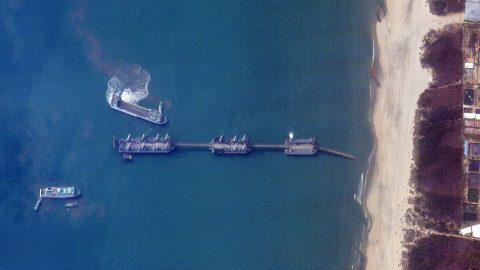
China used the three different platforms seen so far to make a single temporary pier in March. Civilian ferries and vehicle carriers, which often take part in exercises with China’s military, practiced mooring at this pier.
However, these ferries are large, and the sea is shallow off Taiwan’s west coast beaches, from Taoyuan to northern Tainan. A pier made from only three “units” would not reach out to water deep enough to be used by the civilian vessels reliably and safely.
This suggests that either the “invasion barges” are intended to be used in other areas, like Taiwan’s northeast or southwest coasts, or that they will eventually be seen forming longer piers of more than three units.
They were initially described as “invasion barges” in headlines, which is misleading as it invokes a craft intended to ferry material from one place to another. The key capability is that the new ships have jack-up legs that allow them to lift themselves out of the water, forming a stable structure, as well as bridges that can connect to another vessel or to the shore.
Instead of “invasion barges,” U.S. Naval War College analysts Thomas Shugart and J. Michael Dahm coined the term “landing platform utility” to describe the new ships in their China Maritime Studies Institute note, “Bridges Over Troubled Water.” They used the name Shuiqiao (水桥) or “water bridge” in Chinese as a way of referring to the different sizes of platform. Shugart’s open source work enabled much of the analysis Domino Theory performed for this article.
When China deployed the vessels in their first known exercises in March, observers saw that the three Shuiqiao types could be linked together, forming a much longer pier that would allow other ships to dock at its end and sides.
Shugart and Dahm determined these would almost certainly be Chinese civilian ferries and cargo ships, bringing ashore heavier units and more reinforcements after the initial landings. China builds some of its civilian fleet to military standards that mean they can carry heavy tanks as well as cars and trucks.
The exercises off China’s coast in March were carried out in shallow water when the tide was in, meaning that the water was deep enough for the larger civilian vessels. However, if China intends to use the landing platforms as mobile ports that allow reinforcements and heavy equipment to be landed following a successful amphibious assault, it would likely require the piers to be operational 24 hours a day so they can maximize the throughput of material.
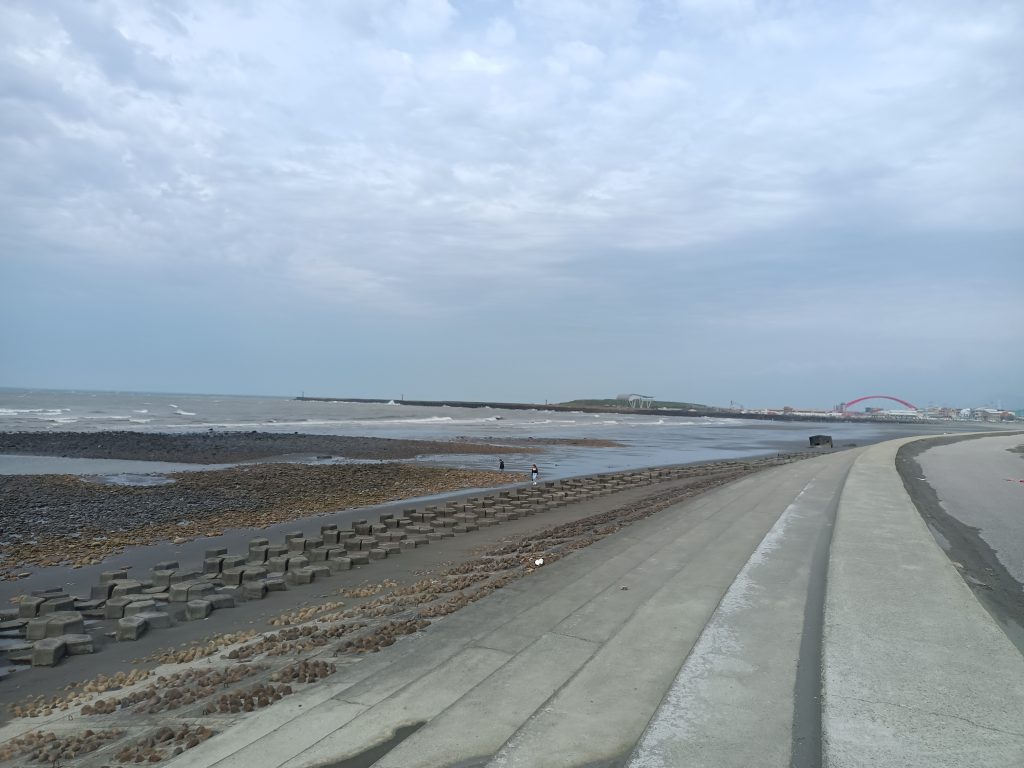
Shugart and Dahm calculated that the combined length of the three platforms and the bridges between them is 820 meters. For beaches all down Taiwan’s west coast, from Taoyuan through to north Tainan, this is not long enough to reach deep water at low tide, allowing round the clock operation with large vessels. The most likely location for a Chinese invasion has long been considered Taoyuan, specifically Haihu beach (海湖海灘) next to the airport.
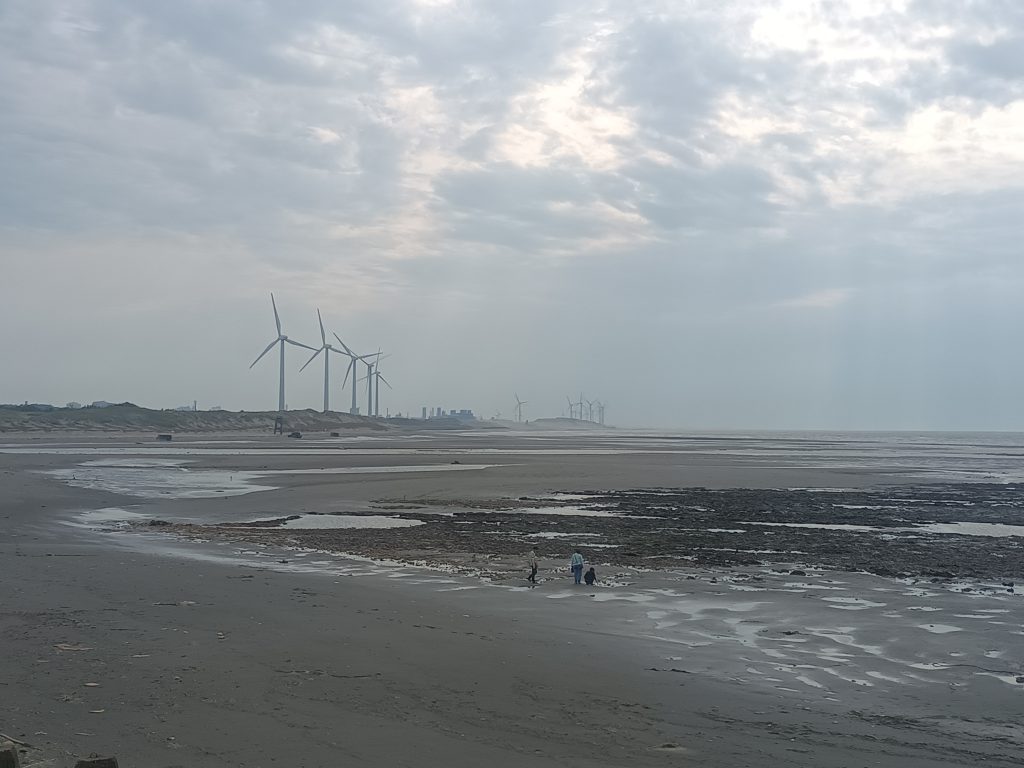
However, for beaches in Kaohsiung and Pingtung in the south, and New Taipei and Yilan in the north, the seabed drops off much faster, meaning a three-unit pier would be feasible in these areas. This is even the case at Linkou, a district of New Taipei adjacent to Taoyuan.
“PLA writings indicate that they will employ deception and surprise in this operation, and their field manuals explicitly call for hiding the main effort amid the overwhelming chaos created by feints, demonstration landings, and multi-pronged attacks,” said Ian Easton, the author of “The Chinese Invasion Threat.” PLA is an acronym for the People’s Liberation Army, China’s military.
In an email exchange with Domino Theory, Easton said he expects China will attempt land in two or three places, with each lodgment centered around a port. He thinks the new landing platforms “could allow the PLA to construct landing zones in areas along Taiwan’s coast that have not been considered feasible in the past.”
In other words, it’s time to look again at old assumptions about where and how China might invade Taiwan.
The landing platforms are differentiated by form and function. The shortest landing platform, the Shuiqiao 110, is optimized for connecting to the beach and shallow water, with a shallower draft and shorter jack-up legs than the other two. The longest, the Shuiqiao 185, has a specific ramp on the rear to allow the larger vehicle carriers to unload. The medium-sized vessel, the Shuiqiao 135, has two ramps, one for each side.
In the March exercises, the platforms were deployed in a line of three, with the Shuiqiao 110 connecting to the beach, the Shuiqiao 185 at the seaward end and the Shuiqiao 135 in the middle.
Perhaps the Chinese military intends to use the landing platforms as already seen, and therefore away from some of the more obvious landing beaches in Taoyuan and Tainan. Possibly it would simply not use them at low-tide, or accept a lower throughput with smaller vessels at those times.
However, another obvious possibility is that the piers could be extended by deploying more landing platforms into a single pier, making them longer than three units. In Taoyuan, four would be enough. In Chiayi, a pier would need to be substantially longer than that.
If China intends to use the platforms to make longer piers, not only is it likely that this would be observed during exercises, it could also be inferred by looking at the ratio of beach connectors to “middle pieces” under construction. This ratio could even suggest which beaches on the west coast might be targeted, since there is considerable variation in how far out the shallows extend.
So far, China has not tried to hide this new capability. Future exercises and satellite imagery are likely to reveal more details. Many eyes will be watching..


Leave a Reply