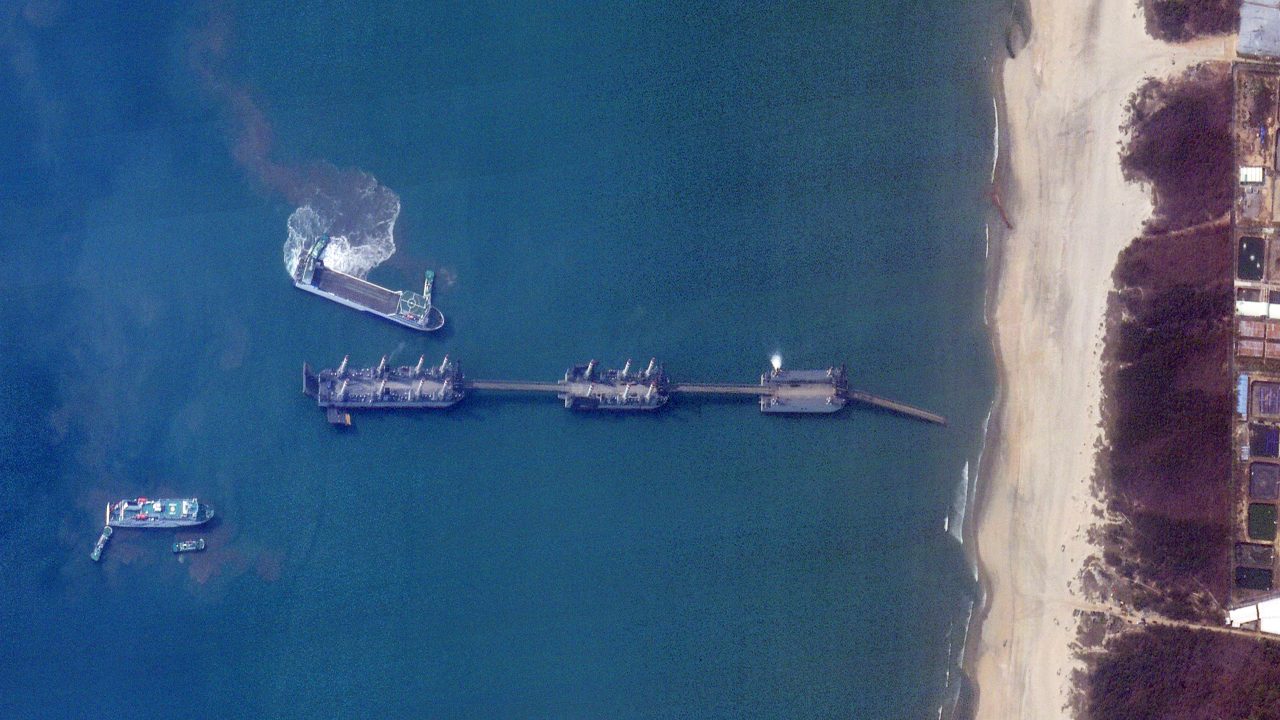
When the first satellite images of China’s invasion “barges” appeared, they sparked fears that Chinese preparations to take Taiwan were stepping up a gear.
Domino Theory covered the first look at the barges in January. But we’ve now seen quite a lot more of them, allowing a second, deeper examination.
So far, three different sizes of new barge have been observed. All have jack-up legs that allow their bodies to be raised out of the water, making them very stable even in rough swell. All have “bridges” that can extend out of the front and link to another barge or to the shore.
The shortest barge is approximately 110 meters long and appears to be intended for connecting directly to the shore. It has shorter, thinner legs and lacks an exposed rudder or propeller that could be damaged in shallow water.
The medium barge is approximately 135 meters long with six legs. It has ramps to allow vehicles to be driven from cargo ships or ferries on to it on both sides.
The longest barge is 185 meters long with eight legs. It has ramps on the stern and on the starboard side.
In exercises in March, the three units were seen connected in series, with the shortest ramping onto the beach, the middle in the middle and the longest at the end. Chinese ferries were seen in satellite imagery mooring up to the longest barge.
It has been estimated that in this setup, the People’s Liberation Army could unload about one battalion of troops per hour, which is roughly 600 to 800 men and their equipment.
There have been several good explorations of what we know about the barges, such as this New York Times article or this article in Naval News by Alex Luck, who is one of the experts interviewed for this piece.
This article will not go over the same ground in more detail. Rather, I want to take what we already think that we know and apply it to a different question: Where might China use the barges?
For this article, I talked to four experts from a variety of differing but related fields who offer relevant expertise. Three have written or commented on the barges already. I also quote a retired Taiwanese admiral who recently commented on the barges in an on-the-record briefing. The ideas in this article are a synthesis of my conversations with them and my own thoughts. Obviously, quotes and ideas are directly attributed where appropriate.
In the first instance, it is necessary to deal with a misconception. No one thinks that these barges are to be used in the first wave of PLA troops that hit Taiwanese beaches. They are not “landing craft on steroids” that are going to drop their ramps over the beach and unload Chinese marines under fire.
It is my contention that the use of the word “barge” has to some extent fueled this misconception, because by its very nature it misinforms the reader as to the purpose of these vessels. For the rest of this article, I will use the acronym LPU for the naming convention “landing platform utility” as coined by J. Micahel Dahm and Thomas Schugart in their authoritative China Maritime Studies Institute note on the vessels.
Everyone I spoke with agrees that the LPUs are intended to bring ashore reinforcements, heavier armor and logistics support after the initial landing when the invasion beaches have been taken and at least partially secured. Because of this, initial ideas that the LPUs could be used to facilitate landings in parts of Taiwan that don’t have “traditional invasion beaches” are much harder to support.
However, beyond this point there is a healthy diversity of opinion about when and how the LPUs could be deployed. For simplicity’s sake, we can distill and summarize these views into two distinct scenarios. Understanding each informs and suggests a different invasion strategy. Finally, the differences between the two can be used to make predictions about which China might choose.
Scenario One: The Distant Rural Landing
Alex Luck is a naval and defense analyst based in Australia. He says that the LPUs are “vulnerable to a variety of attacks,” including artillery, both tube [guns] and missiles, and also drones. Luck says it’s very hard to give precise numbers when there are so many unknowns, but thinks at a push that China would want to “cordon off” at least 20 kilometers around the landing sites and the beachhead to prevent most of the shorter range artillery fire.
Sal Mercogliano is a history professor at Campbell University in North Carolina who specializes in maritime shipping. He told me that the LPUs are intended for a “benign environment,” one where they are not really under fire at all. He suspects it will be hard to have them out of artillery range, though. Unlike Luck, Mercogliano considers the LPUs likely to be relatively tough, especially once they have their legs jacked up and they can’t sink.
Both Luck and Mercogliano think that the LPUs would be better deployed away from urban areas, where amphibious landings would be bloodier on both sides and it would be hard to establish that kind of “benign” environment with a larger perimeter to the beachhead.
This set of assumptions inexorably drives you away from what has long considered the most likely area for the PLA to try to land, which is Taoyuan. Taoyuan has the trifecta of features that are desirable for a successful amphibious invasion beachhead, which is a good beach for landing initial forces and a nearby port and airport that can be seized to allow the bringing in of all subsequent forces for onward operations. If you seize a beach and have no way to reinforce your initial troops, your invasion will inevitably fail.
The problem is that Taoyuan is a heavily urban and industrial environment and is also, theoretically, the most invasion hardened place in Taiwan. Establishing a large perimeter around Haihu beach (海湖海灘) in Taoyuan would require days, even weeks of grinding urban combat.
Instead, if you reject Taoyuan and other possible sites near major cities in Taiwan, you are left with a likely candidate being the beaches or mudflats in the relatively sparsely populated counties of Chiayi, Yunlin and southern Changhua.
As long as the Taiwanese military did not know the location of the invasion in advance, this area would probably be less defended, and a successful landing and large beachhead easier to establish. Here the LPUs come into their own, as they would allow the establishment of quasi-port facilities which the area mostly lacks, with the exception of Mailiao.
Scenario Two: Landing Near an Urban Area
To subscribe to the alternative view, one simply needs to throw out a key assumption: that the LPUs are not intended to come under fire or take losses. After that, not only does their use in a landing near to an urban area become more plausible, the logic even drives it towards necessity.
For the sake of simplicity, we will just treat this scenario as being Taoyuan. The logic applies to other candidate invasion sites, too, but they have the drawback of being further from Taipei.
Shen Ming-shih (沈明室), from Taiwan’s Institute for National Defense and Security Research, thinks that if the PLA landed at Taoyuan, they would bring in the LPUs after they had established a beachhead perimeter of only one to two kilometers. In doing so they would still be under heavy fire from Taiwanese artillery and other systems.
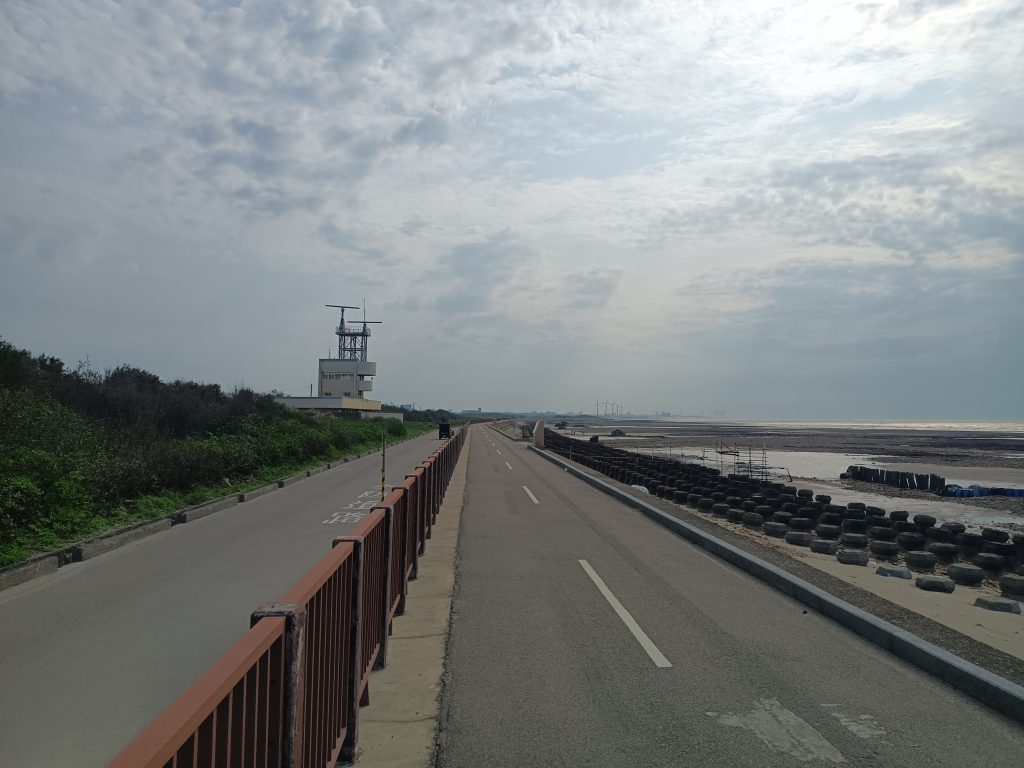
Using the LPUs at this point at Taoyuan makes sense. Although the Chinese forces would likely have already seized the small Zhuwei fishing harbor at the end of the landing beach, they would still be far from the port of Taipei up the coast, which is one of the key “trifecta” objectives.
Rather than allowing more forces to land into a large and secure beachhead in the south, in this scenario the LPUs allow heavier units to flow earlier into a smaller contested lodgment to provide the necessary mass to expand it further against opposition.
Jakub Janovsky is an open source intelligence analyst and the current administrator of the Oryx blog, which documents military losses in ongoing conflicts such as the Russian invasion of Ukraine. I had wanted to speak to him to understand what the effective range of artillery is in practice in 2025, which informs what size of beachhead you would need for the use of the LPUs in the first scenario.
That proved to be too difficult to answer usefully, because the ranges are too disparate between the different systems that Taiwan operates, although again for many of the shorter range systems the number of 10 kilometers is a useful benchmark.
What struck a chord, though, was Janovsky’s comparisons of a notional Chinese beach assault to Russians operations crossing rivers in eastern Ukraine. He said there are examples where a “brigade’s worth of equipment” was lost for “pretty much no gain.”
Janovsky said he expects that the PLA’s amphibious vehicles that can be deployed directly from ships (into the water) would take “significant losses,” and that if they want to deploy serious numbers of even light armor early, it would need to use the LPUs in the second wave. “I suspect that the PLA would be more likely to make [a] decent number of them and just expect some to get lost.”
Which One?
Even if all of this analysis is exactly right, which seems unlikely, it doesn’t tell us which scenario the LPUs are intended to be used in, and thus where. I have just outlined plausible cases for both.
There also exists the credible possibility that China would intend to land at multiple locations around Taiwan, including both of the scenarios outlined in this article.
But there is something that could be used as a way to try to pull some signal out of all the noise: The amount that China builds in the coming months and years.
If that number is relatively low, it would seem unlikely that they are expected to take heavy losses, and vice versa.
A Psyop?
There is another possibility: That the LPUs will not be used at all, either because they are found to underperform in testing or because they are a psyop designed to intimidate Taiwan and the U.S.
Shen from Taiwan’s Institute for National Defense and Security Research thinks that these vessels should be easy to destroy and that they will be hard to use in the shallow waters around Taiwan.
Retired admiral and current Taiwanese Legislator Chen Yeong-kang (陳永康) went further. He told foreign media in Taiwan last week that he thinks the LPUs are “psychological warfare” and that the bridges between the different units “cannot support 70 tons of tank.”
None of the conclusions drawn in this piece should be regarded as firm. I am feeling in the dark, just like everyone else.
However, the more we see China building equipment that a “normal” navy wouldn’t need, the more we should ask how, where and when it might be used.



Leave a Reply