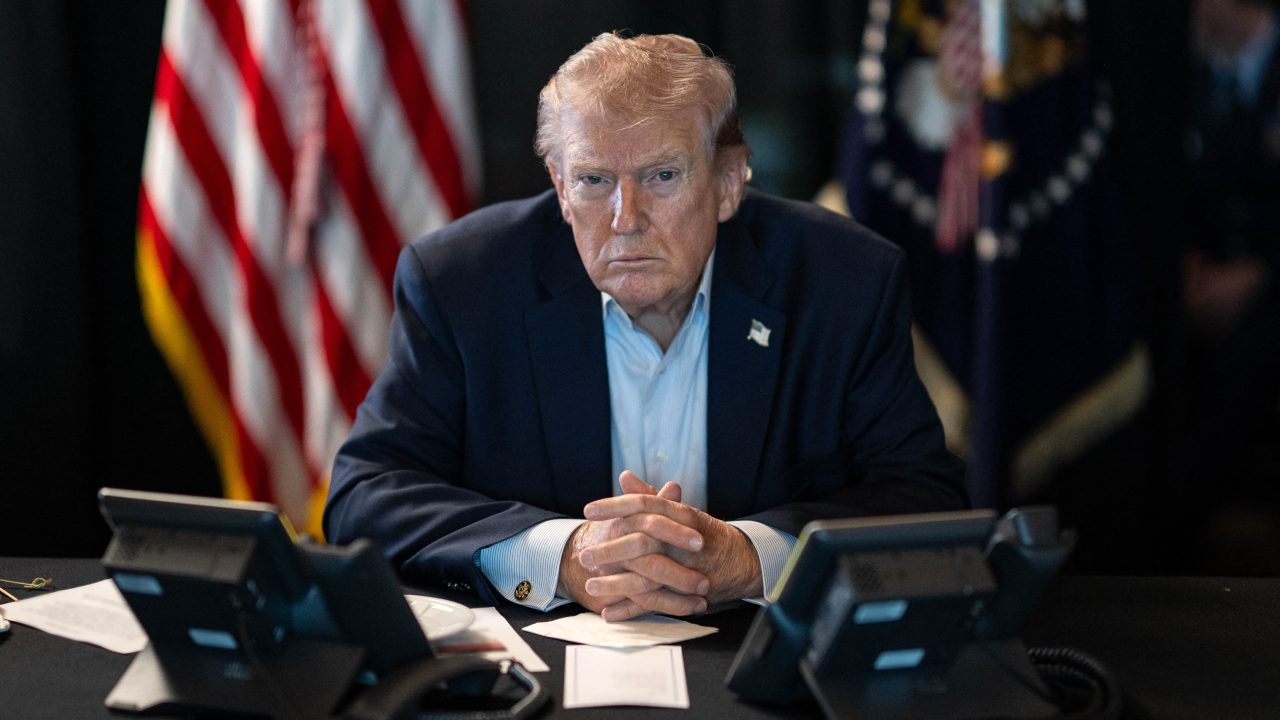
On Monday, President Donald Trump floated the idea that he might not go to China this month. On Tuesday, he confirmed it.
China’s response has been characteristically guarded. The Ministry of Foreign Affairs responded to Trump’s announcement by saying that it remained in communication with the U.S. about the visit.
Despite the ongoing war with Iran, a “comprehensive strategic partner,” China has been surprisingly committed to the idea of the Trump-Xi summit. “Failure to engage between the two nations would only lead to misunderstandings and misjudgments,” Foreign Minister Wang Yi (王毅) said on March 8.
It seems that Beijing may like the idea of hosting the U.S. president while his country is yet again embroiled in a war in the Middle East.
But then again, perhaps there is something else going on.
There are certainly things that China wants from the U.S.
Chinese foreign ministry spokesman Guo Jiakun (郭嘉昆) recently reiterated Beijing’s desire for sanctions on Chinese and Hong Kong officials to be lifted.
Chinese companies have finally placed orders for Nvidia’s advanced H200 chip, lending the lie to the suggestion it might do no such thing.
And while Beijing may enjoy the U.S. being bogged down in an unpopular conflict, it probably doesn’t love losing its access to all that oil and gas, let alone the knock-on effect of all its partners’ economies slowing down. Hardly good news for China’s own struggling economy.
Meanwhile the U.S. is spinning up its domestic energy production, and increasing its weapons production as it realizes how many munitions it actually needs in a modern conflict.
Suddenly things don’t look so rosy.
The good news is, Trump famously wants to make deals. And he wants to go to China. He just doesn’t want to go under a cloud.
Beijing can lift that cloud. China and the U.S. can jointly announce that the summit is back on and that it will be preceded by the lifting of sanctions by both sides.
But to do that, some business has to be handled.
The Hong Kong government has jailed dozens of prisoners on conscience for practicing in protest or simple democratic activities like primaries. Some, like the 78 year old Jimmy Lai (黎智英), now face decades in prison. Others, like Chow Hang-tung (鄒幸彤) are in the dock right now. Yet more are still awaiting trial, like Joshua Wong (黃之鋒), who was rearrested last year while he served an existing sentence.
If Beijing wants the sanctions on Hong Kong officials lifted and the relationship with the U.S. to move forward productively, it will have to deal with the underlying problems.
Some or all of the unjustly imprisoned Hongkongers need to be released.
This doesn’t have to be a one-way street. There are Chinese citizens in American prisons convicted or accused of espionage. Some of them can be exchanged. It can even be done with fanfare rather than discreetly — Trump loves a bit of pomp and circumstance.
Now the summit is back on, and whatever China thinks it needs from the U.S. is on the table again.
And all that was given up was a group of activists who will otherwise be a thorn in the relationship for years to come.



Leave a Reply