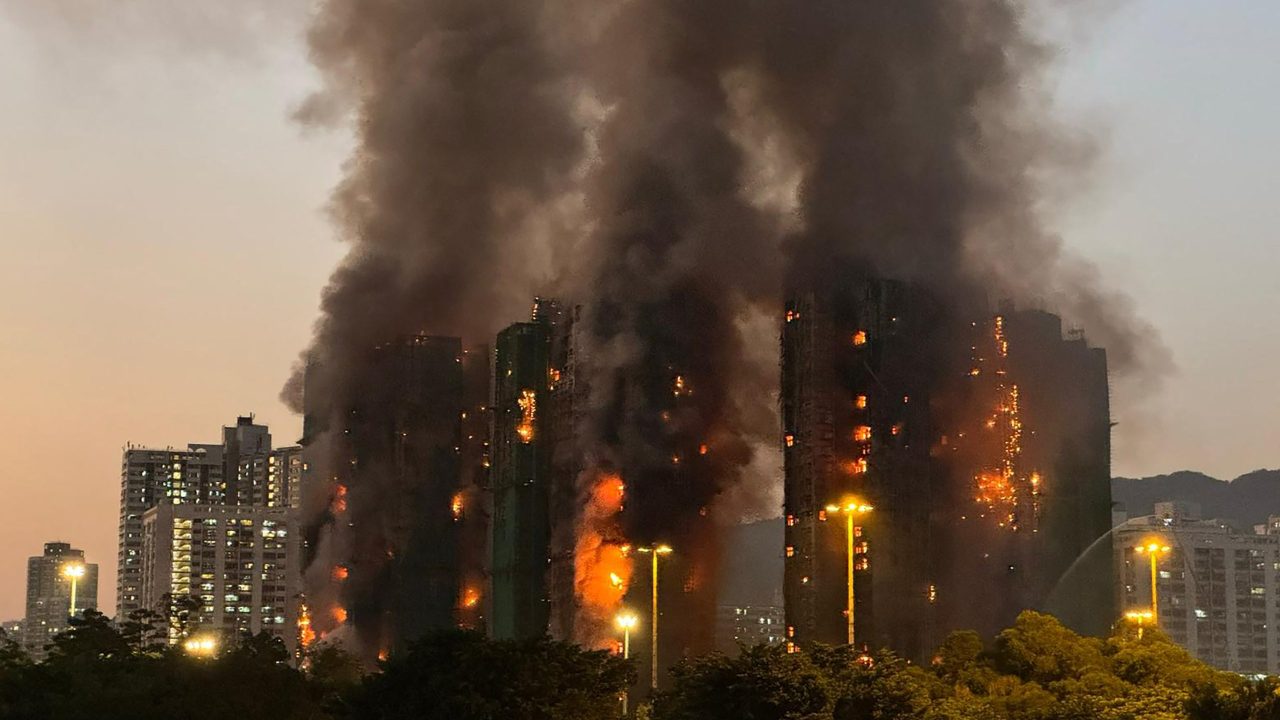
No one is quite sure yet what exactly the fire at Wang Fuk Court has revealed about Hong Kong’s political system. Chinese media has decried the “politicization” of the fire. They say Western outlets are leaning into moralizing rhetoric about democracy and freedom while skirting over Hong Kong’s agency in dealing with the crisis.
At least 160 people have died due to a series of events and decisions that didn’t happen in isolation from the broader political context in Hong Kong. Domino Theory previously reported on the erosion of democratic accountability in Tai Po’s district council, which exacerbated long-standing, corrupt dynamics between homeowners associations, private contractors and residents.
As the Wang Fuk Court fire puts a spotlight on Hong Kong, China is trying to manage the narrative. On December 6, China’s national security office summoned foreign media to warn them about spreading “false information” or smearing government efforts. The implication was that the national security laws could be leveraged to “strengthen the management of” foreign news agencies. Chinese authorities also need to contain public anger in Hong Kong. Speaking during a press conference, Hong Kong security chief Chris Tang (鄧炳強) said, “I hope our society to stand united in dealing with the aftermath of this tragedy, and to leave no room for those who seek to disrupt Hong Kong.” Ultimately, for both the international audience and the domestic one, China will need to assign blame.
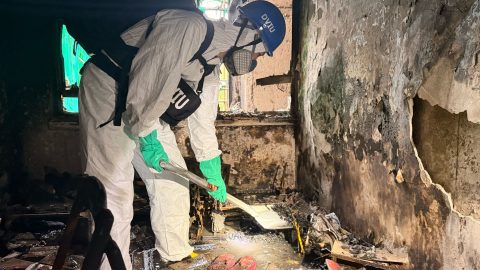
So far, Hong Kong has set up a judge-led independent committee to investigate the cause of the fires and broader regulatory and oversight failures. Crucially, this committee does not have statutory authority, meaning it won’t be able to summon people to give evidence. Some worry that this will reduce its effectiveness. Hong Kong’s anti-corruption agency, the Independent Commission Against Corruption, is also investigating the cause of the fire. Investigators found that samples of netting taken from various locations on the property did not meet legal standards of flame retardancy. It has become clear that the shoddy construction materials installed outside the buildings by Prestige, the contractor, accelerated the fire, encasing seven out of Wang Fuk Court’s eight buildings in flames.
Within a week of the fire, Hong Kong police had arrested 15 people on suspicion of manslaughter. These individuals are all connected to the private sector renovators — Prestige, the engineering consultancy Will Power Architects, the subcontracted scaffolding company and the subcontracted external façade works company. But it will be difficult to pursue manslaughter charges for several reasons, experts told local media, including that the threshold for manslaughter prosecution is very high, existing rules do not regulate the use of the foam panels (a highly flammable material that was installed in the windows at Wang Fuk Court), and Hong Kong has not yet codified corporate manslaughter.
What about Hong Kong’s chief executive, John Lee (李家超)? To whom, during a press conference last week, one brave reporter posed this question: “Over the past few years, you have spoken about leading Hong Kong from chaos to order and from order to prosperity. And yet this prosperous society allowed 151 people to burn to death. Can you tell us why you deserve to keep your job?”
Beijing has not been shy about dismissing or otherwise disciplining public officials who contribute to disasters or mishandle disaster response in the past. In an editorial for The Guardian, author and Hong Kong expert Antony Dapiran pointed out that “The lines of accountability for local officials in cases of similar disasters in the mainland can be brutal and short.” He highlighted an example from last year in which 55 officials, including the local mayor and party secretary, were punished after a fire killed 39 people in Jiangxi province. After the 2008 Sichuan earthquake, whose death toll was escalated by the collapse of shoddily constructed school buildings, almost 200 party and government officials were punished.
In the case of the Wang Fuk Court fire, there was certainly an oversight issue at play. For one, officials conducted safety inspections at Wang Fuk Court 16 times between July 2024 and November 2025. The agency now claims it issued six improvement notices and initiated three prosecutions, but when residents complained about the safety risk of the renovations months before the fire, the Labour Department told them the risk of fire was “relatively low.” Residents were aware of the flammability of the styrofoam panels as early as September 2024, according to posts in a community Facebook group. They employed various statutory and legal avenues to get their concerns heard, all of which failed them. These included submitting a petition to their homeowners association to overturn the selection of Prestige as the contractor for the renovations — because residents were worried about the company’s recent safety violations — as well as filing complaints with the Buildings Department, the Urban Renewal Authority, the Labour Department and the Fire Services Department.
The dynamic between homeowners associations who might have hidden incentives and residents who seek accountability via the statutory and legal mechanisms available to them is a longstanding one in Hong Kong. In the past, democratically elected district councilors acted as a sort of counterbalance to pro-establishment interests that have dominated homeowners associations in Hong Kong (for more on this story, see our article from December 8). But in 2023, when Tai Po’s district council became entirely dominated by pro-Beijing politicians, those checks and balances disappeared.
To be sure, China could blame Hong Kong’s laissez-faire regulatory system. Chinese state media is already publishing reports calling for stricter oversight, such as a regulatory review mechanism to ensure that all materials involved in construction are in compliance with fire-safety standards. China might also blame certain civil servants involved in government oversight, possibly from the Housing or Labour departments, as was suggested in one China Daily editorial. Or perhaps Beijing will single out one district councilor, Peggy Wong (黃碧嬌), who championed the renovation project and has been widely criticized for failing to respond to resident concerns.
If this fire happened in mainland China, officials, even high-ranking party members, would probably be punished. But Hong Kong is in a period of political transition as China tightens its control over the city. Firing several Tai Po district councilors would be tantamount to admitting that China’s strengthened presence in Hong Kong has made the city more corrupt and less safe.
Beijing has to be careful about where it places blame. It could be all too easy to turn that blame back onto itself.




Leave a Reply