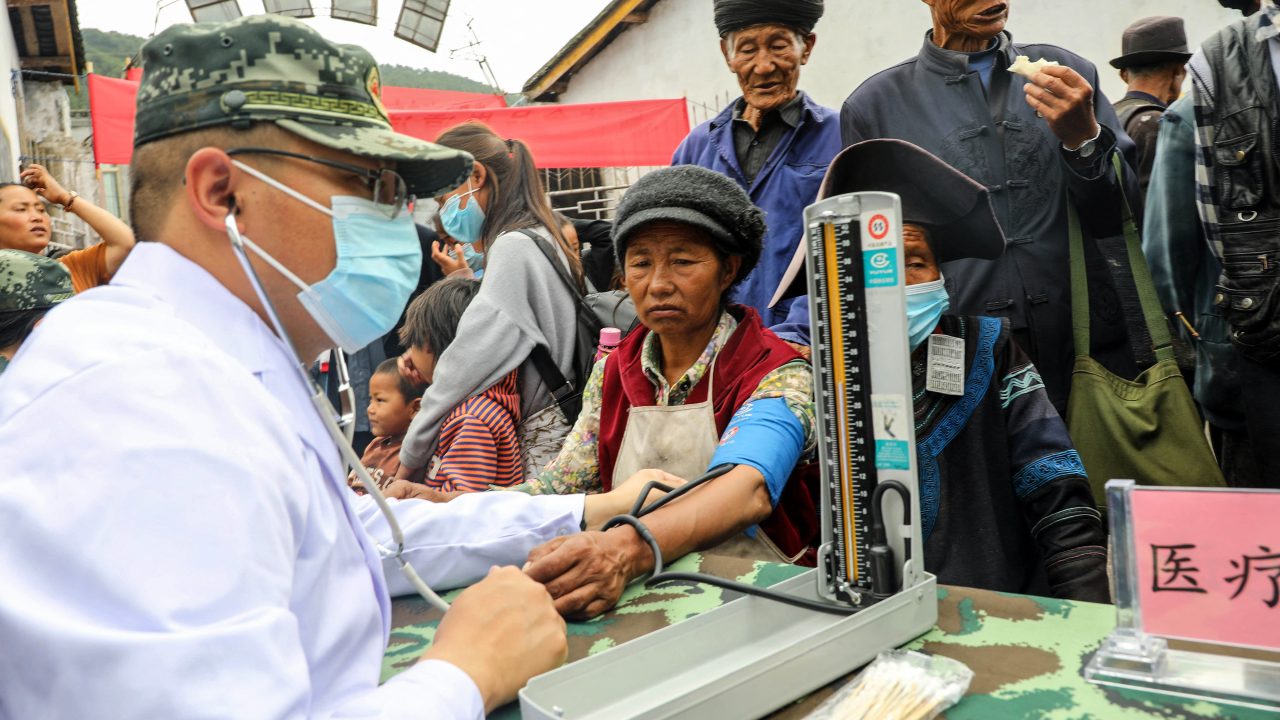
Where should fining people for not washing their bedsheets be placed in the Chinese Communist Party’s grand catalog of crimes?
“Plates not put away yet? That’ll be ten yuan, please. Sofa and table improperly arranged? And another ten. Don’t be shy now — let’s see the bedroom. My goodness! What kind of mess is this?!”
Such are the admonishments that some of the 220,000 residents of Puge County in China’s Liangshan Yi Autonomous Prefecture can reportedly anticipate from environmental department officials, who may soon be empowered to enter their homes and issue them with penalties for “offenses” like failing to make their beds or neatly put away their clothes. Those who get caught with cobwebs in their corners twice can expect fines to double. Literally. Who knows what will become of them if they defy their daily chores for a third time.
The policy, which is currently at the draft stage, can be interpreted as another local-scale salvo in China’s confused “poverty alleviation” charge, which is aimed not so much at empowering people through wealth as transforming them into whatever the Communist Party has conceived to be a model citizen at this particular moment in time. Similar — and far more extreme — drives have been taking place in minority districts for years and are deeply entwined with assimilation strategies.
Naturally, the party’s image of its citizenry does not have room for the kind of slovenly individual, this writer included, who might leave their socks on the floor every now and then. Naturally, also, finding out whether they do or do not have such grotesque habits requires punitive access to their personal space, where all kinds of other information can be gleaned about what they might be doing when the state is not normally looking.
On this occasion, the ruse is hygiene: a time-tested favorite. Authorities from Puge County, where 86 percent of inhabitants are members of the Yi minority, hold that invading people’s houses and depriving some of China’s lowest earners from part of their meager incomes is justified in the interests of health and cleanliness. For, in the eyes of officials, the poor of Puge are dirty and diseased. It results from their backwardness, and the state must step in to show them the correct path to affluence and wellbeing: uncluttered windowsills.
Aside from highlighting vast power differentials — nobody will be busting into Chairman Xi’s lounge to audit where his toenail clippings go — the policy emphasizes the creeping focus on the minutiae of people’s lives in today’s China, as well as an unhealthy regimentation of their daily routines.
Twelve months ago, the state had people lining up — or bending over — for their daily COVID tests. Now a local government wants to see them sweeping their floors to its satisfaction, crossing over, one presumes, with the Chinese Communist Party Central Committee’s latest five-year plan to reform the living environments of rural communities.
But another subtext may be motivating Puge County’s particular call to cleanliness: The campaign follows approximately one year after a video of an ethnic Yi wedding in another of Liangshan Yi Autonomous Prefecture’s counties went viral in China due to the obvious poverty of the celebrants. Many netizens found the footage, which can be viewed on China Dissent Monitor, very shocking, and some of the features it depicts, like people squatting while eating, are currently the target of the aforementioned fines.
Reportedly, Chen Jian (陳建), the person who posted the later-censored video, was subjected to a police interrogation and pressure from the Chinese Communist Party as a result of his decision to share the reality of Yi lives. It seems that the party was embarrassed, because the miraculous achievements of “Xiconomics” and its supposed “complete victory” over poverty have been widely publicized, especially in Yi minority areas, and the video contradicted these claims. A year earlier, a reporter for the Los Angeles Times described local consternation that photos taken in Liangshan might be used for “outside purposes driven by outsiders,” too. House-by-house makeovers might, therefore, ameliorate the risk of loss of face in the future.
The sudden purge of the impure could be motivated by more immediate concerns, however. Local governments in China have tear-inducing debts and disappointing returns on assets. Their long-term fiscal policy, which seems to have involved borrowing money, waxing it on eye-catching construction projects, borrowing more and then presuming that the central government would pick up the tab, has run into difficulties as the economy spluttered, the property market dropped off a cliff, land sales dried up and Beijing proved not quite so generous as originally supposed. Then there is the little matter of COVID-19, which became a very expensive experiment in disease containment. Among others, Liangshan Prefecture does have fiscal weaknesses, according to Fitch Ratings.
True, the amounts levied for housekeeping violations are miniscule by provincial debt standards and therefore not a credible approach to financial rebalancing, especially in areas that are already almost destitute. On the other hand, in a country where authorities are so desperate for cash that penalties have apparently been issued for serving shredded cucumber without a license, micro-fines for dusty surfaces and other creative new ways to eke out a little revenue are welcome, especially if they can scale up.
Should the methods employed simultaneously obscure the poverty that results from an economic downturn, then that is certainly all the better.





Leave a Reply