
China has ratified the United Nations Food and Agriculture Organization’s Agreement on Port State Measures, the only legally binding international treaty in the world to target illegal, unreported and unregulated fishing, or IUU. This is a significant moment in the battle for sustainable fishing and the human rights of fishers. But what exactly does — and doesn’t — it change?
The Port State Measures Agreement’s objective is to “prevent, deter and eliminate IUU fishing by preventing vessels engaged in IUU fishing from using ports and landing their catches.” Countries that sign up agree to screen fishing vessels for port entry or denial based on factors like their flag state, the catch on board, fishing authorizations or permits and recent fishing activity.
In a world where overfishing is having a devastating effect on ocean ecosystems, there is a case to be made that this is more important for China than anywhere else because of the sheer scale of its fishing footprint. It captured more fish than any other country in 2022 (13.0 million tons in the most recent year for which the U.N. offers a total) and it has been identified as having the top ten busiest ports in the world.
“With its massive fishing fleets and busy ports, China can play a key role in addressing IUU activity and, by extension, help strengthen port controls around the world,” the Pew Charitable Trust said in response to the signing of this treaty.
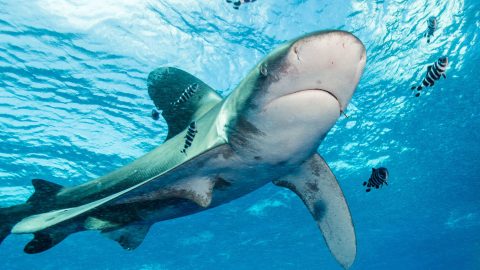
An equally key element of this is that China’s fishing fleet has also consistently been accused of human rights and environmental offences. An Environmental Justice Foundation report last April, for instance, found 80% of fishers it interviewed on Chinese vessels in the Southwest Indian Ocean reported shark finning, 100% reported abusive working and living conditions, 96% excessive overtime and 55% physical violence. Myriad other examples are easy to find around the world.
The Port State Measures Agreement looks to stop vessels engaged in those practices from using Chinese ports and landing their catches.
But reasonable doubts remain. China is not yet a full party to the agreement. Ratification means it commits to taking actions which prepare it to become a full party. And implementation is a different beast to signing papers.
“China is considered the top perpetrator of illegal, unreported, and unregulated (IUU) fishing in our world today,” Oceana Campaign Director and Senior Scientist Max Valentine told Domino Theory.
“Ratifying the Port State Measure Agreement (PSMA) would be a major step toward protecting our global fisheries, but only if China holds true to the measures within the PSMA. If not, this ratification will only be lines on a paper instead of action on our oceans.”
In this regard, there has already been some skepticism expressed around the mechanism that acted as a precursor to signing this agreement: ongoing revisions to China’s Fisheries Law.
A draft released in December promotes “scientifically determined annual fishing quotas,” stricter regulations on closed areas and gradual reductions in fishing intensity. It also promises the digitization of port records. But compared to a 2019 draft, some of the measures have been watered down from mandates — backed by fines — to encouragement.
Additionally, Zhang Yanxuedan (張燕雪丹), an associate professor at Shanghai Ocean University’s College of Marine Culture and Law who was involved in drafting the law, told Dialogue Earth that the hundreds of thousands of fishing boats in China makes implementation difficult, and time will be required to build up enforcement capacity for inspections at ports.
For outside observers of both the Fisheries Law and the Port State Measures Agreement, one key indicator of progress — or lack of — will now be the information made available to the media.
“Lets see how and if the details regarding Chinese ports’ actions under the [Port State Measures Agreement] are made available publicly or in a transparent way to the press,” Mark Godfrey, a journalist covering the agriculture and fisheries sectors, told Domino Theory.
“One of the big issues regarding China’s distant water fleet is information regarding punishments of companies and vessels found to be acting illegally in international waters or the EEZs [Exclusive Economic Zones] of other countries. It’s very hard to get up to date information on fishing companies that were caught or investigated by other states recently.”
In other words, it’s likely that the more we hear, the better.


Leave a Reply