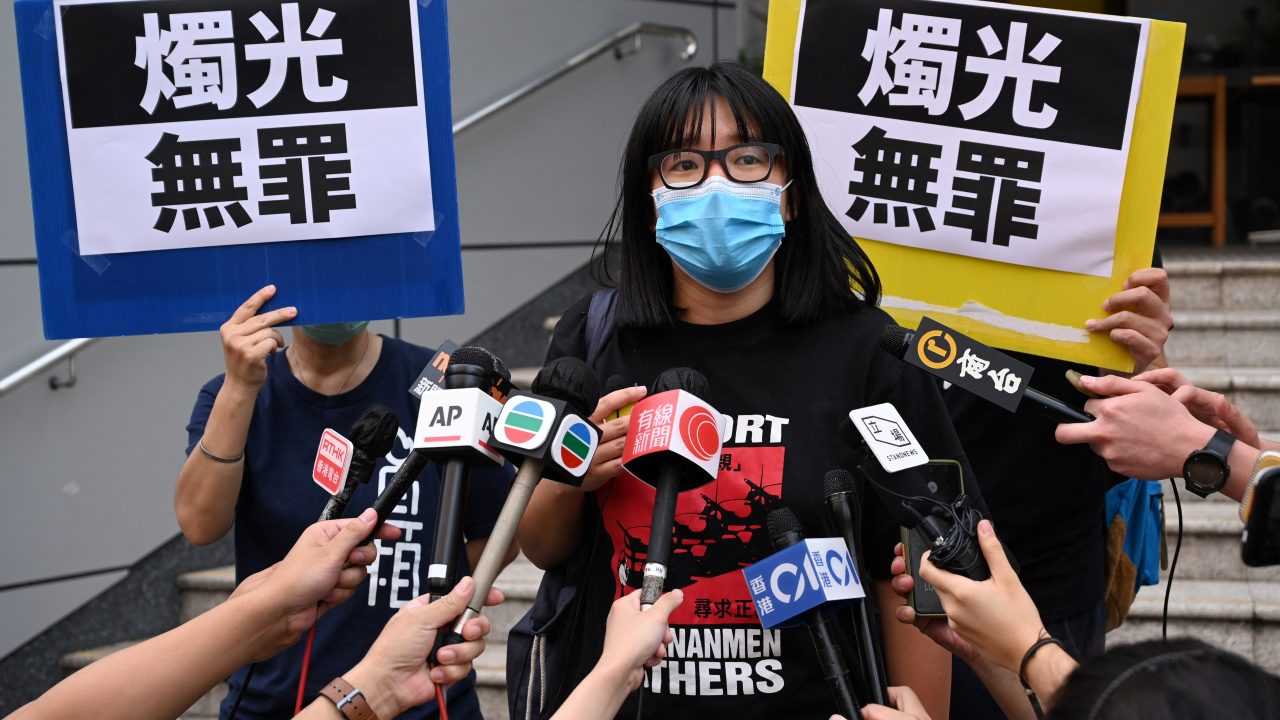
Since the crackdown on the democracy movement in Hong Kong in 2020, a disturbing phenomenon has emerged. Political prisoners, accused of crimes that are no crime at all but simply normal participation in what was supposed to be a free society, are not even able to access the twisted version of legal process that is still afforded them.
Instead, they wait in jail without bail for years for trials that do not come, and then for verdicts that are not announced. Jimmy Lai (黎智英), publisher of the pro-democracy Apple Daily newspaper, and Chow Hang-tung (鄒幸彤), the lawyer and activist, are but two of the individuals hanging in limbo in these circumstances.
The mental and emotional toll that being held indefinitely without trial can be extreme. It is a “systematic punishment exercise by the authorities to prolong the sufferings of the defendants under the national security law by manipulating the judicial process,” said Christopher Mung (蒙兆達), from Hong Kong Labour Rights Monitor. “They lost their freedom for a long time. They have to endure the long separation from their family members. They are suffering, actually, without any trial.”
But you don’t have to take his word for it, and you don’t have to use your own imagination. Mia Leung, a journalist and student, wrote a paper for the Rule of Law Journal analyzing the letters written by Hong Kong political prisoners. She quotes a letter by Ventus Lau (劉穎匡), who was held without trial for two years until he pleaded guilty to rioting in May 2023, and then without sentence until he was given 54 months in March 2024:
“it’s tortuous for not knowing your prison sentence … When you are remanded, you can only live by looking into the past. Only when you know the date of release, you live by looking forward.”
The simplest reason for the delays is that since the protests in 2019, more than 10,000 people have been arrested, and 3,000 charged, said Eric Lai (黎恩灝), a legal scholar at Georgetown law school. This has put a strain on the progression of cases, with waiting times doubling. But most of those charges were not brought under national security legislation, nor were they high-profile cases.
Hong Kong introduced new national security laws in 2020 and in 2024. The cases discussed in this article are at least in part being tried under the 2020 laws, which were imposed on Hong Kong by Beijing through a mechanism in Hong Kong’s Basic Law that came out of the handover negotiations between China and the U.K.
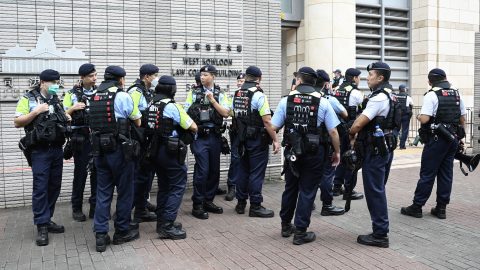
The number of people remanded in Hong Kong hit a 24-year peak in 2024, the South China Morning Post reported. According to the Correctional Services Department, 3,650 people were held on remand in 2024, an 18 percent increase on 2023. Research by Amnesty International showed that almost 90% of 255 individuals charged under national security legislation were denied bail, spending an average of 11 months in pre-trial detention.
Chow Hang-tung has been remanded in custody in Hong Kong for over 1,500 days. She has already been convicted of several other offences, but is still awaiting trial for the most serious charge, subversion. That trial was scheduled for November 11, but last month it was announced that it has been delayed until January next year.
“For ordinary common law criminal trials in Hong Kong, there is always a presumption of bail that if a defendant unless he’s seen as committing a serious crime or the court deemed the defendant has this possibility to abscond from trial,” Eric Lai said. But for national security trials, “this principle is totally subverted to presumption against bail.”
The late legal scholar Jerome Cohen pointed out in a paper written in 2022 that to get bail defendants would have to prove they will not continue to commit acts endangering national security, a negative that is “very difficult to prove.”
There are examples in other cases, Eric Lai said, of the prosecution repeatedly asking for adjournments to prepare more submissions and documents before the trial started. This has been allowed by the court despite the objections of the defendants.
If someone was held without bail and without trial in a common law jurisdiction, they would typically have grounds to have their case thrown out because of abuse of process, Eric Lai said. The fact that they have not been shows “the mass arrests as well as the massive use of pretrial detention against these people is more a political act rather than a legal act.” Eric Lai also pointed out that after long pretrial detentions, many political prisoners end up pleading guilty or even turning prosecution witness, and that this is “favorable” for the Hong Kong government.
It is understood that one possible reason for the most recent delay to Chow’s trial is because the judge who would have presided over it is still occupied with Lai’s verdict.
Lai is currently awaiting the verdict in his trial for colluding with foreign forces and publishing seditious materials. His trial took place earlier this summer, but at the end of the trial the judge said the verdict would be announced “in good time.” Lai has already been convicted of fraud and unauthorized assembly. In total he has now spent more than 1,800 days in prison, since he was charged in December 2020.
Samuel Bickett is a lawyer and human rights advocate who was arrested in Hong Kong during anti-government protests in 2019, and imprisoned in 2021. In a voice mail exchange, he told Domino Theory that judges shouldn’t need so many months to consider these cases, and said that part of the reason they do is that they are under a lot of scrutiny. However, he also suggested another cause:
“I would be surprised if there’s not approvals going on that did reach people that an independent judge should not be consulting with, people associated with Beijing … I can’t imagine that judges in the Jimmy Lai case, for example, are acting entirely of their own accord.”
Bickett also pointed out that both Lai and Chow have been fighting their cases hard. Many other political prisoners have pleaded guilty, Bicket said, but Lai and Chow have been fighting for their rights and bringing motions, which also creates more court time.
Bickett thinks that the delays are having the effect of forcing guilty verdicts, but doesn’t believe there is evidence this is a deliberate effort by the government. He said it’s just a combination of the deterioration of rights and the indifference to that from the government.
“I think they just don’t care.”





Leave a Reply