Ted Hui (許智峯) fled Hong Kong on the last day of November in 2020. The former Hong Kong lawmaker says if he had left one month later, he would have been the “48th.”
By this, Hui means that he would have been charged with subversion under the National Security Law and jailed along with 47 other Hong Kong democracy activists and politicians for participating in unsanctioned democratic primary elections. All except for two of these 47 remained in jail until April this year. Eight have been released in the past couple of months, but their whereabouts and activities are largely unreported.
“I’m just very lucky … to be out, and that’s why I feel that it’s my responsibility to speak for them, because we are one. If I don’t speak for them, there will be no one doing that. So I feel it’s more like a moral responsibility, and it’s … a lifelong mission,” said Hui.
Activism among Hong Kong’s diaspora has shifted drastically in the past decade as freedoms on the ground have diminished. During the 2014 Umbrella Movement, Jeffrey Ngo (敖卓軒) helped organize parallel protests in New York and Washington. “But we played a supportive role and the protests in Hong Kong were the main point,” said Ngo. After Covid-19 and the imposition of the 2020 national security law, “the possibility of organizing protests on the ground in Hong Kong, for the first time ever since the middle of the 19th century, was gone … So now the difficulty is that if you have nothing interesting going on in Hong Kong, you can’t really support anything in Hong Kong from the outside.”
The Chinese government has jailed nearly 2,000 political activists in Hong Kong in the years following 2019. About half remain in prison. The number of national security-related arrests in Hong Kong peaked in 2021 and has gradually decreased since — a testament to the impact of political repression on activism in Hong Kong. “One unfortunate but inevitable thing is that the diaspora movement will likely disconnect with the community still in Hong Kong, because that’s exactly what the CCP is trying to do — to cut off Hong Kong from the international community,” said Ray Wong (黃台仰), who fled to Germany in 2017.
As freedoms in Hong Kong diminished, the number of Hong Kongers in the diaspora ballooned. Nearly 90,000 residents left Hong Kong in the year after the 2020 national security law went into effect. And over 500,000 people are estimated to have left Hong Kong between 2021 and 2023. “The space for pro-democracy movements on the ground is relatively small, maybe even non-existent. But the diasporic movement has just begun,” said Wong.
Hong Kong activists are starting to build political power across the diaspora. “There are new ways to organize, and there are ways to use our experience of political organization and participation in previous years in Hong Kong, and [translate] that to drive … political change abroad.” said Ngo.
Since she moved to Germany for a master’s program in 2018, Glacier Kwong (鄺頌晴) says her activism in Europe has shifted from doing advocacy work as an outsider to working within the system. At the Inter-Parliamentary Alliance on China, a group that helps lawmakers across different countries coordinate on China-related policy, Kwong now advocates for Hong Kong as part of her broader portfolio on China. Even though Kwong’s efforts aren’t solely focused on Hong Kong anymore, this role allows her to help keep Hong Kong on the agenda, particularly as Taiwan becomes a hotter topic. “Frankly, compare Hong Kong with Taiwan. Taiwan is definitely of more importance right now given semiconductors dependency and the whole geopolitical environment.”
Ted Hui has also embraced a more integrated approach to advocacy. After two years building out a network and advocating for Hong Kong’s freedom in Australia, Hui realized “it’s not enough that they are aware. It’s not enough that we are now acquaintances or friends.” To achieve greater influence, Hui would have to “be one of them.” So he joined the Liberal Party, while fellow politician and exiled Hong Konger Kevin Yam (任建峰) joined the Labor Party. They coordinated on this, wanting to ensure that “there’ll be some wanted Hong Kong politicians in both major parties. So they’ll have to help us,” Hui said with a laugh. He thinks his integration into politics and the legal community in Australia has compelled leaders to speak out against Chinese transnational repression on his behalf.
Indeed, when the Hong Kong government issued arrest warrants against Hui and Yam and put 1 million Hong Kong dollar bounties on their heads in July 2023, Australian Prime Minister Anthony Albanese said, “I am of course disappointed. I’ve said we’ll cooperate with China where we can. But we will disagree where we must.” When anonymous letters detailing Hui’s bounty information were sent to his workplace and pamphlets saying that Hui is “a pro-Jewish man and siding with Israel to wage war” were sent to Adelaide mosques, Foreign Minister Penny Wong’s office called these actions “reprehensible.” The Law Society of South Australia, which Hui joined in 2023, published a letter earlier this month denouncing the intimidation tactics used against Hui. “No member of the legal profession, or anyone for that matter, deserves to be intimidated, harassed, surveilled, or impersonated by any other person,” wrote Marissa Mackie, the law society’s president.
Looking toward the future, the activists interviewed by Domino Theory highlighted some common goals for Hong Kong’s diasporic movement. One is the preservation of Hong Kong’s culture. Another is immigration reform to create paths to residency and citizenship for Hong Kongers abroad. “[W]e’ve been trying so hard for so many years to get an immigration bill for Hong Kongers passed in the U.S. Congress. It has been quite difficult,” said Ngo, adding that a third goal is “to free political prisoners in Hong Kong, we talk about that all the time.” A final goal is combating transnational repression. “We don’t want people to leave Hong Kong, or leave China, and move to a democratic country and then not have the ability to exercise the rights they are guaranteed,” said Ngo.
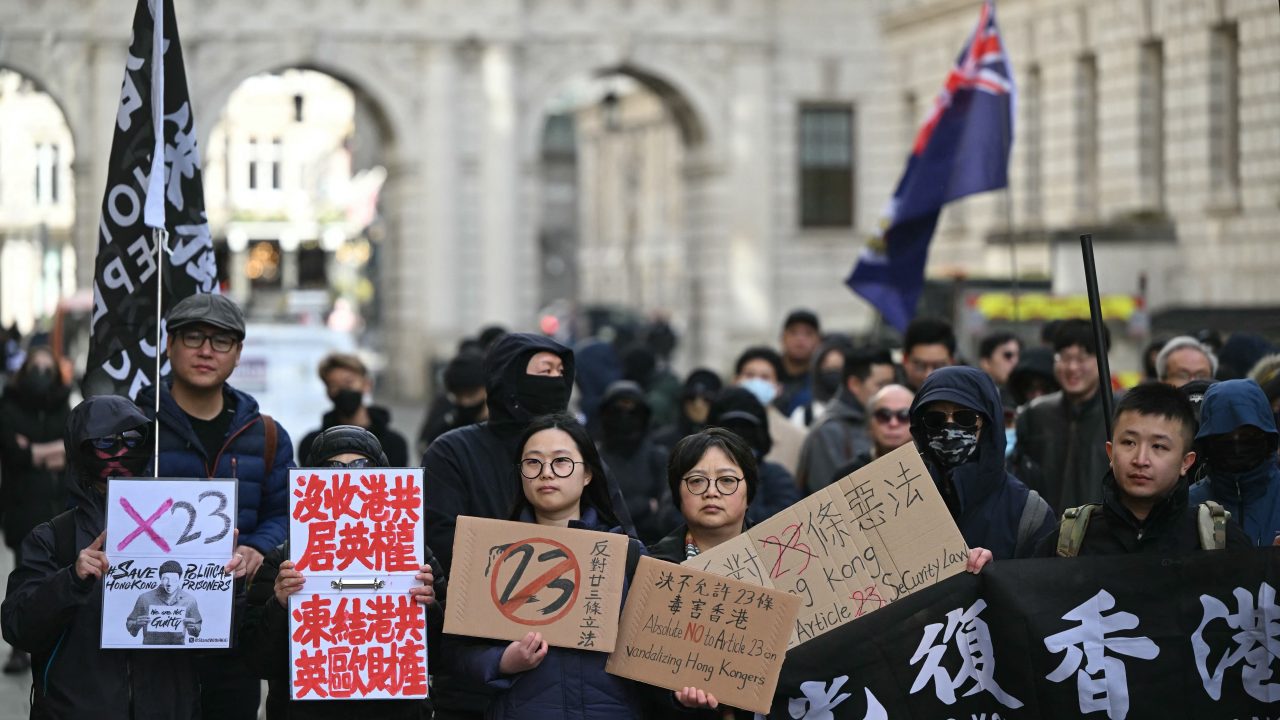
One way in which Hong Kongers are countering transnational repression is by protesting the proposed Chinese mega-embassy in London, which is home to one of the largest Hong Kong diaspora communities in the world. If approved by the Labour government, this new 5.5-acre complex will become the largest diplomatic outpost in Europe. “We know that the Chinese embassy and Chinese consulates around the world coordinate surveillance activities against human rights activists,” said Ngo. For the same reason, Ngo and other activists want to make sure that Hong Kong Economic and Trade Offices around the world “no longer get diplomatic privileges and immunities and exemptions, as they currently do in many countries.”
Putting the movement into perspective, Ngo said, “We are only five years into the national security law, which is obviously a very long time for those people who are languishing in jail, for those who are losing their rights in Hong Kong.” But the movement is also just five years into a new “order of things where those of us in the diaspora have to assume a greater responsibility to think about how to preserve our unique identity as Hong Kongers, and how to exercise our political rights and power abroad to make our voices heard.”
“I see a lot of opportunity,” said Ngo.



Leave a Reply