
There’s a new air defense kid on the block in Ukraine. The Swiss Army knife short-range Raven system, developed by the U.K., has fired over 400 missiles, and has shot down more than 70% of its targets. Taiwan fields a similar-looking, but aging, system, Antelope (捷羚), which it introduced in the 1990s.
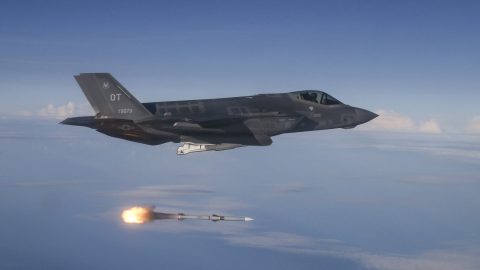
Raven has attracted interest and admiration because it is an effective system that was rapidly developed to use existing vehicles, launchers and missiles. The missiles are the U.K.-built short range Advanced Short Range Air-to-Air Missile, or ASRAAM, air-to-air missile, with launch rails taken off older retired fighter jets. Raven can target drones, cruise missiles and aircraft. The U.K. publicly revealed the air defense system more than two years after it was first deployed in action.
Taiwan’s indigenous Antelope system shares a lot of similarities with Raven, but is significantly older. Taiwan should take another look at the concept and consider whether to update it for the modern battlefield.
Taiwan has many different land-based surface-to-air missile air defense systems, commonly known as SAMs, in service. These can broadly be divided into three categories: short, medium and long-range. For the sake of simplicity, short range is defined as being under 10 kilometers; medium range 10 to 100 kilometers; and long range greater than 100 kilometers. (Exact values are usually classified and numbers in media should be treated with caution.)
For short-range air defense, Taiwan’s army has the U.S.-made Stinger missile, which can be fired from a man-portable device or mounted on a Humvee, where it is then called Avenger. The air force has the Swiss Skyguard system, which has both gun and Sparrow missile components on separate mounts. Finally there is the Antelope system, based on the Sky Sword 1 (天劍一) TC-1 missile, which is currently operated by the air force.
For medium range, Taiwan’s army has its domestically produced Land Sword 2 (陸射劍二) system, which fires a variant of the air-to-air Sky Sword 2 (天劍二) TC-2 missile. The air force is awaiting delivery of the Norwegian Advanced Surface-to-Air Missile Systems, or NASAMS, system, made by the U.S. and Norway. NASAMS can fire multiple missiles, including the air-to-air AIM-9X Sidewinder and AIM-120 AMRAAM missiles, as well as a specific ground-to-air extended-range variant of the AMRAAM called the AMRAAM-ER.
At long range, Taiwan’s air force has the domestically produced Sky Bow 2 (天弓二型) TK-2 system, and the Sky Bow 3 (天弓三型) TK-3. Sky Bow 4 (天弓四型) TK-4 will enter production next year. Taiwan’s air force also operates the American Patriot system.
Antelope is deployed by Taiwan’s air force to protect airports and key installations, according to Taiwanese news outlet CTS. Integrated with the T-82 twin-barrel 20 milimeter autocannon, Antelope forms a mobile, short-range, low-to-medium altitude defense unit using infrared-guided Sky Sword 1 missiles with fire-and-forget capability. Built on a modified three-axle truck chassis, it has a 9-kilometer engagement range and is effective to an altitude of 6,000 meters. Equipped with thermal imaging for night operations, it can engage targets independently or with radar support, complementing medium and high-altitude systems for a comprehensive air defense network. It features remote operation via wired control.
The reason Antelope even exists is an interesting one. It was built because Taiwan ordered too many Sky Sword 1 missiles and needed a use for them, according to Xu Tianran (徐天然), a senior analyst focusing on Northeast Asian security and missile systems for Open Nuclear Network, a nuclear risk reduction nonprofit in Austria.
Taiwan had initially intended to build around 250 of its Indigenous Defense Fighters, the F-CK-1, Xu told Domino Theory. However, this changed when the air force was able to unexpectedly acquire the F-16 from America and the Mirage 2000 from France. Taiwan reduced its order of the F-CK-1 down to 130 aircraft, but the contract for the Sky Sword 1 missiles had already been placed.
The surplus missiles were instead twinned with a small fire-control radar and an optical sight and placed on a truck, forming the new and somewhat improvised system.
In this sense Antelope is very similar to Raven, except Raven only possesses an optical sight and no radar. Both use short range air-to-air infrared guided missiles.
However, ASRAAM is a more advanced missile than Sky Sword 1, and Antelope is getting old. It’s worth considering whether Taiwan should replace Antelope with an updated version.
One of the basic lessons that has been relearned in Ukraine is that quantity matters. Ukraine fields whatever it can get its hands on, whatever allies will give or sell it.
Allies resupply Ukraine easily due to its land border with Poland. For Taiwan, its oceanic moat makes this much harder. Taiwan should think about what it will want after the initial stages of conflict and bring them in now.
One of the advantages of the NASAMS system is that it can fire the same missiles as Taiwan’s F-16 jets. In a war with China where Taiwan suffers heavy losses to its fighter fleet or cannot keep its runways and airbases operational, the ability to still use important assets like missiles could really tell.
Land Sword 2 uses canisterized missiles which are slightly different from the Sky Sword 2 air-to-air missiles. Xu told Domino Theory this means Land Sword 2 can share the same production line as the naval air defense version of Sky Sword 2, TC-2N, and Taiwan will build a lot of these.
Taiwan is also developing a short range naval air defense missile system called Sea Oryx (海劍羚), which is derived from Sky Sword 1 and Antelope. Sea Oryx may have yet another derivation, Land Oryx. However, Taiwanese media Liberty Times reported that Land Oryx would have 24 missiles in canisters, unlike the four that Antelope carries on rails.
The virtue of a smaller system like Raven is that it is self-contained on a single vehicle. It achieves this by having a much smaller radar or optical sight that doesn’t need to be carried separately.
Raven is a less capable system than NASAMS. But being contained on a single vehicle means it can be deployed to more locations simultaneously and is much easier to hide. Raven is not really intended to target fighter jets, but on the modern battlefield where drones are constantly overhead, or cruise missiles are flying, there is more than enough work for a simpler system.
Xu is skeptical, though. He pointed out that Raven’s 70% target hit rate would not pass evaluation if it were not an emergency system pressed into service using existing stocks. By comparison, NASAMS has reportedly achieved a hit rate of 94% in Ukraine.
Taiwan could build a small version of Land Oryx that is mobile and dispersible. Maybe it will do so. But there is also the human resource angle to consider. Does Taiwan have enough armed forces personnel to operate and support so many different air defense systems? Could its reserve forces pick up some of the workload with weapons specially intended to be simpler to operate and to shoot down lower priority targets?




Leave a Reply