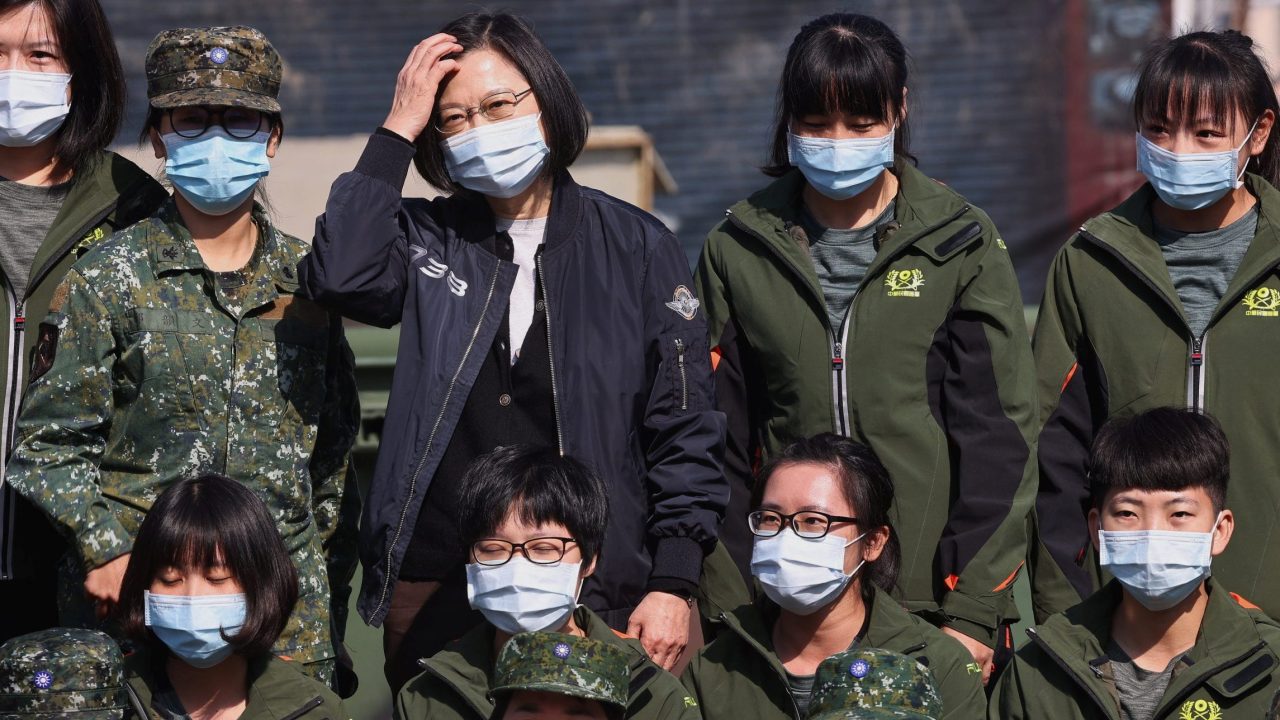
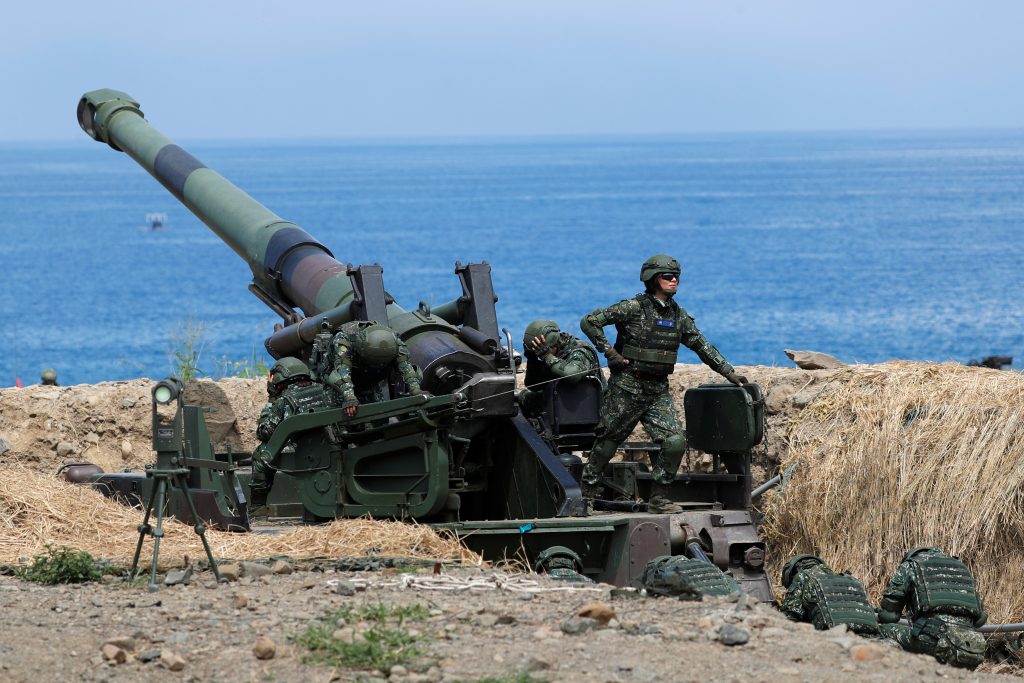
The Taiwanese military needs more manpower — or rather, womanpower. Taiwan’s population is declining as its geopolitical situation becomes increasingly precarious. Recruiting more women — who currently make up about 16% of the military — is the obvious solution. Taiwan is rated the highest country in Asia for gender equality, and by all appearances Taiwan’s Ministry of National Defense is working hard to address gender-related discrimination. The success of these efforts is evidenced by the steady increase in the proportion of women in the military since the 1990s, despite the fact that women (unlike men) do not have to complete mandatory military service.
The experiences of two retired female military officers interviewed for this article confirm an improvement over the past several decades in the military’s openness toward women and support of their participation. But the idea that women and men can be equal contributors to Taiwan’s security is more of an ideal than a reality — and the ideal itself is one that is not necessarily shared by Taiwan’s defense leadership.
“National security is everyone’s responsibility, regardless of gender,” said retired army colonel Zhang Lingling (張玲玲), who served for over 30 years, mostly in different units directly under the defense ministry, and retired as a reservist. Zhang joined the military in 1988 as a political warfare officer assigned to the Young Female Working Team (女青年工作大隊), nearly two decades before women were widely recruited as soldiers. Zhang’s options were limited, as combat roles were traditionally off limits to women.
In 1991, the military began opening up its ranks to women, particularly to fill various technical positions as officers and non-commissioned officers. Three years later, Taiwan’s military academies began enrolling female students. But women’s admittance to the military was incremental, closely controlled by the defense ministry and based on a quota system. As outlined in the 2002 National Defense Report, Taiwan “continues to recruit female individuals to attend various academies and schools, or specialized classes for officers or NCOs [non-commissioned officers]. In addition, female officers and NCOs are gradually to be assigned to vacancies in combat and technical service units.” According to Zhang, the recruitment of women to the military initially focused on logistical support (e.g., personnel, supply and maintenance) and then gradually opened up to include combat support (e.g., political warfare and information operations) and later combat roles. It wasn’t until 2006 that women were able to volunteer for most enlisted and non-commissioned ranks.
During her earlier days in the military, Zhang recalls facing gender discrimination with respect to career advancement. In 1999, she applied for a promotion to the rank of major, but was denied by her supervisor, who told her that she “should focus on family instead of competing with men for this position.” At that time, women were able to advance through the military more quickly than men — they required less experience to climb the ranks — but were only allowed to serve until the age of 45. However, things have changed, said Zhang. As more and more women joined the military, gender-related discrepancies became impossible to ignore, and policies were implemented to foster equality, such as standardizing promotion requirements across genders.
When Domino Theory asked defense officials at an October 29 defense ministry press conference about the military’s efforts to reduce gender discrimination, ministry spokesman Major General Sun Li-fang (孫立方) said, “the military has seen a significant increase in women’s leadership and capabilities in recent years … Of course, nothing is perfect, so we are always looking to improve things from good to better.”
So why aren’t there more women in the military right now? According to Zhang, the military doesn’t actually have a problem recruiting women: “We have a set quota for female recruitment, so they’re generally more willing.”
Another retired military officer that I spoke to, Cony Hsieh (謝昀希), shed some light on why this is. Hsieh served for six years in the army in a unit focused on telecommunications engineering, retiring as a sergeant in 2018. Hsieh is now a reservist and hosts a podcast called 微叛逆女孩 (Micro-Rebellious Girl), which focuses on gender and defense-related issues.
Hsieh thinks there is perhaps an overabundance of women who are interested in joining the military, guessing that if ten slots are designated for women by the defense ministry, 50 women will be interested in the position. When I asked Hsieh whether she thinks the Taiwanese military wants more women to join, she replied, “No. They are trying to control the number of females to join the military because they think females are not good enough for some missions.” I told Hsieh I was surprised by her answer, because not only is recruiting more soldiers a national security imperative for Taiwan, but the defense ministry seems committed to gender mainstreaming. “It’s pretend,” Hsieh said.
While there has been significant progress in scrapping policies that arbitrarily differentiate between male and female officers, there still exists significant gender divisions in the military. Hsieh highlighted two examples: sexual harassment and resource allocation.
Sexual harassment in the Taiwanese military most often occurs between a higher-ranking man and a lower-ranking woman, according to Hsieh’s personal experience and observation, as well as what she has found through her graduate research. Hsieh has also observed that it occurs more often than is reported, because women worry that they will face backlash from their managers. Hsieh recalled a story of her friend who tried to report an instance of sexual harassment to a higher-ranking staff and was told that something “bad” would happen to her if it turned out that her complaint was not true. Another time, Hsieh was warned not to report sexual harassment she personally faced, and told that nothing would come of her complaint. Hsieh said she wouldn’t have reported the harassment if she wasn’t already planning to retire, due to a concern about how it could lead to awkwardness and distance between her and her superior.
In the military, when sexual harassment is reported, it is investigated and deemed either valid or invalid. According to recent numbers released by the defense ministry, nearly 50% of sexual harassment cases this year were deemed invalid. While cases are being investigated, Hsieh observed that the military “typically” moves the person who reported the harassment to a different unit, which Hsieh says can be embarrassing for women, who worry that this will make them seem like “troublemakers” who let their officers down.
Beyond the occurrence and reporting of sexual harassment, Hsieh said the threat of being reported on can create an uncomfortable environment for female officers. Hsieh has heard stories from her friends that some higher-ranking male officers like to make jokes to lower-ranking female officers along the lines of “don’t get too near to me, otherwise I might get ‘#MeToo’ed’ … don’t make me get in trouble.” According to Hsieh, the #MeToo movement in Taiwan led to more focus and sensitivity for these issues, but there still tends to be a cultural belief in the military that sexual harassment is not a big deal.
One way in which the military tries to preempt instances of sexual harassment is by creating strict “gender borders,” as Hsieh says. This was confirmed by Major General Wu Chang-feng (吳長風) at the defense ministry press conference, who said that the military addresses sexual harassment by making “sure male and female soldiers keep a secure distance.” Women live in separate dorms with locks and bars on the windows “just like in jail,” Hsieh said, adding that oftentimes women’s bathrooms require a key to enter. Men’s dorms and bathrooms are not typically locked. Some women like this separation, but Hsieh thinks it ultimately hinders their opportunities for career growth. Women sometimes aren’t chosen for special missions with small units because the army doesn’t want to invest in creating separate rooms or barracks, Hsieh said. For example, when teams of two were sent into the mountains to build radio stations, Hsieh said she typically wasn’t chosen because it was logistically easier to pair two men up. To be promoted to a higher rank in the future, these kinds of experiences are necessary.
Although the issue of women in the military rarely comes up in Taiwanese news, a slew of articles were published last year about the first training of female reservist officers. Hsieh recently participated in a two-week training for reservists. Out of the 100 people in her unit, Hsieh was the only woman. When she arrived, the officers in charge of organizing uniforms and housing for the reservists seemed surprised she came. While the three men she arrived with got their uniforms and housing sorted quickly, Hsieh says she was waiting the entire afternoon. She thinks they hadn’t expected a woman to show up and hadn’t adequately prepared for her.
Ultimately, these gender divisions that Hsieh described not only cause women to feel uncomfortable and be excluded, but they may also disincentivize the recruitment of more women soldiers by creating an environment where the management of women is a political and logistical hassle for higher-ranking staff.
In Hsieh’s opinion, unless women are conscripted at some point in the future, there will never be a gender balance in the military.
Additional reporting by Kris Lih
Leave a Reply