In many ways, Mr. Wu (吳) is a walking advertisement for everything that Taiwan has achieved in the last several decades. He grew up in the waning days of Chiang Kai-shek’s (蔣介石) dictatorship, graduated from college just as martial law ended, then spent the next 30 years building a successful career while Taiwan built a vibrant democracy.
But when it comes to national identity, Wu, who asked to be referred to by his surname to protect his privacy, feels deeply alienated from the direction of his own society. A few weeks ago, he paused in front of a Chiang Kai-shek bust at the Chinese Nationalist Party’s (KMT) headquarters in Keelung, a port city 15 miles northeast of Taipei, and began to explain why. “First, my core values are rooted in Greater China. I am Chinese, absolutely no question about it,” Wu said. “Second, although I agree that Taiwan has an independent culture, that doesn’t mean it’s an independent country.”
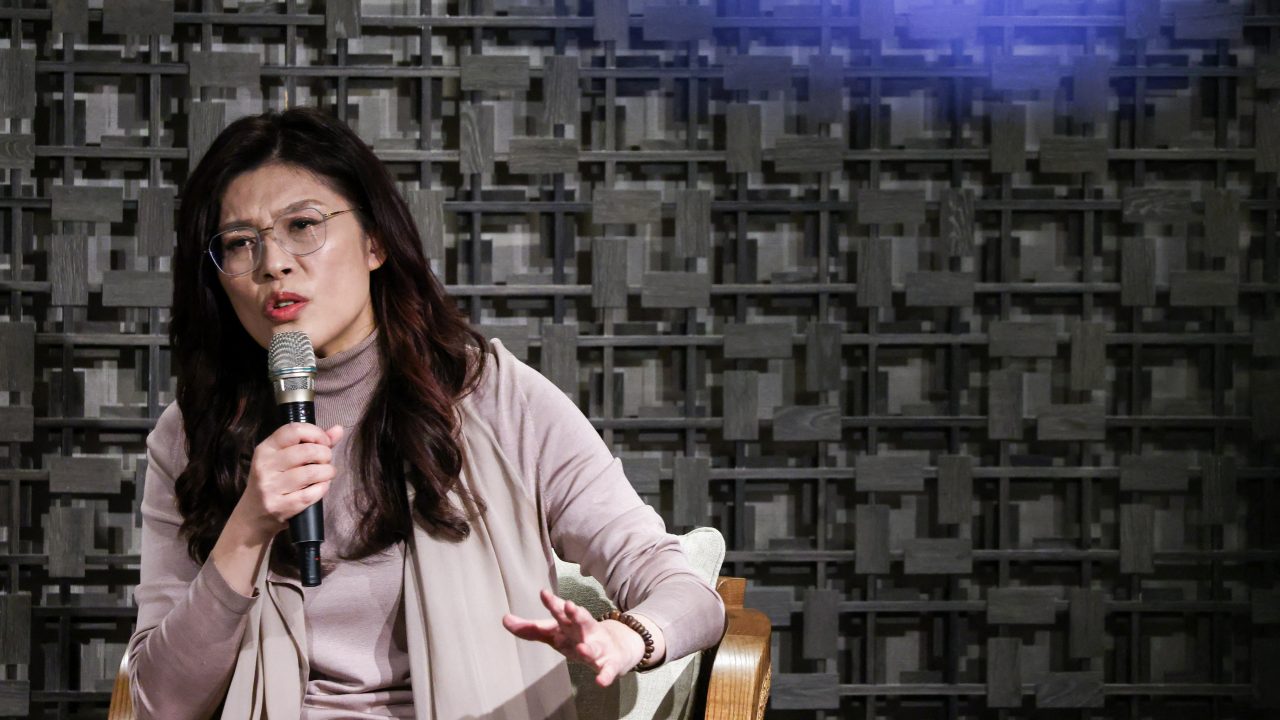
Wu is among the people in Taiwan who are cheering this week as KMT Chairwoman Cheng Li-wun (鄭麗文) travels to China for a series of meetings with the Chinese Communist Party, making her the first Taiwanese political leader to do so in more than a decade. On Wednesday, I asked Wu what he hoped Cheng would say in a meeting with Chinese President Xi Jinping (習近平). “The Chinese nation is a peace-loving and anti-war nation,” he said. “Both sides of the Taiwan Strait should work together to serve the people.”
Cheng has struck a similar tone, arguing that dialogue with Beijing represents the best approach to peace across the Taiwan Strait. Her opponents say that China has no intention of compromising, and that trying to negotiate with a government that has threatened to annex Taiwan by force is like bargaining with a dragon.
Wu’s beliefs about national identity do not put him in the majority. According to the latest polls, just 34% of people who live in Taiwan identify as Chinese, and among those, the vast majority also identify as Taiwanese. But his sentiments were shared by enough members during the KMT’s chairmanship election last October to elevate Cheng from a relative political outsider to one of the most disruptive forces in Taiwanese politics in recent memory.
“Nobody” expected her to win, said Chen Fang-yu (陳方隅), a professor of political science at Soochow University in Taiwan. “Almost everyone expected Hau Lung-bin (郝龍斌), who is a party heavyweight, an experienced politician. But suddenly, [Cheng] just came out of nowhere.”
Chen attributes a large portion of Cheng’s success to Beijing, which he said worked aggressively to promote her on social media during the chairmanship race. But he also acknowledged that Cheng herself has brought something new to a party that has lost three straight presidential elections. “She is energetic. She is young, relatively young,” he said. “She was previously a talking head on a TV show, so she can talk.”
Most of all, Chen said, people like Cheng because she’s a fighter. “A blue fighter,” he said, using a Chinese phrase, zhandoulan (戰鬥藍), for a member of the KMT coalition who aggressively confronts their opponent. “They think that [Cheng] can fight the DPP and fight against Taiwan independence,” he added.
The spirit of the blue fighter was in the air the night I first met Wu last July. Tens of thousands of KMT supporters had gathered on a boulevard in central Taipei to protest the attempted recall of 31 of the KMT’s legislative representatives. “Oppose the green communists, save Taiwan,” the posters around us read. “This recall campaign, it’s fake,” Wu told me. “A true recall should be directed at a single representative who isn’t doing their job. But this is the DPP trying to take out a series of blue representatives all at once.”
All 31 of the recalls failed. A day later, Wu messaged me triumphantly: “The true majority of the people has expressed their opposition to the current government’s anti-China policy and their desire to avoid confrontation and war with the mainland,” he said.
The failure of the recall meant that the KMT held on to its majority coalition in the legislature, which it shares with the Taiwan People’s Party (TPP). In the months since, the party has been emboldened, using its majority to block nearly all of the DPP’s major initiatives. In November, President Lai Ching-te (賴清德) published an editorial in The Washington Post, announcing a new special budget proposal that would fund $40 billion in arms purchases over the next eight years. In the three months that followed, the KMT’s legislative leadership refused to even consider it.
Howard Shen (沈正浩), the KMT’s foreign press secretary during the 2024 presidential campaign, said that many in the party view the defense budget as the latest in a string of overreaches by the DPP. “The KMT perceives this fight over the defense supplemental as a lot bigger than it is, in and of itself,” he said. “Since the beginning of this [legislative term], in February 2024, the KMT feels that this new government has done nothing but antagonize them in every way possible.”
According to Shen, Lai should have adjusted his approach after the recall movement setback, but refused to. “Even after all these landmark political confrontations,” he said. “Lai Ching-te felt that the best way forward to pass the defense supplemental was to pass on information to The Washington Post … without even briefing the [Legislative Yuan].”
In March, Cheng finally put forward her own alternative. The roughly $12 billion she proposed is just enough to cover the weapons which the U.S. Congress has already approved. But the KMT has refused to commit to any future spending, despite growing pressure from U.S. lawmakers, several of whom have since visited Taiwan to push for the DPP version.
When Taiwan’s legislature first began discussing alternatives for the defense budget, it seemed for a time that a more moderate group of KMT lawmakers might emerge in support of a spending level that would split the difference between Cheng’s $12 billion and Lai’s $40 billion. But those hopes soon evaporated. Cheng, it appeared, was still in charge.
Last month, when I visited the KMT headquarters in Keelung, just two days had passed since Cheng released her minimalist proposal. Wu led me upstairs, past the Chiang Kai-shek statue and into a long, empty room with a portrait of the party’s founder, Sun Yat-sen (孫逸仙), who led the revolution that overthrew the Qing Dynasty in 1911, on the wall. Huang Po-yuan (黃博源), a KMT city councilor in Keelung, sat down across from us. Huang is 40 and speaks with a mild local accent.
He said that despite Cheng’s loose-cannon persona, behind the scenes she has moved shrewdly to shore up support from different groups within the party. “She roped in the new generation, people like me,” Huang said. “In the DPP, we would be considered old people, but in the KMT, we are young.”
After a few minutes, Wu cut in with a question that it seemed like he had been waiting to ask: “By the way, who did you vote for?”
“Cheng Li-wun,” Huang said.
Wu started clapping. “Thank you, thank you. You saved us!” Wu said. “Regardless of your reasons, this vote was right.”




Leave a Reply