
Last week, an annual survey that ranks press freedom in Hong Kong saw journalists give their lowest scores since it began. Asked by the Hong Kong Journalists Association to rank press freedom out of 100, the average score given by 250 journalists was 25, down 0.7 from last year and down 17 points from when the survey launched in 2013.
Below those headlines, though, was another trend. The average survey score given by the public was 42.2, an increase of 0.8 from the previous year — and notably higher overall than the journalists’ score.
In the context of two Hong Kong journalists being found guilty of sedition this Thursday and the introduction this year of Article 23 legislation that created new national security offenses to add to 2020’s National Security Law, the gap poses a question. Does the public’s relative lack of sensitivity to censorship demonstrate its real world success?
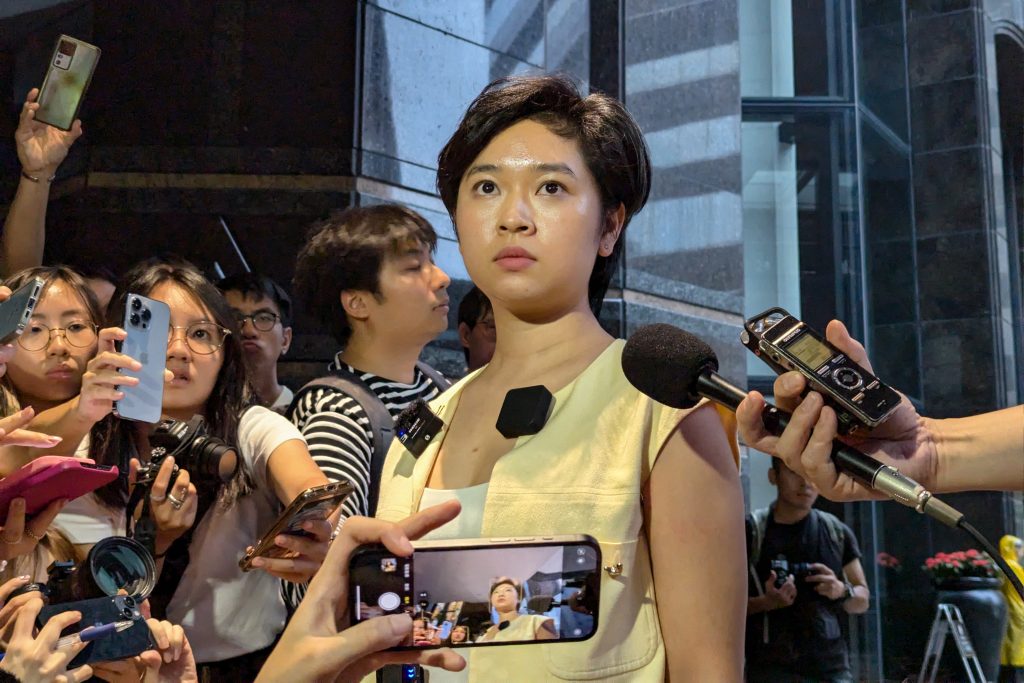
For its part, the Hong Kong Journalists Association believes the discrepancy between journalists’ views and the publics’ “can be attributed to journalists being more cognizant of the specific details of how new legislations could affect their work than the public does,” Selina Cheng (鄭嘉如), chair of the organization, told Domino Theory in an emailed statement.
“Self- and internal censorship are quite common in Hong Kong newsrooms which ultimately limits the kind of news that become available to the public, but only journalists get to see the kind of censorship and anxiety they faced before a story is published, or shelved,” Cheng said.
The end result, according to Cheng, who was fired by the Wall Street Journal after being elected to lead the Hong Kong Journalists Association: “It would take a very discerning eye to question or notice what was left out, unreported, or censored. Most news consumers might not give too much thought on what’s been missing.”
While this may seem pessimistic in comparison to Hollywood movies, where censorship tends to be shown as bound to fail in the end, it fits the version of events described by media watchers who have experience with the extent of restrictions and atmosphere within Hong Kong.
“[S]ince enactment of National Security Law RSF [Reporters Without Borders] has witnessed an increasing downfall of press freedom, reflected in the RSF Press Freedom Index, where Hong Kong has plummeted to the historically low score, and is currently in 135 place out of 180 countries,” RSF spokesperson Aleksandra Bielakowska told Domino Theory by email.
“Since 2020, dozens of media outlets have closed, including two mainstream outlets that ceased to exist due to forced closing by the authorities. Numerous journalists have been arrested and prosecuted, and to this day RSF counts at least 10 journalists and press freedom defenders currently in detention, awaiting verdicts.”
Behind this is the day to day reality for journalists. “Numerous journalists have been followed, they reported increasing pressures on the local staff, lack of clear definition of the [red lines], that led some of them to self-censorship, and closely review each article before publishing,” Bielakowska said. She added that a lack of clarity over red lines left journalists unsure what could trigger prosecution and that the number of activists and pro-democracy legislators who had been jailed or exiled limited access to sources.
“We have also reported numerous journalists being not granted visas, or barred from entering Hong Kong, as well as direct pressure from authorities on foreign media outlets for them to not write on specific topics,” she said.
The idea that such restrictions might ultimately have a significant impact on what the public knows or doesn’t know is familiar to free speech experts, who have found similar trends in other places.
Philipp Lutscher, a postdoctoral fellow at the University of Oslo, published research on Egypt’s censorship regime last year which endorsed the view that “while adaption to repression can keep some form of opposition alive, it becomes less likely to spread.” This was based on the evidence that blocking websites within Egypt significantly impacted their traffic, despite efforts to work around the blocks.
Speaking to Domino Theory by email, Lutscher said of Hong Kong that while not as drastic as Egypt, some of the patterns were comparable. He noted that in Hong Kong censorship was operating on two levels, “incrementally tightening media control” and “the most drastic action,” closing Apple Daily in 2021 and the accompanying arrests. Both create the conditions for self-censorship, he said, and this could feed through to public awareness levels.

The Hong Kong Journalists Association survey results “could indicate that censorship is self-perpetuating as journalists are afraid to critically report on these new restrictions,” Lutscher said. “[A]nother explanation could be of course that the public just becomes more depoliticized in general and don’t read political news as frequently anymore (a strategy pursued by some authoritarian regimes).” He added that “It would be interesting to see trends in news websites visits, for example, to provide some evidence whether this is true.”
Another appraisal of the “chilling” effect of censorship was offered by Geeta Seshu, founding editor of the Free Speech Collective.
Senshu said in the case of more selective censorship “the public doesn’t even get to know or learn of the clampdown later, often in an informal manner rather than through official announcements or notices.” And in the case of censorship used against an entire population, such as the suspension of civil liberties or internet shutdowns, “people are cut off from one another and, as we witnessed in Kashmir in India after the abrogation of Art[icle] 370, the public response is also distinctly muted, anxious and even fearful,” she said.
Senshu ended by noting that censorship also works hand in hand with governments and supportive media “aggressively push[ing] a narrative that is at variance with the lived experience of people,” which she said “works very effectively with censorship to curb public discussion.” But she also stressed that the fact that the public cannot voice its views should not be confused with the notion that the public does not think.
“Of course, people do think and will act, as we are seeing right now in Bangladesh. So censorship will not work, in the long term,” she said.
This analysis will now be tested over months and years in Hong Kong. Journalists Chung Pui-kuen (鍾沛權) and Patrick Lam (林紹桐) were found guilty on Thursday of conspiracy to publish seditious materials, the first conviction of that kind since Hong Kong returned to Chinese rule in 1997 — and many warn that the grip of authorities could tighten further.
RSF’s Bielakowska said that with Article 23 in place, the range of tools that could be used against journalists had increased. “‘Sedition’ is one of the crimes that raises biggest concerns, as journalists could face 10 years in prison, just for reporting on the topics that are not in line with the authorities’ narrative.”
“Although Article 23 has not been used yet against any journalist, we could see signs of tightening the grip of the authorities,” Bielakowska said, citing as an example RSF staff being detained and deported from Hong Kong after the legislation was passed.
In a press briefing which addressed the Hong Kong Journalists Association survey results, the Chinese Ministry of Foreign Affairs said the security laws “target a very small number of individuals who severely endanger national security, not law-abiding media reporters.”


Leave a Reply