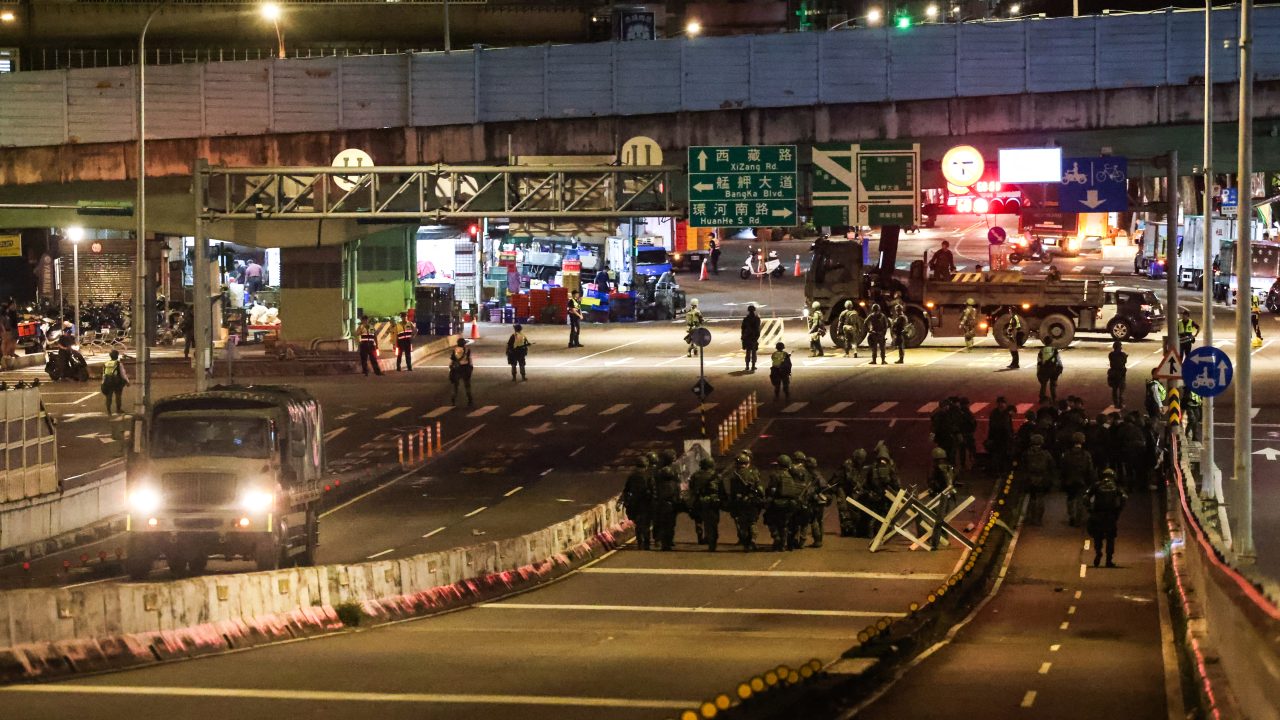
China invaded Taiwan on Saturday night — on screen. Specifically, on “Zero Day Attack,” the buzzy new television show that explores the prospect of a near-future Chinese attack on Taiwan.
While China aims to achieve “national rejuvenation” by 2049, an ambiguous goal that is linked to unification with Taiwan, many think an invasion could happen much sooner. Washington has been fixated on the year 2027 ever since U.S. Indo-Pacific Command chief Admiral Philip Davidson spoke at a congressional hearing in 2021. “The threat is manifest during this decade,” Davidson said. “In fact, in the next six years.”
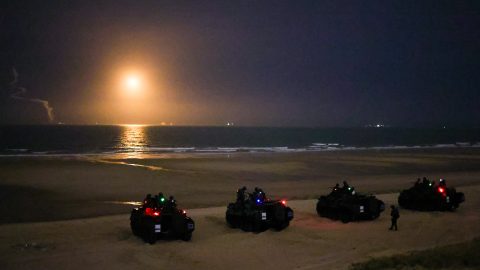
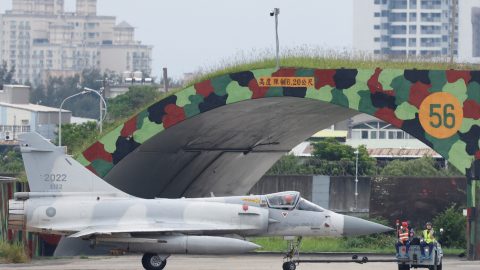
“Zero Day Attack,” which is ostensibly set during Taiwan’s next presidential election, reflects Taiwan’s focus on the 2027 deadline as well. Last month’s Han Kuang military exercise — Taiwan’s annual test of military readiness for a People’s Liberation Army attack — simulated possible scenarios for a 2027 attack on Taiwan.
However, China has dismissed 2027 as a legitimate political deadline for unification. So how did this narrative become so widespread? Is there truth to it? And whose interests does it serve?
Back in 2021, Admiral Davidson’s articulation of the 2027 timeframe caused so much new concern about a Chinese invasion of Taiwan that it became known as the “Davidson Window.” At a later congressional hearing in 2021, General Mark Milley, then-chairman of the Joint Chiefs of Staff, clarified that China was planning to be capable of invading Taiwan by 2027. China’s intent is not certain, but “Intent is something that can change quickly,” Milley said.
In 2023, then-CIA director William Burns reiterated that 2027 is a military readiness deadline. At the Shangri-La Dialogue that same year, former Secretary of Defense Lloyd Austin said that conflict over the Taiwan Strait was “neither imminent nor inevitable.”
But for some defense officials, the increased mention of the Davidson Window seemed to make the threat appear very much imminent. In 2023, a memo from General Mike Minihan, head of Air Mobility Command, was leaked. Minihan wrote, “My gut tells me we will fight [China] in 2025.”
The Trump administration has reiterated the 2027 preparedness deadline at the cabinet level. At the Shangri-La Dialogue in June, U.S. Secretary of Defense Pete Hegeseth broke from Austin’s approach by mentioning the deadline in his speech: “It has to be clear to all that Beijing is credibly preparing to potentially use military force to alter the balance of power in the Indo-Pacific. We know. It’s public that Xi has ordered his military to be capable of invading Taiwan by 2027.”
Indeed, 2027 is a key point in China’s military preparedness timeline. In 2017, Xi announced a military modernization plan that called for “accelerating the integrated development of mechanization (weapons and vehicles), informatization (information warfare) and intelligentization (applying the speed and processing power of artificial intelligence to military planning) by 2027.” That year is also the 100-year anniversary of the founding of the People’s Liberation Army.
However, Chinese President Xi Jinping (習近平) reportedly denied the idea that China will invade Taiwan by 2027 at the Xi-Biden Summit in San Francisco in 2023. This makes sense. Committing to an imminent political schedule would reduce strategic flexibility by creating a cost for not invading in 2027: the loss of credibility.
Still, China has used the 2027 narrative to bolster its mainstay messaging. First is that Taiwan is weak. In response to the Han Kuang 2027 attack simulations, state-run tabloid the Global Times wrote, “no matter how the DPP authority poses to boost their own courage, such acts are merely the same old stuff in a new guise and a fragile facade ready to crumble at the first blow.” This kind of messaging is part of Beijing’s gray zone strategy to compel Taipei into negotiations for reunification. Gray zone tactics include military operations in the Taiwan Strait, the spread of disinformation and diplomatic isolation. Some think the mechanism of this coercion is psychological. By making Taiwan feel as if war is “inevitable and irresistible,” China hopes Taiwan will not ultimately resist.
The second component of this messaging is that the U.S. is an unreliable ally. “Some individuals in the U.S. have clear ulterior motives, continuously fabricating so-called ‘timelines’ and hyping the mainland’s ‘military threat,’ creating an atmosphere of war across the Taiwan Straits,” wrote the Global Times in 2024. The article went on to argue that Taiwan’s Democratic Progressive Party (DPP) has become a “pawn” in the U.S.’s quest to stifle China’s rise. The core narrative is that Taiwan would become collateral damage in a war that the U.S. provokes.
Whether a 2027 invasion should be treated as a legitimate possibility and thus a marker of the U.S.’s and Taiwan’s military preparedness is controversial. One reason for this is a lack of expert consensus. When the Center for Strategic and International Studies polled 64 China and Taiwan experts in 2022, they found that only two experts agreed that 2027 was China’s unification deadline. Five experts thought China will invade in the next 15 years, and 28 thought China’s deadline is 2049. Notably, three quarters of the respondents said they believed China would invade immediately if Taiwan declared independence.
Commercial interests might dishonestly impact whether the 2027 narrative is embraced. A group of American state attorneys-general signed a joint letter this year calling on BlackRock to more accurately assess the risk of investing in China. The letter said that many BlackRock fund disclosures failed to reflect the “material risk” of China’s intention to invade Taiwan, citing the 2027 military preparation deadline. BlackRock undeniably has a financial interest in downplaying the China threat. As the biggest asset manager in the world with a large China footprint, BlackRock manages billions of dollars worth of China-focused funds.
By the same token, strategic risk and security firms have declared the opposite: The risk of invasion is very likely even sooner than 2027. One firm said that by 2027, China will be able to annex Taiwan as a “war of choice … while minimizing associated costs and risks.” While providing practically zero supporting evidence, another firm said China is most likely to invade Taiwan between 2024 and 2028. Since these firms make their money advising companies on how to navigate geopolitical risks or by providing security services, they have an obvious commercial incentive to play up the risk.
Even if the 2027 timeline is merely used as a yardstick for American preparedness to defend Taiwan in the Indo-Pacific, this is still controversial. For one, if the U.S. prepares for a war in the short term, this could jeopardize its preparedness for a war in the long term. Since Admiral Davidson’s testimony in 2021, Congress has appropriated more funds to the Pacific Deterrence Initiative — a budget framework for activities carried out to enhance military posture in the Indo-Pacific — than the Defense Department has asked for every single year. In fiscal year 2024, Congress granted the Pacific Deterrence Initiative 60% more funds than the Defense Department requested. Defense News warned that these efforts could jeopardize long-term preparedness if the 2027 deadline comes and goes and the U.S. begins to feel complacent.
Secondly, preparing for a 2027 war could become a self-fulfilling prophecy. As Jessica Chen Weiss writes in Foreign Affairs, “Even if [Xi] prefers to avoid a near-term conflict and believes that China’s military prospects will improve over time, he might still order a military operation if he and other Chinese leaders perceive a sharp increase in the risk that Taiwan could be lost,” Chen Weiss wrote. “China has often used military force to counter perceived challenges to its sovereignty claims in territorial and maritime disputes.”
Perhaps former Indo-Pacific Command leader John Aquilino put it best when he said that “everybody is guessing” at China’s timeline. After all, China is not giving any strait answers.






Leave a Reply