As the new Labour government has taken power in the U.K., two policy directions appear to sit in tension with one another.
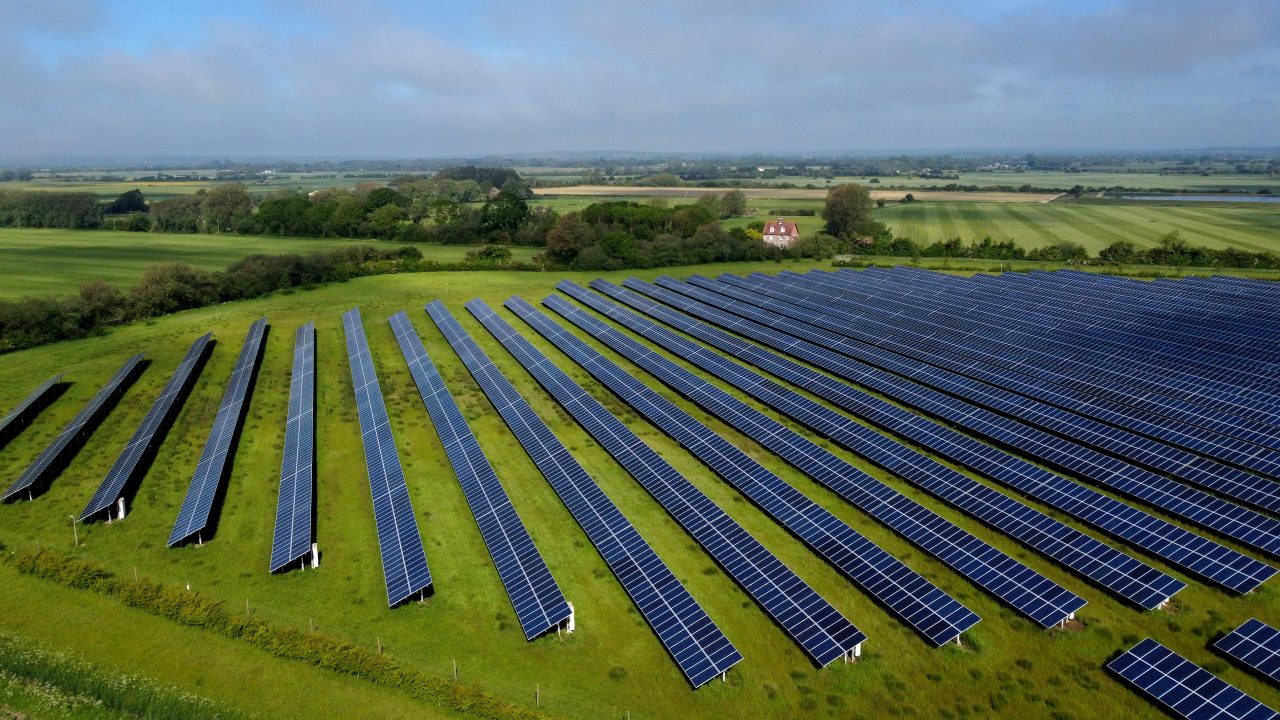
On the one hand, it has begun a strategic review of relations with China that will criticize the previous government’s “champion[ing Chinese] investment in sensitive industries, despite the risks.” On the other hand, one of its own first acts in government has been to approve three “nationally significant” solar development projects, where there is a strong chance many of the materials will be sourced from China.
The simplest explanation for this is that the consultation process for the three solar farms — Burton Gate, Sunnica and Mallard Pass — was completed before July’s general election. An emailed statement from the U.K. Planning Inspectorate confirmed this.
But the final approval for the farms was made by the new Secretary of State for Energy Security and Net Zero, Ed Miliband, and thus another more fundamental explanation seems to be in play. Even if you don’t like China investing in “sensitive industries,” it is simply very difficult to build solar farms without it.
The facts are that China produces 85% of the world’s solar cells, 97% of wafers and 79% to 83% of polysilicon used in building solar panels. For a decade, the U.S. has tried to reduce reliance on China for solar, but in 2023 almost 80% of its solar imports were coming from Southeast Asia when the U.S. Department of Commerce determined the majority of the value-add in panels produced by some firms there was actually Chinese.
These stark terms, though, have not precluded debate over China’s role in the new projects in the U.K. Indeed, quite the opposite is the case.
In its written evidence opposing one of the three new solar developments, the Mallard Pass Action Group, set up to oppose the solar project at Mallard Pass, included a significant section on China. It said China had used unfair market practices to gain solar dominance and compared reliance on China to “dependence on Russia for oil and gas.” It added there was potential for this to be used as “leverage.” It also said reliance on China for solar panels could present a “security risk,” before asking if China’s involvement in the U.K. could mean it gaining access to otherwise confidential information.

In addition to these points, there have also been a number of prominent critiques regarding the labor practices and environmental impact involved in sourcing panels from China.
Alicia Kearns, the Conservative Member of Parliament for Rutland and Melton, said in Parliament that the Mallard Pass solar farm was being “developed by a de facto Chinese company with supply chains reaching into Xinjiang, the site of the Chinese Communist party’s genocide.” Others suggested emissions generated by China in producing the panels limit their environmental value, because of China’s heavy use of coal power plants.
On the other side of the fence, a spokesperson from Solar Energy U.K. — which advocates for solar developments in the U.K. — offered a number of responses to these points by email.
Regarding labor practices and environmental impacts, Solar Energy U.K. said it worked with “counterparts in Brussels, SolarPower Europe, to develop the Solar Stewardship Initiative, intended to deliver a more responsible, transparent, and sustainable value chain. Procuring members have also signed our supply chain statement.” The Solar Stewardship Initiative has just released a first draft of a “traceability standard,” a certification system designed to “strengthen confidence in how the materials and products in the solar supply chain are manufactured and used.”
On security, Solar U.K. said the situation with Russian gas and oil is “entirely different.” It said official statistics showed the U.K. was not actually dependent on Russia for oil and gas — and that even before the war in Ukraine, it was a relatively small supplier. Then it noted the fundamental difference between solar and the two fossil fuels.
“[I]f the U.K. was dependent on Russian energy, that would mean we would have to keep paying for it indefinitely. That is evidently not the case for solar panels, which have a one-off cost as power generation equipment. Once installed, the energy source is the sun which prevents dependence on imports,” it said, adding that the Mallard Pass Action Groups’ “claim disregards climate change, the low cost of renewables, and the high and varying cost of fossil fuels.”
When we contacted the Mallard Pass Action Group, they referred us to the national action group it is part of, the U.K. Solar Alliance, which did not respond to requests for comment.
These issues are, evidently, open to discussion. However, the central fact of a lack of viable alternatives is not questioned by either side. Is it realistic to expect solar sites like Gate Burton, Sunnica or Mallard Pass to source solar panels entirely from elsewhere?
Solar U.K. is categorical. “No, this is not a realistic expectation,” it said — adding that “It is, however, realistic to assume that all the procurement for these projects will be done with careful due diligence taking into account social and environmental practices across the supply chain, in line with the [the Solar Stewardship Initiative] and wider industry good practice.”
But the Mallard Pass Action Groups’ written submission is equally clear. “It is difficult to see how [reliance on China] can be resolved in the short term. Countries other than China are now developing manufacturing capability but this will take some time to develop and until then China will remain in a dominant position,” it said.
This leaves a counter challenge to those opposed to solar panels from China. If not there, then where?
Tentative answers have been offered in some quarters. Developing a partnership of countries that can together supplement China’s solar contribution was proposed in a Bruegal report last year. But the International Energy Agency’s analysis of global energy policy already suggests the world is on track for 2.4 degrees of warming by 2100 (compared to pre-industrial levels), and these calculations are built on existing policy. Even optimistic projections say a new Western attempt to de-risk from China would slow renewable progress.
And there is a second-order problem here, too. While the debate is being had, it has the potential to generate uncertainty. Solar U.K. told Domino Theory it did not foresee an impact from the new government’s China review, pointing to the enthusiasm on display from the three approvals discussed here and the forthcoming Solar Roadmap, the government task force that will set out the practical measures required to reach 50 gigawatts of solar capacity by 2030. However, one director involved in facilitating community owned solar in Wales told us that the question over human rights had been brought up by local authorities recently.
In such circumstances, it’s quite obvious why the new U.K. government seems to have simply accepted a degree of incoherence in its policy package.






Leave a Reply