
The Italian Navy aircraft carrier Cavour and its escort ship Alpino visited Japan at the end of August as part of the carrier strike group’s five month-long deployment to the Indo-Pacific region.
Prior to arriving at the naval base in Yokosuka near Tokyo, the Cavour carrier strike group had visited Guam and Darwin, having left Taranto Naval Base in Italy at the beginning of June.
The Italian Navy patrol vessel Raimondo Montecuccoli was reported to be visiting Okinawa, Japan on a separate deployment to the Indo-Pacific at the same time.

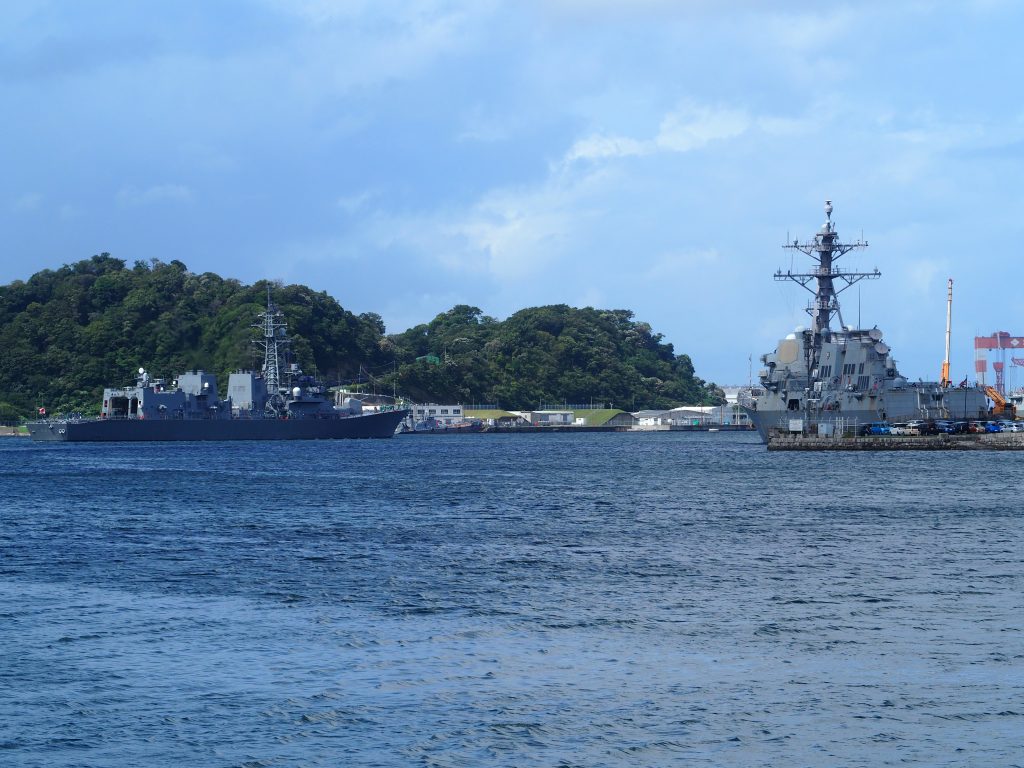
In some ways, the most interesting thing to note was that not only was the Cavour and escort in town, but there were also French and German naval vessels at Yokosuka base. Two German ships in fact.
At the opening ceremony for the Villagio Italia and the Italian Navy training ship Amerigo Vespucci on August 26 in Tokyo, Italian Defense Minister Guido Crosetto revealed that after Cavour left Yokosuka the next day, it and the Alpino would conduct joint training with the Japanese navy.
It was thus extremely interesting to observe that as well as three JMSDF frigates and destroyers going out to sea at the same time as the Cavour and Alpino, the French and German frigates and German support vessel also left the port. Shortly after, both German and French armed forces accounts on X shared photos of the countries’ ships training together. The Germans went further and included the U.S. and Australia in their posts.
So Why Is an Italian Carrier Visiting Japan?
First, we should point out that naval diplomacy has a long tradition and that fundamentally it’s not unusual for countries to do this kind of thing. But still, why now for Italy?
Matteo Dian, an associate professor at the University of Bologna who specializes in security in East Asia and Japanese foreign policy, says that Italy now has “a right-wing government that tries to emphasize the role of defense contribution to the visibility, the image, the prestige of the country.”
However, he pointed out that “in Italy, foreign and defense policies are not massively partisan if we exclude the fact that the left tends to be more attached to pacifism. So this is somehow similar to Japan. In this sense, there is an idea of relaunching the central aspect of Italian foreign defense policies, which is the relationship with the U.S.”
The theme of Italy and other European countries engaging more in the Indo-Pacific because the U.S. would like them to is important. Dian told me that “if the United States calls for burden-sharing and the NATO dimension involves … the Pacific, so we do the same. And within this framework, we try to carve out something that is for our interests as well.”
Fabrizio Coticchia, an expert in Italian defense policy and a professor at the University of Genoa, agreed with Matteo Dian about the relationship with the U.S. and expanded on a second point: “We focus on the Indo-Pacific in order to exploit opportunities for our industry in that sense, so enhancing cooperation, [like] GCAP with Japan. We use our forces in a way to develop industrial and military capabilities.” So Italy is pursuing industrial and technological objectives in its security engagement with Japan. (GCAP, or Global Combat Air Programme, is a collaboration between Japan, Italy and the U.K. to produce a sixth-generation fighter jet.)
Gabriele Abondanza, international relations academic at the University of Madrid, the University of Sydney, and the Italian Institute of International Affairs, told me via email that: “Given Rome’s focus on cooperation, prosperity, and international law, the closer ties with Tokyo — and with many other like-minded actors in the region — is a welcome and necessary development.” Last week Domino Theory reported on the Italian ambassador to Tokyo’s remarks during the visit of the Italian training ship Amerigo Vespucci where he spoke directly about supporting maritime security.
Demonstrably, Italy is not alone in deploying naval ships to the Pacific. Emma Salisbury, who is the Sea Power Research Fellow at the Council on Geostrategy, gave me more context for why European states more generally are looking east: “I think a lot of people assume that European navies in particular are very focused on the Euro-Atlantic, and obviously that is a very important theater because that’s where we are geographically, but it’s very important to make sure that we are, as European navies, not abandoning our allies and partners in the Indo-Pacific.”
Why Is Japan Also Reaching Out to Europe?
Yoshihiro Inaba is a PhD candidate at Senshu University in Tokyo, researching Japanese defense legislation. He says that Japan wants to find new security partners, because of the shift in global power: “[The world has moved to] a multipolar situation. So, the Japan-U.S. relationship is very important for Japanese security, and this is the baseline for Japanese security. But also, we should find another solution or another partner with not only the regional country, but also the outside … that is the European nations.”
Ryo Hinata-Yamaguchi, an assistant professor at the University of Tokyo who writes on defense and security, told me via email that Japan specifically values the NATO connection: “Much is about connecting with NATO and member states to promote mutual understanding, coordination, and cooperation on global security issues, but also about cooperation in security technologies.”
Yoshihiro Inaba says that the physical presence of a port call is also valuable:
“We can share each other’s knowledge. That is a very important thing from the military perspective. But also I think it will be something of a signal for the Chinese or North Korean side that if some kind of contingency will be happening, there is some possibility that the European countries will go to the Indo-Pacific side of conflict. There is a possibility, just a possibility.
It’s not a concrete one. But I think that it’s sufficient that if 99% they will not, but only 1% [that they will], then China has to consider about that.”
What Are the Training Benefits for Italy?
Emma Salisbury says that “the carrier strike group is going to do various operations with various other armed forces on the way around its tour. So being able to operate with the Australians, the Americans, Japanese, I think the Greeks at some point, there’s so many different partners, and because a lot of the problem with interoperability is that every navy, air force and so on, has its own thing that it does when it’s operating.”
She also pointed out that: “if we’re going to be called upon to operate together in a crisis moment, it’s better to have learned those things beforehand than to be trying to do things off the cuff in a dangerous situation.”
Are we likely to see return visits by the JMSDF to Europe? Yoshihiro Inaba noted that there is a Japanese navy training vessel in Germany right now! But he does also think it’s likely that actual warships will follow eventually, for reasons of symmetry and supporting European security.
On the face of it, these European deployments are perfectly successful. They achieve their physical goals and fly the flag. However, I find it concerning that one of the main impetuses appears to be “encouragement” from the U.S. European countries have put forward clear Indo-Pacific strategies in recent years (except, ironically, Italy). Yes, there is the industrial component, and the commitment to open sea lanes (side-eyes to the Taiwan Strait). However, it seems that what all sides really want is actual increases in security in both Europe and Asia, and those won’t come without more significant commitments. After two years of war in Ukraine, it’s obvious that more than anything else what is required is a steady supply in resources and equipment, but especially munitions. Developed democracies in both regions are already effectively all on NATO standardization. Beyond joint training and interoperability, wouldn’t it be something if concrete steps were taken to ensure sustained logistical support and supply if “partners not allies” find themselves in conflict?
The Italian Navy has left Japan for now. But, on X, the day after Cavour left, photography account @Alsace_class posted photos of Royal Australian Navy destroyer HMAS Sydney recently arrived to Yokosuka, presumably fresh from exercises with European partners. Clearly Japan’s appeal as a recipient of naval diplomacy, and as a regional hub for long-distance deployments, shows no sign of slowing down.




Leave a Reply